Ananya is 32, and she just did something a lot of Indian investors never quite manage: she picked a retirement date. 2051. What she hasn’t picked is how her money should get there — how much equity, how much debt, when to start playing it safer, which of the thousands of mutual funds on offer to actually use.
That thicket of decisions is exactly why so many people default to a fixed deposit instead of investing properly.
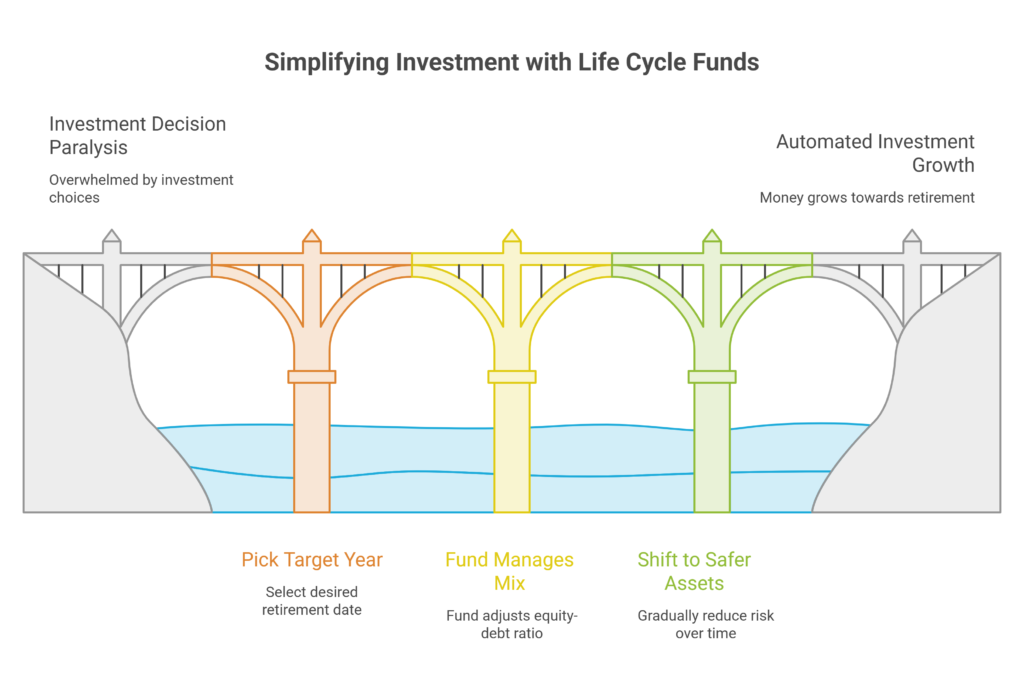
Life cycle funds in India are a brand-new mutual fund category built to solve exactly this problem. Pick your target year, and the fund handles the rest — deciding today’s equity-debt mix, and quietly shifting it as that date gets closer.
The idea isn’t new globally. Target-date funds have run this playbook in the US for two decades, and by the end of 2025 they held roughly $4.8 trillion there.
Since the Pension Protection Act of 2006, they’ve been the default option in most workplace retirement plans, so savings flow into them automatically unless an employee actively opts out.
India’s own retirement system, the National Pension System, has offered something similar through its Auto Choice option for years — but joining the NPS is voluntary rather than a workplace default, and adoption among private-sector employees has stayed thin.
The mutual fund industry’s version, introduced in February 2026, is the first real attempt to bring this idea to a wider set of goals — not just retirement.
What a Life Cycle Fund Actually Does
A life cycle fund is an open-ended scheme built around a single year — the one you expect to need the money. That target year has to appear in the fund’s name, so the first Indian schemes carry names ending in 2031, 2036, 2041, 2046, or 2051.
You pick whichever is closest to your own goal, and the fund manager takes it from there — deciding the allocation, rebalancing it, and gradually shifting from equity to debt as that year approaches, without you lifting a finger or triggering a tax event at every switch.
The logic is straightforward. The farther you are from your goal, the more risk you can afford, because you have time to sit through market downturns.
The closer you get, the more capital preservation starts to matter more than growth. Staying fully in equity right up to the year you need the money is exactly the kind of exposure that can undo years of good returns in one bad quarter — a glide path builds the de-risking in automatically.
The Glide Path, In Numbers
SEBI’s framework sets bands rather than fixed numbers, giving fund managers room to move within a range depending on how many years remain to the target date:
| Years to Maturity | Gross Equity (%) | Debt (%) | Gold/Silver/InvITs (%) |
|---|---|---|---|
| 15-30 | 65-95 | 5-25 | 0-10 |
| 10-15 | 65-80 | 5-25 | 0-10 |
| 5-10 | 50-65 | 5-25 | 0-10 |
| 3-5 | 35-50 | 25-50 | 0-10 |
| 1-3 | 20-35 | 25-65 | 0-10 |
| < 1 | 5-20 | 25-65 | 0-10 |
Source: SEBI circular dated February 26, 2026.
Take Ananya, 32, with roughly 25 years left to 2051 — she’d sit in the 15–30-year band, meaning her fund could hold anywhere from 65% to 95% in equity today.
Compare that to her father-in-law, 58 and five years from retiring in 2031: his fund would sit in the 3–5-year band, capped at 35–50% equity, with a much larger debt cushion. Same category of fund, two very different portfolios — because the entire point is that the mix moves with the calendar, not with anyone’s opinion on the market.
One catch worth knowing: because these are ranges, not fixed numbers, two funds sharing the same target year can still hold meaningfully different mixes. The manager’s choices inside that band matter as much as the year printed on the label.
The SEBI Rules Worth Knowing
This category of life cycle funds in India — introduced in February 2026 — replaced an older solution-oriented bucket (retirement and children’s funds) that SEBI scrapped because those schemes often ended up looking like ordinary equity or hybrid funds in disguise. The rules that replaced them are fairly specific:
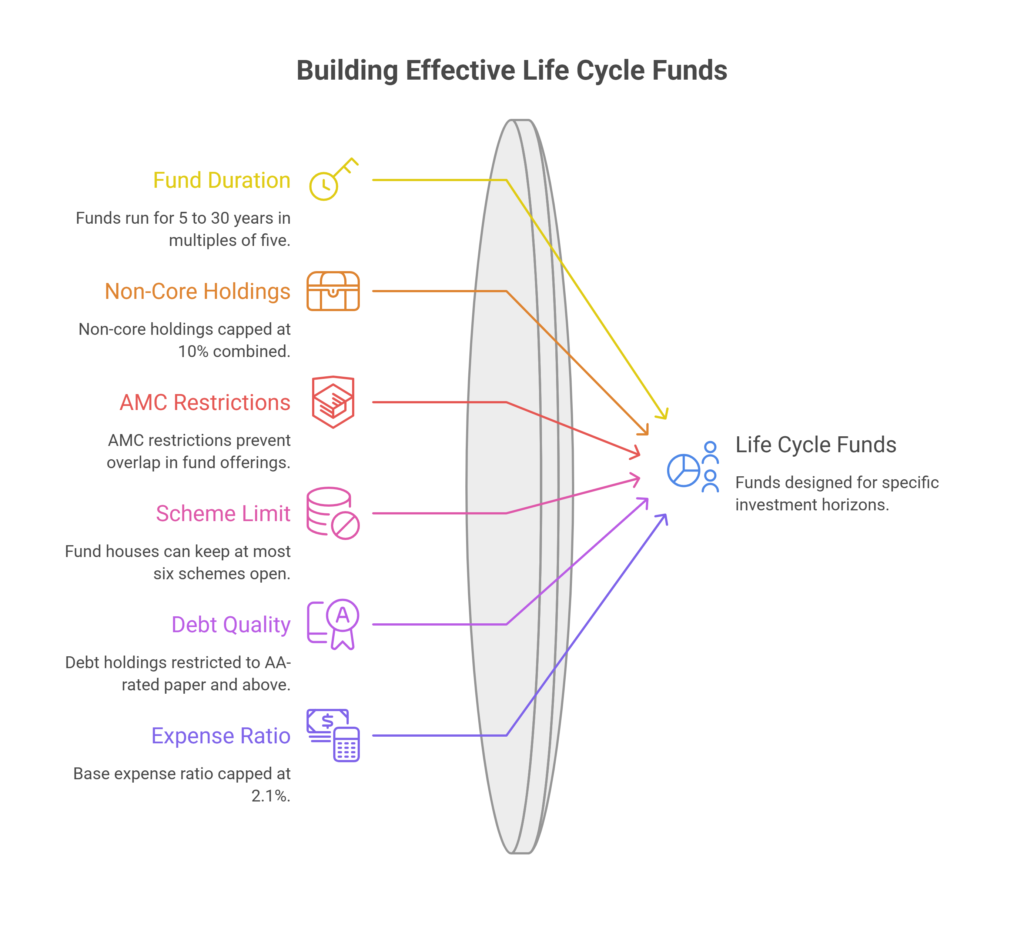
- Funds run for 5 to 30 years, in multiples of five, and the target year must appear in the name; return-flattering words are barred.
- Non-core holdings — gold, silver ETFs, InvITs, ETCDs — are capped at 10% combined, so equity and debt still drive the bulk of returns.
- An AMC already running a retirement fund can’t launch a 30-year life cycle fund — and a house running a children’s fund can’t launch a 20-year one — aimed at preventing overlap.
- A fund house can keep at most six such schemes open at a time.
- Debt holdings are restricted to AA-rated paper and above as maturity approaches.
- The base expense ratio is capped at 2.1%, in line with hybrid fund limits.
- Exit loads are graded: 3% within the first year, 2% within the first two, 1% within the first three — there’s no lock-in, but quick churn is discouraged.
Life Cycle Fund vs NPS Auto Choice
India already had a version of this glide-path idea, just wearing different clothes — the NPS’s Auto Choice option. The two aren’t really substitutes; they’re built for different jobs.
| Details | Life Cycle Fund | NPS (Auto Choice) |
|---|---|---|
| Glide path | Tied to a target year | Tied to the subscriber’s age |
| Structure | Open-end, no lock-in | Locked in for 15 years or till age 60, whichever is earlier (Tier I) |
| Goals | Any dated goal — retirement, education, a big purchase | Primarily retirement |
| Liquidity | Redeemable anytime, exit load applies for 3 years | Limited; Tier I withdrawal rules apply |
| Expense ratio | Base capped at 2.1% (actual costs not yet disclosed) | Capped at 0.12% |
| Tax break | None beyond standard mutual fund taxation | Up to 60% of corpus tax-free at retirement |
The NPS rewards patience with a real tax break in exchange for locking your money away.
A life cycle fund trades that tax edge for flexibility — usable for any dated goal, redeemable whenever you want, exit load permitting. If you’re weighing whether that trade-off makes sense for your own plan, it’s worth talking it through rather than guessing — you can book a free planning call if that would help.
What’s Still Unclear
Because the category is only weeks old, a few real questions don’t have answers yet.
- Cost: No scheme has disclosed its actual expense ratio yet — 2.1% is just the ceiling. Actual costs will likely sit well above the NPS’s 0.12%, and over a 20–30 year horizon that gap compounds meaningfully.
- Taxation: As a fund’s mix turns debt-heavy near maturity, gains could shift toward slab-rate taxation. Zerodha says it will use equity arbitrage to preserve equity-style taxation throughout, but this isn’t settled industry-wide.
- Manager discretion: Zerodha’s schemes track the Nifty LargeMidcap 250 largely passively; ICICI Prudential’s three (still at draft stage, led by CIO S Naren and fixed-income head Manish Banthia) are actively managed. Two genuinely different approaches, in a category with no Indian track record yet.
None of this is a reason to avoid the category — it’s a reason to read the Scheme Information Document before buying, the same way you would for any new product.
Who It Suits — and Who It Doesn’t
Life cycle funds in India suit an investor who:
- Has a specific milestone with a known year, such as retirement, a child’s education, or a major purchase.
- Can stay invested for the full horizon.
- Would rather the mix shift automatically than rebalance by hand and pay tax at each switch.
- Accepts higher risk in the early years.
It fits less well for someone who needs the money soon, has no fixed target year, prefers to steer their own allocation, or wants low volatility from day one. And since each fund covers one goal on one date, it doesn’t replace planning across a portfolio with several goals on different timelines.
If that second description sounds like you — multiple goals, different horizons, maybe an NPS account already running alongside other investments — a single life cycle fund won’t do that sequencing for you.
That’s usually a conversation worth having with an advisor rather than a fund fact sheet; our Wealth Management service is built around exactly that kind of multi-goal planning, and our Mutual Fund Advisory can help you weigh Zerodha’s passive approach against ICICI Prudential’s active one for your specific target year.
FAQs : About Life Cycle Funds
At maturity, you’ll have three ways to proceed:
1. Withdraw in full
Take out your complete investment amount — exit charges don’t apply here.
2. Start a Systematic Withdrawal Plan (SWP)
Rather than pulling out the full amount at once, you can arrange periodic payouts — monthly, quarterly, or on a schedule of your choosing. The balance continues to remain invested.
3. Roll into a Life Cycle Fund
With your approval, the corpus transitions into the closest matching Life Cycle Fund, so your money stays active in the market under that fund’s new glide path strategy.
A life cycle fund can be used for any dated goal and has no lock-in beyond a graded exit load; NPS Auto Choice is retirement-specific, locks money in for 15 years or till age 60, but offers a real tax break the mutual fund version doesn’t.
It depends on the fund house. Zerodha’s schemes are largely passive, tracking the Nifty LargeMidcap 250. ICICI Prudential’s are actively managed. Check the Scheme Information Document for the specific approach.
Zerodha Fund House was the first to launch, in mid-2026. ICICI Prudential has filed to launch three more schemes, still at the draft stage as of this writing.
Begin your rebalancing review for you Portfolio [ Book a Call ] →

Founder R S W Personal Finance Advisors.
B.E , PGDM [Marketing] ,
Chaterered Wealth Manager,
PMS Disributor, Mutual Fund Distributor.
Passionate about Personal Wealth Management. Practising 4+ Years.
Read more “About Me”