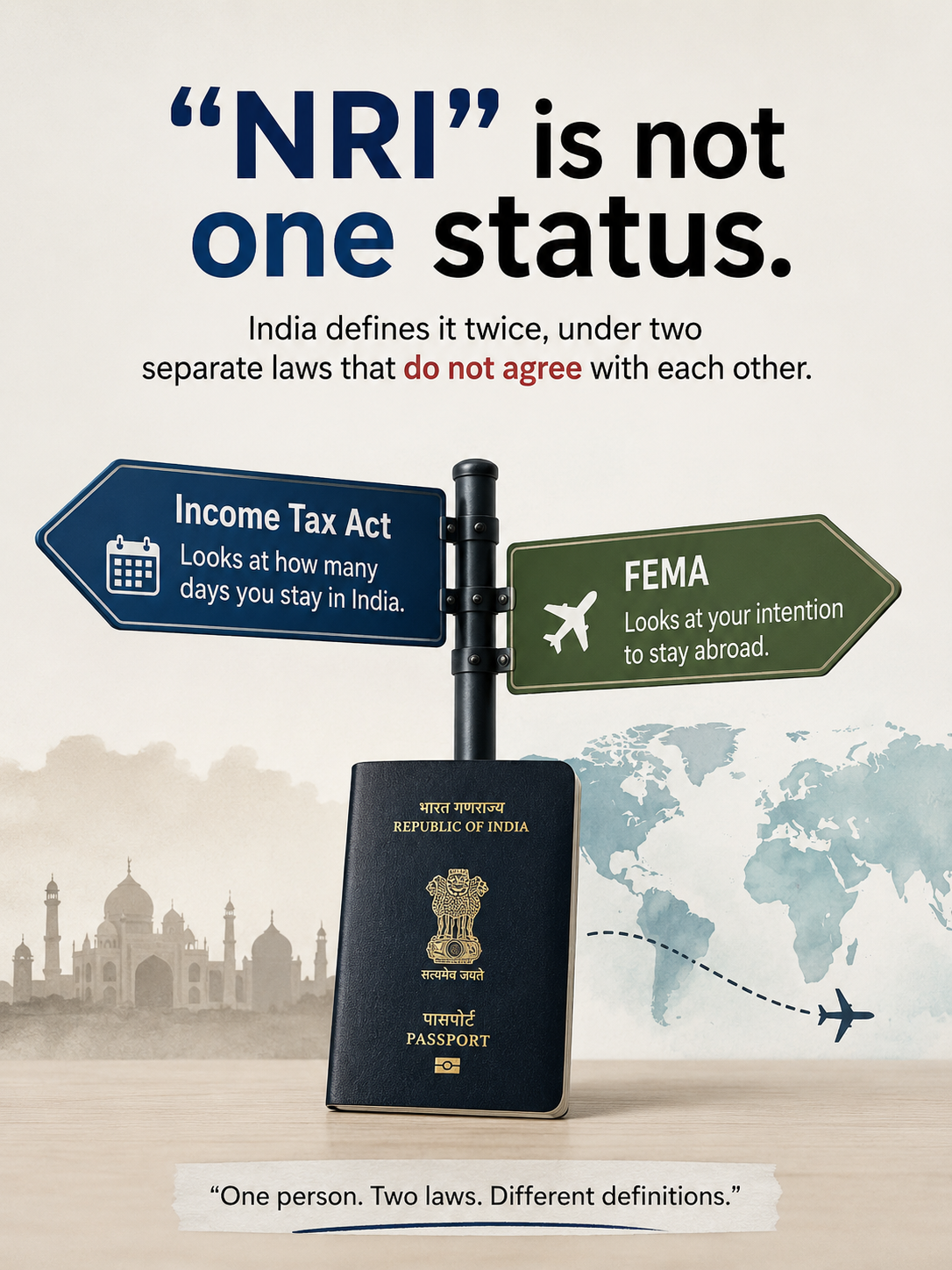
“NRI” is not one status — India defines it twice, under two separate laws that do not agree with each other.
The Income Tax Act decides how much of your income India can tax, using a strict count of days spent in India.
The Foreign Exchange Management Act (FEMA) decides what you can own, invest in, and repatriate, using yourintentionto stay abroad.
You can be a non-resident under one law and a resident under the other in the very same year — which is exactly why NRIs get tripped up. Getting either classification wrong can mean an unexpected tax bill, a frozen bank account, or a FEMA penalty.
The Two Definitions at a Glance
| Basis | Income Tax Act, 1961 (Income-tax Act, 2025 from 1 Apr 2026) | FEMA,1999 |
|---|---|---|
| What it governs | How your income is taxed in India | Bank accounts, investments, property, remittances |
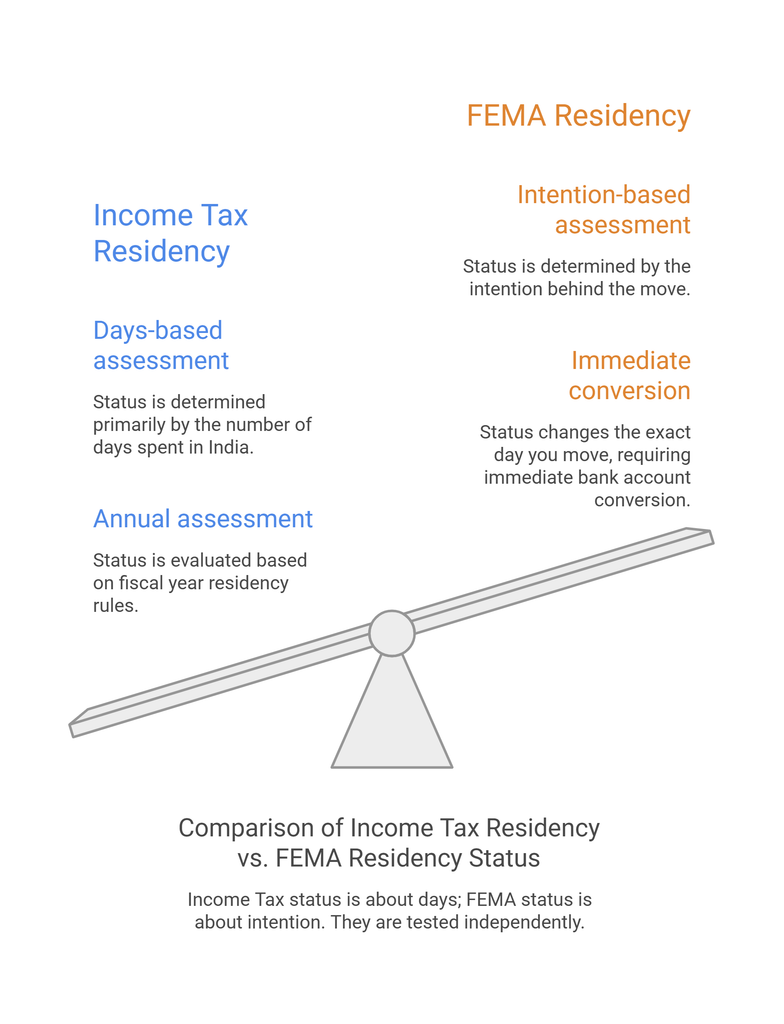
| Test used | Day-count in the financial year (objective) | Intention and purpose of stay (subjective) |
| When status changes | Decided for the whole financial year (1 Apr–31 Mar) | From the day you leave (or arrive), not year-end |
| Categories | Resident (ROR), Resident but Not Ordinarily Resident (RNOR), Non-Resident | Person Resident in India / Person Resident Outside India (NRI) |
| Citizenship relevance | Status depends on days, not citizenship | NRI = person resident outside India who is an Indian citizen (PIO for some purposes) |
Residential Status Under the Income Tax Act
Your status is tested afresh every financial year. You are a Resident if you meet
either basic condition; fail both and you are a Non-Resident (NRI).
| Test A | In India for 182 days or more in the financial year | Everyone |
| Test B | In India for 60 days or more in the year and 365 days or more across the preceding 4 years | Everyone, subject to the relaxations below |
Relaxations to Test B (the 60-day threshold changes):
| Indian citizen leaving India for employment, or as a crew member of an Indian ship | 182 days |
| Indian citizen / PIO visiting India, with Indian income up to ₹15 lakh | 182 days |
| Indian citizen / PIO visiting India, with Indian income above₹15 lakh | 120 days |
Following examples clarify the above:
Residential Status: Three Worked Examples
| Departing Employee | High-IncomeVisiting NRI | Zero-Day”Stateless” NRI | |
|---|---|---|---|
| Profile | Vikram, Indian citizen, resigns and moves to Singapore for employment on 1 Aug | Priya, Indian citizen settled in the US, visits India with a large rental portfolio back home | Arjun, Indian citizen based in Dubai (no personal income tax there) |
| Days in India this FY | 122 (beforedeparture) | 130 | 0 |
| Indian incomethis FY | — | ₹20 lakh | ₹40 lakh |
| Test A (182 days) | Not met | Not met | Not met |
| Applicable threshold | 182 days — relaxed, since he’ s a citizen leaving for employment | 120 days — tightened, since she’ s a visiting citizen with income above ₹15 lakh | n/a — 0 days clears no threshold |
| Deemed residency (Sec 6(1A)) | n/a | n/a | Applies — citizen, income > ₹15 lakh, not taxed anywhere else |
| Result | Non-Resident | Resident, Auto-RNOR | Deemed Resident, Auto-RNOR |
| What it shows | The employment-departure relaxation protects him: without it, 122 days would have made him Resident | The relaxation works against her — tightens instead of loosening — but auto-RNOR still shields her foreign income | Only Indian income is taxed, same as an NRI— the provision closes a compliance loophole rather than taxing global income |
Ilustrative figures. Confirm income classification and prior– year day counts with a CA before applying to an actual case.
Deemed residency (Section 6(1A)): An Indian citizen with Indian-source income above ₹15 lakh who is not liable to tax in any other country is treated as a resident regardless of how many days they spend in India — even zero. This targets “stateless” NRIs based in zero-tax jurisdictions like the UAE. A deemed resident is classified as RNOR, so only Indian income is taxed, not global income.
Resident, but which Kind? ROR vs RNOR
If you qualify as a resident, a second test decides how much of your global income India taxes.
| Category | How you qualify | What India taxes |
|---|---|---|
| Resident & Ordinarily Resident (ROR) | A resident who does not meet either RNOR condition | Worldwide income |
| Resident but Not Ordinarily Resident (RNOR) | Non-resident in 9 of the 10 preceding years, or in India for 729 days or fewer across the preceding 7 years (also automatic for deemed residents and high-income 120—182 day visitors) | Only Indian income (foreign income stays exempt) |
| Non-Resident (NRI) | Fails both basic residency tests | Only income earned or accrued in India |
RNOR is effectively a transition buffer for returning NRIs — foreign income stays outside India’ s net for typically two to three years before ROR status kicks in.
Note on the new law: The Income-tax Act, 2025 replaces the 1961 Act from 1 April 2026, but the residency framework and day-count logic are retained unchanged in renumbered sections (deemed residency moves from Section 6(1A) to Section 6(7)).
Residential Status Under FEMA
FEMA ignores the calendar and asks whyyou left. Under Section 2(v), a “person resident in India” is someone residing in India for more than 182 days in the preceding financial year — but this expressly excludes anyone who has gone abroad for employment, business, or any purpose indicating an intention to stay outside India for an uncertain period.
The practical consequences:
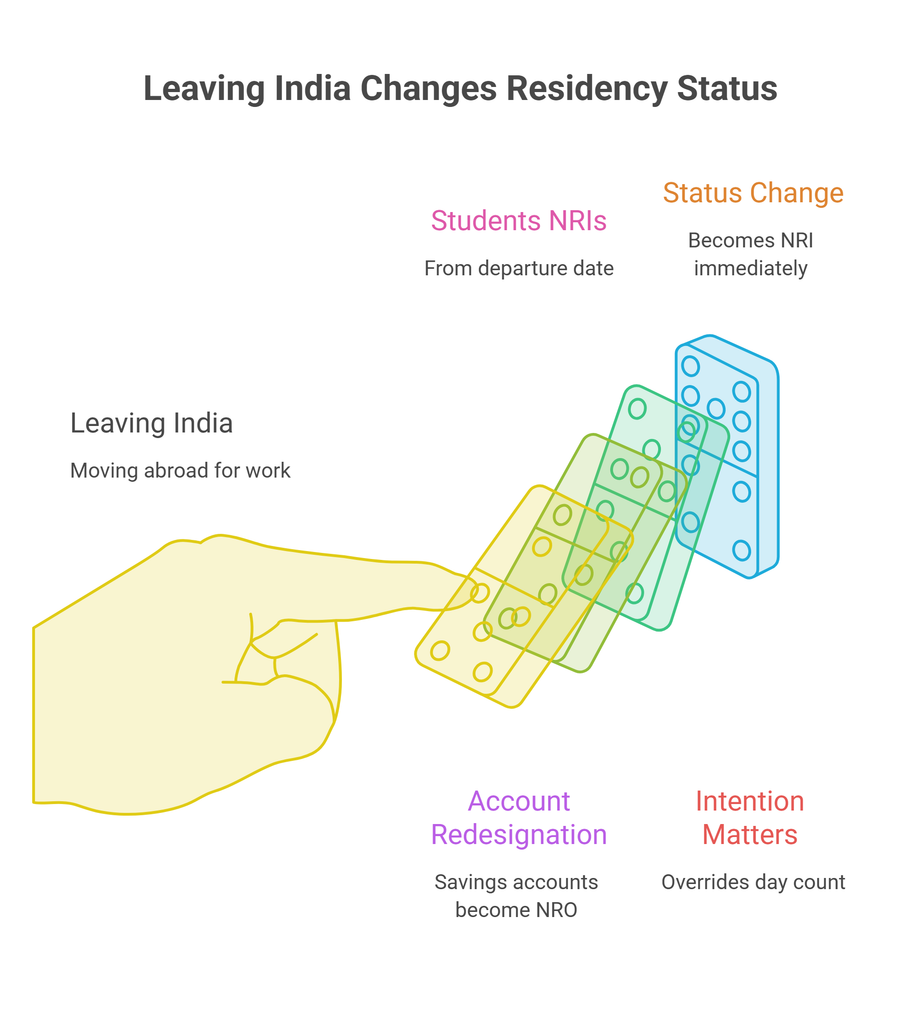
- Status changes on the day you move, not at year-end. Leave India for a job abroad in August, and you become a person resident outside India (NRI) from that day — even though you spent most of the year in India.
- Intention overrides day–count. An NRI settled abroad who visits India stays an NRI regardless of how long the visit lasts, as long as they haven’ t returned for permanent settlement.
- Students abroad are NRIs from the date of departure, per an RBI circular — their stay is treated as being for an uncertain period.
- NRIs cannot hold a resident savings account. On becoming an NRI, existing accounts must be redesignated as NRO (or NRE/FCNR).
Why the Two Definitions Diverge — A Worked Example
Consider an Indian citizen who moves to Dubai for a job in August 2025 and spends 200 days in India that financial year before leaving:
- Under FEMA: NRI from the day of departure in August — the move was for employment with an intention to stay abroad indefinitely.
- Under the Income Tax Act: Resident for FY 2025—26, because they were physically in India for 182+ days.
Same person, same year, opposite labels. FEMA lets them open an NRE account and repatriate freely; the Income Tax Act may still tax their global income for that transition year. This is normal and legal — the two laws simply ask different question.
Frequently Asked Questions
in the same year — or the other way round?
Yes — and this is genuinely common, not a rare edge case.
The two laws are answering completely different questions: the Income Tax Act only counts days physically present in India during the financial year, while FEMA asks why you left and how long you intend to be gone.
Take the Dubai example from earlier in this guide: someone who leaves for a job abroad on 20th Oct but has already spent 200 days in India that year is Non-Resident under FEMA from 20th Oct (departure for employment, uncertain-period intention) but still Resident under the Income Tax Act for that entire financial year (182+ days physically present, decided for the whole year regardless of when they left).
Neither status determines the other — you run both tests independently every year, and disagreement between them is the norm in the year you leave or return, not a sign something’ s wrong.
once I become an NRI?
Yes, and the trigger is your FEMA status specifically, not your Income Tax status. The moment you become a “person resident outside India” under
FEMA, holding a regular resident savings account is a compliance breach, regardless of what your Income Tax Act status says that year.
In practice: foreign earnings go into an NRE account, Indian-sourced income (rent, dividends, existing FDs) moves to an NRO account.
This isn’t a minor technicality — FEMA penalties for an unredesignated account can run up to three times the amount involved or ₹2 lakh, whichever is higher, plus a running daily penalty until it’ s corrected. Contact your bank’ s NRI cell as soon as your status changes rather than waiting for your next trip home.
under the Income Tax Act that year, is my NRE/FCNR interest still tax-free?
No — and this is exactly where the mismatch between the two laws can cost real money if you don’ t plan for it.
The tax exemption on NRE/FCNR interest is explicitly conditioned on you being a “person resident outside India” under FEMA, not on your Income Tax residency.
So the day your FEMA status flips to resident, the exemption’ s precondition disappears — even though your Income Tax Act status might still read “Non-Resident” for that entire financial year.
FEMA separately lets you keep the deposit running until maturity rather than forcing an immediate close-out, but the interest earned from your FEMA-resident date onward becomes taxable, split at the date your status changed.
Most people only check their Income Tax status and wrongly assume the exemption automatically follows it — it doesn’ t.
Reassessed fresh every single financial year under the Income Tax Act — nothing carries forward automatically.
Being NRI last year doesn’t make you NRI this year and being resident one year back does not lock you in either; each year’s status depends only on that year’s day count (and where relevant, the preceding year’s totals used in Test B and the RNOR tests)
This matters most in transition years — the year you leave, the year you return, or any year your travel pattern changes materially.
Recalculate your status before filing each year’ s return rather than assuming last year’ s classification still holds.
Want more clarity about NRI and Other queries [ Book a Call ] →

Founder R.S.W. Personal Finance Advisors.
Chartered Wealth Manager (CWM®)
AMFI Registered MFD ARN-244802
APMI Registered PMS Distributor APRN-07002
B.E. (Mechanical ) | PGDM (Marketing) | 9+ years in personal wealth management | Based in Pune
Specialising in Holistic Wealth Management for salaried professionals and NRIs — using the R.S.W. Financial Independence Framework.
Read more “About Me”