Where Mid Cap Funds Fit in a Wealth Pl
Mid Cap funds invest in companies ranked 101st to 250th by market capitalisation — businesses beyond the institutional dominance of large caps, but with enough operational scale to sustain growth through market cycles.
This segment offers a structural return premium over large caps, but demands a longer horizon and higher volatility tolerance in return.
Within the RSW Financial Independence Framework, Mid Cap funds serve a defined role:
- Accumulate Wealth: Growth accelerator within the CORE equity allocation — suitable for long-horizon goals (retirement, children’s education) where the investor has 10+ years to absorb mid cycle volatility.
- Accelerate Wealth: High-conviction equity layer for investors expanding beyond their CORE portfolio to generate alpha returns through active exposure to emerging market leaders.
Mid Cap funds are not a replacement for Large Cap or Flexi Cap allocations — they are a return enhancer. The higher volatility is the price of the return premium. This trade-off is appropriate only within a structured plan where the investor’s safety net and CORE goals are already funded.
The 5-Parameter Evaluation Framework
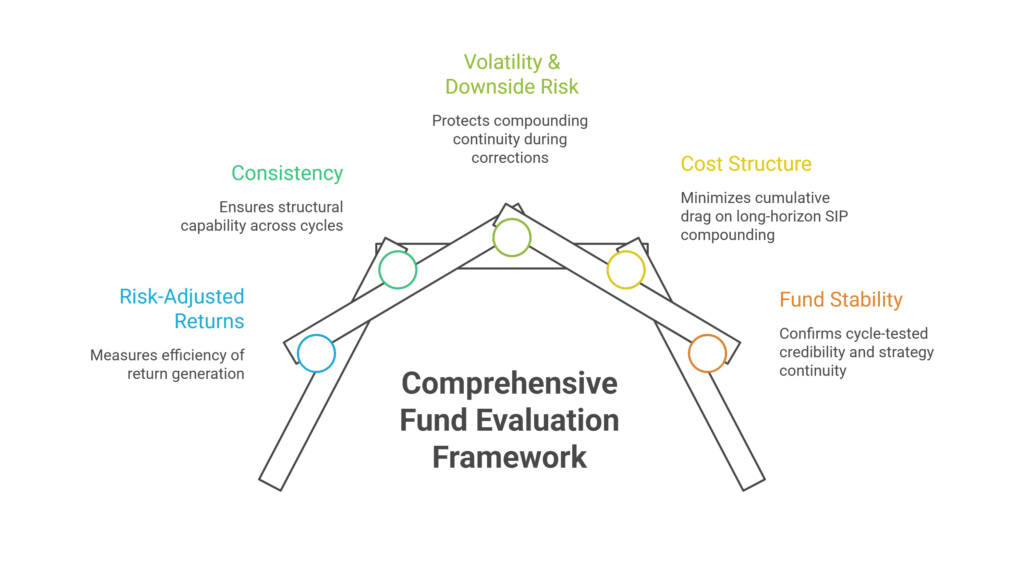
Fund selection follows five structured parameters. A fund must satisfy all five to qualify as a core holding.
| Parameter | What It Measures | Why It Matters in Wealth Planning |
|---|---|---|
| Risk-Adjusted Returns | Sharpe & Sortino Ratios | Efficiency of return generation, not just quantum |
| Consistency | Rolling 3Y/5Y/7Y returns across cycles | Prevents performance-chasing; ensures structural capability |
| Volatility & Downside Risk | Std Dev, Beta & Max Drawdown | Protects compounding continuity during corrections |
| Cost Structure | Expense ratio & exit load | Cumulative drag on long-horizon SIP compounding |
| Fund Stability | AUM, fund age, manager tenure | Confirms cycle-tested credibility and strategy continuity |
Top 5 Mid Cap Funds — 2026 Evaluation
| Fund | Mean Return (%) | Sharpe | Sortino | Alpha | Beta | Std Dev (%) | Expense Ratio (%) | Fund Age |
|---|---|---|---|---|---|---|---|---|
| Edelweiss Mid Cap | 23.91 | 1.01 | 1.26 | 2.81 | 0.94 | 17.88 | 1.80 | 18Y 4M |
| HDFC Mid Cap | 22.67 | 1.04 | 1.30 | 3.00 | 0.86 | 16.10 | 1.37 | 18Y 10M |
| Invesco India Mid Cap | 24.93 | 0.97 | 1.19 | 2.73 | 1.01 | 19.56 | 2.17 | 19Y |
| Nippon India Growth Mid Cap | 24.57 | 1.02 | 1.37 | 2.99 | 0.97 | 18.28 | 1.54 | 30Y 7M |
| ICICI Pru Midcap | 25.25 | 1.03 | 1.44 | 3.52 | 0.98 | 18.67 | 1.77 | 21Y 6M |
Risk ratios and fund data as of May 2026. Past performance does not guarantee future results. Source: Value Research.
HDFC Mid Cap — Core Portfolio Anchor
The most complete profile for a core Mid Cap holding. Highest Sharpe in the group (1.04), strong Sortino (1.30), and the lowest beta (0.86) — meaning it absorbs less downside during market corrections than peers. The lowest portfolio turnover by a significant margin (7.16%) signals a high-conviction, low-churn strategy that maximises tax efficiency and minimises transaction drag. At ₹94,745 Cr, it is the largest Mid Cap fund in India — reflecting deep institutional trust. Expense ratio of 1.37% is among the most competitive for active management at this scale.
Wealth management role: Primary Mid Cap allocation within the Accumulate Wealth stage. The lowest-risk, highest-efficiency profile in the category.
Nippon India Growth Mid Cap — Highest Returns, Lowest Churn
Leads on mean return (24.57%) and carries the longest track record in the group at 30Y 7M — the only fund here with three decades of cycle validation. Portfolio turnover of just 4% is the lowest in the evaluation, confirming exceptional strategy discipline. Alpha of 2.99 and Sortino of 1.37 are strong, though the higher beta (0.97) means it moves closely with the broader market during downturns.
Wealth management role: Strong primary or co-primary allocation within the Accumulate Wealth stage. The 30-year track record makes it the most cycle-tested Mid Cap fund available.
ICICI Pru Midcap — Best Alpha, Smallest Fund
Delivers the highest alpha (3.52) and mean return (25.25%) in the group, with a strong Sortino (1.44). However, the AUM of ₹7,557 Cr is the smallest in this evaluation — limiting its ability to hold larger mid cap positions without market impact. The expense ratio at 1.77% is the highest among evaluated funds and warrants monitoring relative to alpha persistence.
Wealth management role: High-conviction secondary allocation within the Accelerate Wealth stage for investors seeking maximum alpha. Not recommended as a standalone core holding given AUM constraints.
Edelweiss Mid Cap — Strong Returns, Moderate Efficiency
Solid mean return (23.91%) and Sortino (1.26), but the Sharpe of 1.01 and std dev of 17.88 indicate the returns come with above-average volatility relative to HDFC Mid Cap. Portfolio turnover at 37% is moderate but meaningfully higher than the top two funds. The 18-year track record provides adequate cycle validation.
Wealth management role: Secondary allocation for growth-oriented investors, complementing HDFC or Nippon India as the core. Best suited within the Accelerate Wealth stage rather than as a primary Accumulate Wealth holding.
Invesco India Mid Cap — High Returns, High Cost
Strong mean return (24.93%) and a reasonable Sharpe (0.97) and Sortino (1.19), but a beta of 1.01 is the only fund in this evaluation that moves in full lockstep with the broader market — offering no downside cushion during corrections. The expense ratio at 2.17% is the second highest in the group and, combined with a portfolio turnover of 28%, creates a meaningful total cost burden relative to peers with comparable returns. The 19-year track record provides solid cycle validation.
Wealth management role: Tactical secondary allocation within the Accelerate Wealth stage for investors comfortable with market-level beta. The cost structure requires explicit justification — monitor whether alpha of 2.73 persists net of fees over a full cycle.
A Critical Observation: Turnover as a Hidden Cost
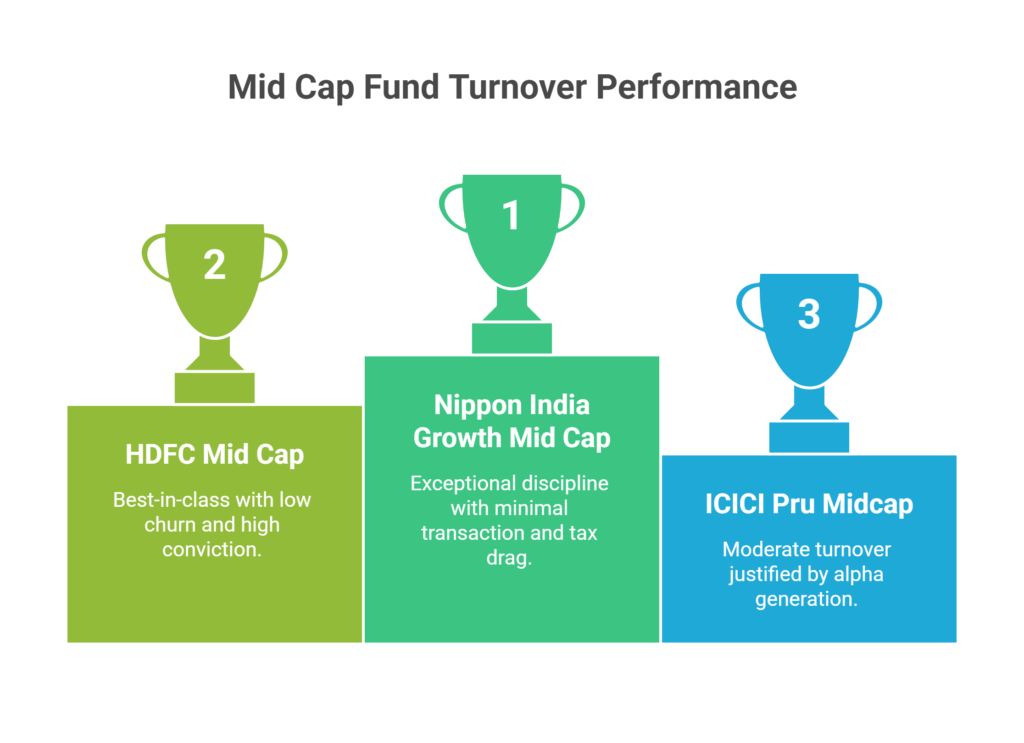
Portfolio turnover is consistently underweighted in fund selection decisions — yet in the Mid Cap category, where transaction costs are higher due to lower liquidity, it is a material factor.
| Fund | Portfolio Turnover | Implication |
|---|---|---|
| Nippon India Growth Mid Cap | 4.00% | Exceptional discipline — minimal transaction and tax drag |
| HDFC Mid Cap | 7.16% | Best-in-class — low churn, high conviction |
| ICICI Pru Midcap | 24.00% | Moderate — alpha (3.52) justifies current churn level |
| Invesco India Mid Cap | 28.00% | Moderate-elevated — monitor net alpha after cost drag |
| Edelweiss Mid Cap | 37.00% | Elevated — monitor whether alpha compensates cost |
High turnover in a Mid Cap fund is a compounding headwind. Every portfolio rotation incurs transaction costs and potential capital gains — both of which reduce the net return to the investor even when the headline return looks strong.
Positioning Mid Cap Funds by Goal
| Goal | Recommended Funds | Complementary Instruments |
| Long-Term Wealth Corpus — 10Y+ | HDFC Mid Cap + Nippon India Growth | Flexi Cap as primary equity core |
| Accumulate Wealth — CORE goal funding | HDFC Mid Cap as primary | NPS equity + Large Cap for stability layer |
| Accelerate Wealth — alpha beyond core | ICICI Pru Midcap as satellite | Flexi Cap or Multi Cap as primary |
A Fund Selection Is Not a Wealth Plan
Mid Cap funds carry the highest volatility among the equity categories evaluated in this series. They belong in a portfolio only after the Build Safety Net stage is complete — emergency fund, term insurance, and health insurance in place — and only within an allocation sized to the investor’s specific risk capacity and goal horizon.
The right Mid Cap allocation depends on where you are in the RSW framework, what role this fund plays relative to your existing equity exposure, and whether your goal horizon can absorb a 30–40% drawdown without triggering a panic exit.
Fund quality is one input. Your Wealth Personality, your current stage in the RSW Framework, and your specific goal timelines determine the right combination.
Q: If my Flexi Cap fund already holds Mid Cap stocks, do I need a separate Mid Cap fund?
A: Check the actual allocation first. If your Flexi Cap fund holds less than 20% in Mid Caps, a dedicated Mid Cap fund adds meaningful exposure. If it already holds 30%+, adding a Mid Cap fund creates overlap and concentrates risk without diversification benefit.
Q: Should Mid Cap be my core holding or should Flexi Cap take that role?
A: Flexi Cap should always be the core. Mid Cap is the growth accelerator sitting alongside it — never the anchor. The higher volatility of Mid Cap funds makes them unsuitable as a standalone core holding within the Accumulate Wealth stage.
Q: How much of my equity portfolio should be allocated to a Mid Cap fund?
A: For most investors in the Accumulate Wealth stage, Mid Cap should not exceed 20–30% of total equity allocation. Flexi Cap holds the remaining 40–60% as the core. Allocating more than 30% to Mid Cap without a strong Flexi Cap anchor introduces volatility that most investors cannot sustain through a full market correction.
Q: How is a Mid Cap fund taxed, and does switching from Flexi Cap to Mid Cap trigger tax?
A: Gains held over 12 months are taxed at 12.5% LTCG — with ₹1.25 lakh annual exemption. Gains under
12 months at 20% STCG. Yes — switching from a Flexi Cap fund to a Mid Cap fund is a redemption event and triggers capital gains tax immediately, even if you reinvest. Factor this cost into any rebalancing or portfolio restructuring decision.
Q: At what stage of my wealth plan should I exit a Mid Cap fund?
A: Begin exiting earlier than you would a Flexi Cap fund — at least 4 years before a goal deadline, not 3. Mid Cap funds experience deeper drawdowns of 35–45% during corrections and take longer to recover. A systematic transfer into hybrid or debt funds starting 4 years out protects your corpus from sequence-of-returns risk at the worst possible time.
Begin your Midcap Portfolio with my Expert guidance [ Book a Call ] →

Founder R S W Personal Finance Advisors.
B.E , PGDM [Marketing] ,
Chaterered Wealth Manager,
PMS Disributor, Mutual Fund Distributor.
Passionate about Personal Wealth Management. Practising 4+ Years.
Read more “About Me”