Most NPS conversations in India focus on one thing — accumulation.
How much should I contribute? Which fund manager should I choose? Equity or government securities?
These are important questions. But they are only half the picture.
The part that rarely gets discussed is what happens at age 60 — when you actually have to live off the money you spent decades building.
That is the decumulation problem. And PFRDA has just introduced a significant answer to it.
It is called the Retirement Income Scheme (RIS).
What Was the Problem RIS Is Trying to Solve?
For a full understanding of how NPS accumulation works before you reach retirement, the NPS Complete Guide covers everything from account types to fund selection and tax benefits.
Before RIS, an NPS subscriber retiring at 60 had two choices for the 80% corpus they could withdraw as a lump sum:
Take the full amount as a lump sum and manage it yourself — with the real risk of spending it too fast, too early.
Or use the Systematic Lump Sum Withdrawal (SLW) — which gave flexibility but no structure around sustainability.
The annuity, meanwhile, handled the remaining 20% (the mandatory minimum). Guaranteed income, yes — but poor inflation protection and no ability to participate in market growth.
The gap PFRDA was staring at was this: retirees were either over-spending their corpus or under-utilising it by parking everything in fixed instruments out of fear.
RIS is the structural bridge they have now built.
What RIS Actually Does
Under RIS, your 80% NPS corpus remains invested after retirement — it does not get handed to you in one shot. Instead, it generates periodic payouts while continuing to participate in the market, right up to age 85.
Think of it as a post-retirement lifecycle fund combined with a systematic withdrawal plan. The corpus stays alive. And so does your income.
How the Asset Allocation Works
One of the most important features of RIS is what happens to the investment mix as you age. The portfolio automatically becomes more conservative:
| Age | Equity | Corporate Debt | G-Sec |
|---|---|---|---|
| 60 | 35% | 10% | 55% |
| 65 | 25% | 15% | 60% |
| 70 | 15% | 20% | 65% |
| 75+ | 10% | 20% | 70–75% |
You do not have to think about this. The regulator has built the lifecycle into the product.
At 60, there is still meaningful equity exposure — important because a 60-year-old may have a 25-year retirement ahead. By 75, the portfolio has shifted decisively toward stability.
Two Ways to Receive Income Under RIS
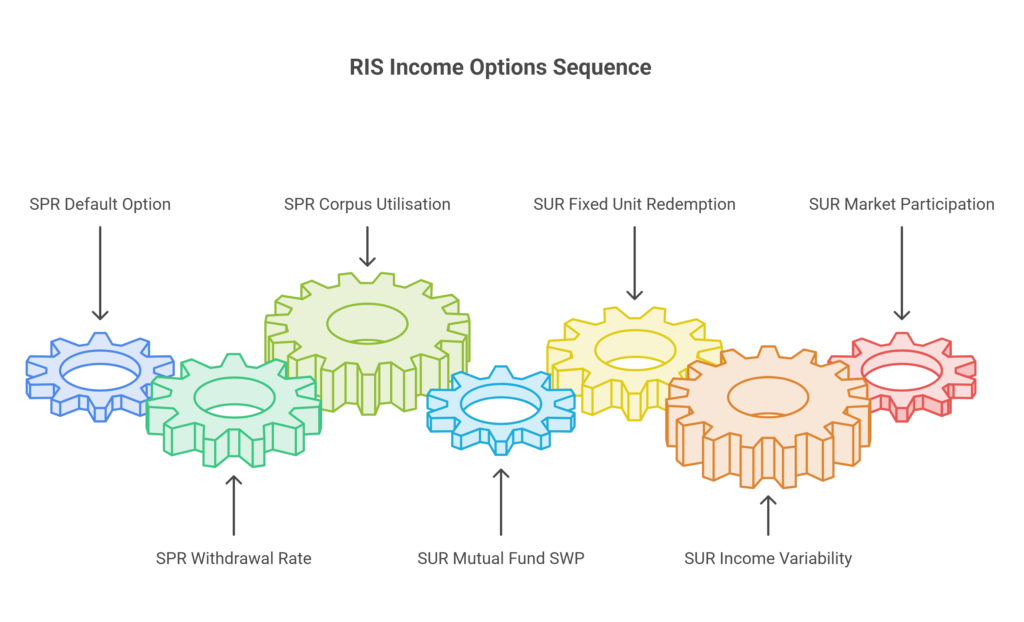
SPR (Systematic Payout Rate)
This is the default option. Each year, a percentage of the corpus is withdrawn — and that percentage increases as you age, so that the corpus is designed to be fully utilised by age 85.
| Age | Annual Withdrawal Rate |
|---|---|
| 60 | 4.0% |
| 65 | 5.0% |
| 70 | 6.67% |
| 75 | 10.0% |
| 80 | 20.0% |
The logic here is straightforward — withdraw conservatively early, when you have time for the corpus to recover; withdraw more as you age.
SUR (Systematic Unit Redemption)
This works like a mutual fund SWP. Fixed units are redeemed periodically. Your income varies with NAV — higher in rising markets, lower in falling ones.
If your corpus performs well, you receive more. If markets fall, your payouts fall too.
SUR suits investors who are comfortable with income variability and want maximum participation in market upside.
Where RIS Fits in the Larger Retirement Picture
Before RIS, the post-retirement decision for an NPS subscriber was essentially binary: Annuity or Lump Sum.
Now the conversation is more sophisticated:
| Option | Income Type | Market Participation | Longevity Risk |
|---|---|---|---|
| Annuity | Guaranteed | None | Covered |
| Lump Sum / SLW | Flexible | Managed by self | Fully on you |
| RIS | Market-linked, structured | Yes | Managed to 85 |
| Mutual Fund SWP | Market-linked, flexible | Yes | Fully on you |
In many cases, the most effective retirement income strategy will not be any single option — it will be a combination. The mandatory annuity portion provides a floor.
RIS manages the bulk of the NPS corpus with discipline. A mutual fund SWP adds flexibility. An emergency reserve stays outside NPS altogether.
This is exactly how retirement income planning should work — layered, structured, and not dependent on a single instrument performing perfectly.
Three Limitations You Must Not Overlook
1. No return guarantee
RIS is not a pension. There is no guaranteed monthly payout. What you receive depends on corpus performance. This needs to be clearly understood — especially by retirees who may assume that a PFRDA-regulated product carries an implicit income guarantee. It does not.
2. Tax treatment is unresolved
At the time of writing, PFRDA has not clarified how staggered RIS withdrawals will be taxed. This is a meaningful gap. Until there is regulatory clarity on this, the full tax efficiency of RIS cannot be precisely calculated. Watch this space.
3. Corpus designed to end at 85
This is the most significant planning concern. RIS manages longevity risk — but only to age 85. If you live beyond that, and many people now do, you will need alternative income sources in place. RIS should not be your only plan.
Is RIS Right for You?
RIS is likely to suit you if:
- You are comfortable with some market-linked variability in your monthly income
- You have other stable income sources — rent, a spouse’s pension, or a separate annuity
- You want your retirement corpus to continue growing even as you draw from it
- You dislike the idea of converting everything into an annuity at a moment when interest rates may not be favourable
RIS is likely not the right choice if:
- You need a fixed, predictable amount to hit your account every month
- Market volatility will cause you anxiety that affects your quality of life in retirement
- You have no backup income and cannot afford a dip in payouts during a bad market year
What This Means If You Are Still in the Accumulation Phase
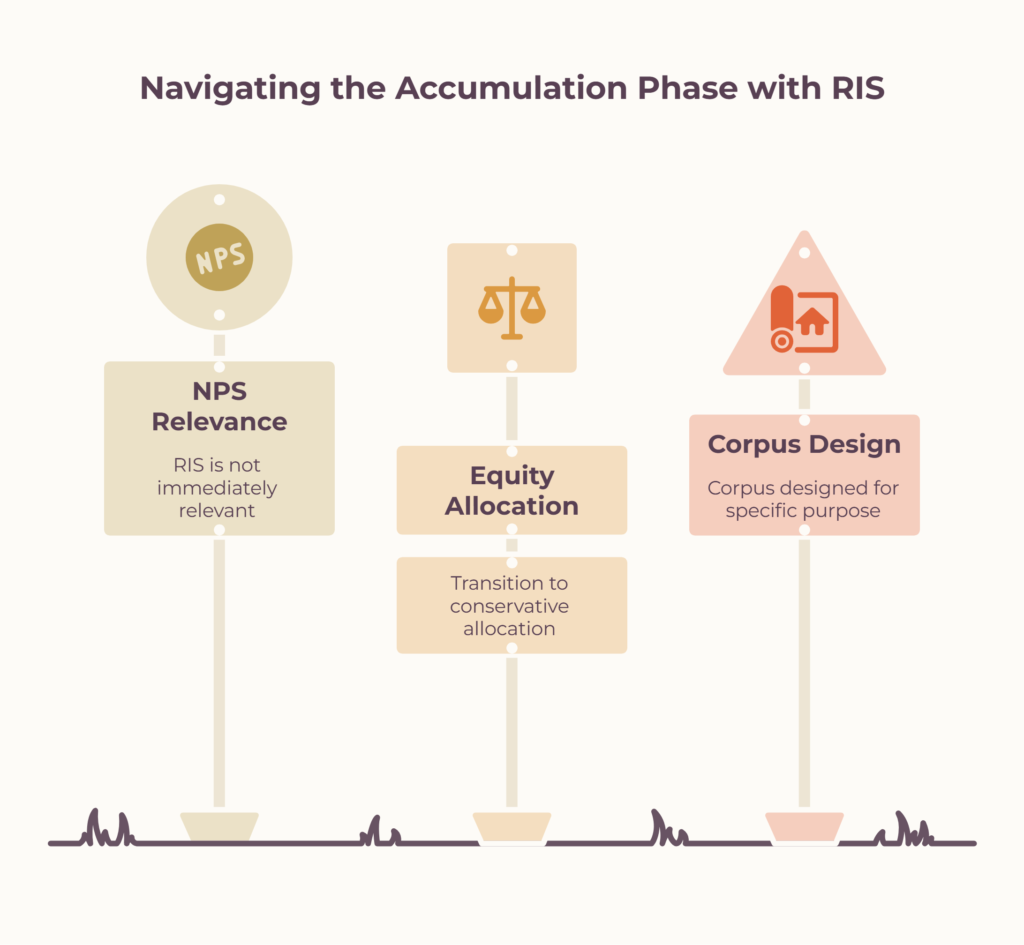
If you are 35 or 45 and reading this, RIS is not immediately relevant to you — but it changes how you should think about your NPS today.
Knowing that a structured, market-linked income phase exists post-retirement means you have more reason to build a meaningful NPS corpus, not just the minimum. It also reinforces the case for staying in higher equity allocation through your working years — because the transition to conservative allocation happens automatically once you enter RIS.
This is precisely the kind of structure the RSW Financial Independence Framework is built around — not just accumulating, but knowing exactly what the corpus is designed to do when it is finally put to work.
The Real Value of RIS
The most important thing RIS offers is not higher returns. The market will determine those.
Its real value is discipline.
RIS introduces a withdrawal structure that prevents two of the most common retirement mistakes — withdrawing too much too soon and withdrawing too little out of fear while sitting in low-return instruments.
It keeps the corpus invested and adjusts risk as you age.
And it does all of this within a regulated framework, without requiring you to manage the mechanics yourself.
For anyone who has spent 25–30 years building an NPS corpus, that structure is not a small thing.
Suggested Internal Links:
- → NPS Returns Explained — Why No Two NPS Investors Get the Same Outcome
- → The RSW Financial Independence Framework — Five Stages Explained
Book your free one-hour wealth planning call →

Founder R.S.W. Personal Finance Advisors.
Chartered Wealth Manager (CWM®)
AMFI Registered MFD ARN-244802
APMI Registered PMS Distributor APRN-07002
B.E. (Mechanical ) | PGDM (Marketing) | 9+ years in personal wealth management | Based in Pune
Specialising in Holistic Wealth Management for salaried professionals and NRIs — using the RSW Financial Independence System.
Read more “About Me”