
Most salaried professionals in their 30s and 40s have quietly accepted one thing as fact: commercial property is out of reach.
Not the house you live in. But investment property — the kind that generates rental income every month. A commercial office space in a Bengaluru tech park.
A retail unit in a Mumbai mall. A warehouse leased to a logistics company. The sort of asset that wealthy families accumulate and live off for generations.
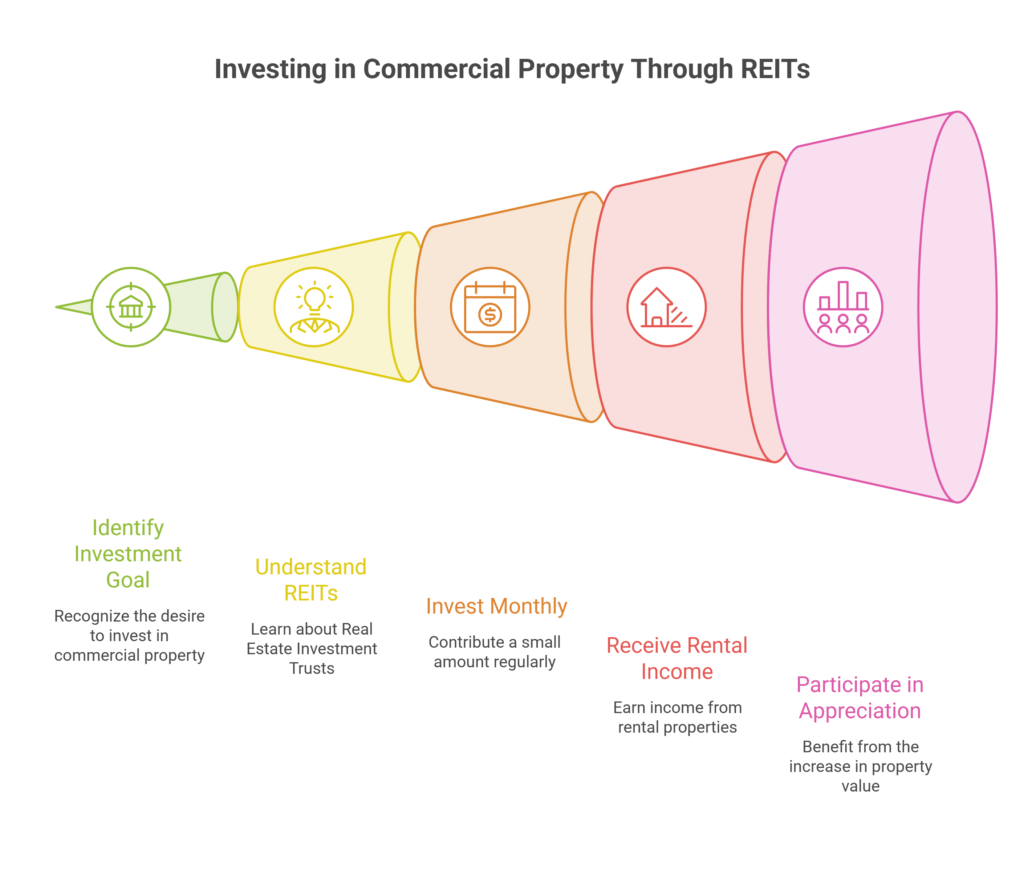
That assumption is worth questioning. Because there is a way for an ordinary salaried professional — someone investing ₹10,000 or ₹20,000 a month — to own a slice of exactly those assets, receive rental income from Grade-A office buildings, and participate in commercial property appreciation. Without buying a single square foot.
It is called a Real Estate Investment Trust. A REIT.
And if you have come across the term before and filed it away for later — something just changed that makes now the right time to pay attention.
What Is a REIT? How Real Estate Investment Trusts Work in India
A REIT is a professionally managed portfolio of income-generating commercial properties — office buildings, tech parks, malls, warehouses — listed on the stock exchange like a share.
Instead of one person buying one building, thousands of investors pool money into a trust. That trust acquires and manages a diversified portfolio of properties. The rental income flows back to investors as regular quarterly distributions.
You buy REIT units on NSE or BSE through the same broking account you use for stocks.
SEBI mandates that REITs must distribute at least 90% of their rental income to unitholders every year — this is a legal requirement, not a management choice.
In plain terms: you put in money, professionals manage real estate on your behalf, you receive rental income quarterly, the properties may appreciate over time, and you can exit any trading day by selling your units. Something no physical property can offer.
REITs vs Buying Property in India — Which Is the Better Investment?
Most people romanticise investment property. The reality is harder.
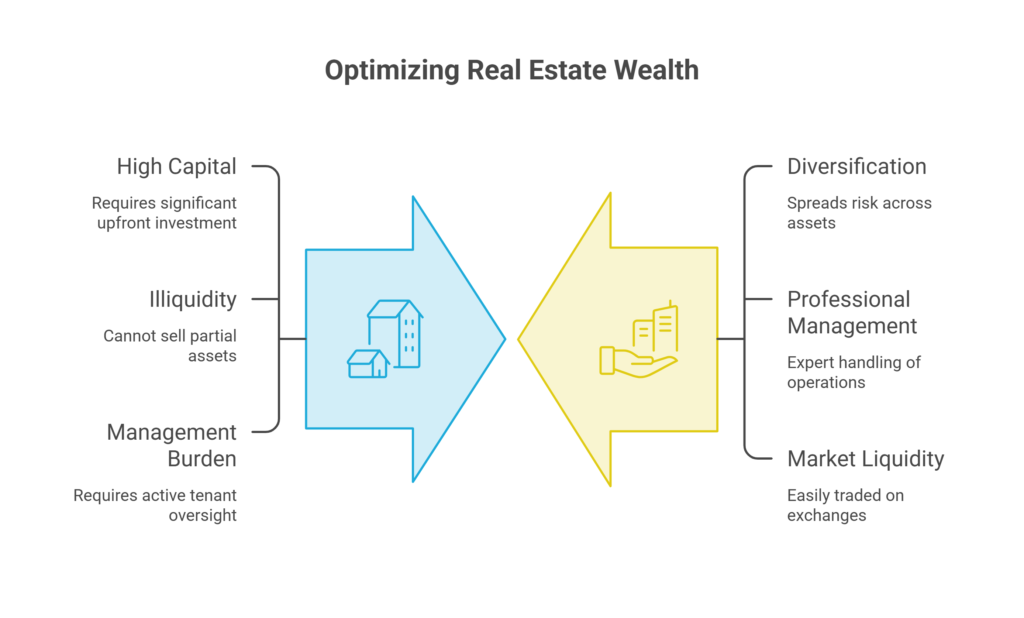
A second property in a Tier-1 city requires ₹50 lakh to several crore upfront — locked in a single asset you cannot partially sell. You manage tenants, maintenance, and vacancy yourself. Your entire real estate bet rides on one locality. And commercial property — which generates far better rental yields — is priced well beyond individual reach.
REITs solve every one of these problems: diversified portfolio across multiple Grade-A assets, professional management, and listed liquidity. Plus, with equity taxation now in place, the after-tax return picture is more compelling than at any point in their history in India.
What Returns Do REITs Generate in India?
Indian REITs have historically delivered distribution yields of 5% to 7% per annum. On ₹1 lakh invested, that is ₹5,000 to ₹7,000 per year paid quarterly into your account.
Yield is only part of the story. Unit prices can also rise as property values grow and rents escalate through built-in lease clauses. Combined, total returns for Indian REITs can potentially reach into the double digits annually.
As Aashish Somaiyaa, CEO of WhiteOak Capital, noted in The Fynprint: “REITs are ideal hybrid instruments offering both yield and potential appreciation. Combined, the total holding period return can potentially reach into the teens.”
What drives REIT performance:
| Factor | What to Watch |
|---|---|
| Occupancy Rate | Higher leased area = more rental income. 95% occupancy vs 78% is a very different investment |
| Rental Growth | Lease escalation clauses — typically 5% annually or 15% every 3 years — create compounding income |
| Interest Rates | Rising rates compress yield spreads and can suppress unit prices in the short term |
| Asset Quality | Grade-A properties in Bengaluru ORR, Mumbai BKC, Hyderabad HITEC City command premium rents |
| Sponsor Strength | The institution behind the REIT determines asset quality, governance, and growth pipeline |
REIT Equity Reclassification India 2026 — What Changed and Why It Matters
For most of their existence in India, REITs had a structural tax problem.
The bulk of what a REIT pays you — the quarterly rental distribution — was classified as interest income and taxed at your slab rate. For someone in the 30% bracket, a REIT yielding 6% on paper was actually delivering closer to 4% after tax. A fixed deposit suddenly looked competitive. The case for REITs weakened considerably.
That objection no longer exists.
REITs are now classified as equity for taxation purposes — formalised through a SEBI circular in November 2025 and effective from January 2026. This is not a minor adjustment. It is the single most important development in Indian REITs since their first listing in 2019.
| Details | Before Reclassification | After Reclassification |
|---|---|---|
| LTCG Tax Rate | 20% with indexation | 12.5% — same as equity mutual funds |
| Holding Period for LTCG | 36 months | 12 months |
| Portfolio Classification | Hybrid / Other | Equity |
| Comparison to Equity MFs | Tax disadvantaged | Level playing field |
The holding period change alone is significant. Three years was a meaningful deterrent for investors who wanted flexibility. Twelve months aligns REITs with every other listed equity instrument and removes the last structural reason to treat them as second-class citizens in an equity portfolio.
REITs were always a structurally sound product. They now have the tax treatment to match.
REITs vs InvITs in India — Key Differences Every Investor Must Know
You will almost always see REITs mentioned alongside InvITs — Infrastructure Investment Trusts. They are structured similarly but behave very differently.
An InvIT holds infrastructure assets — highways, power lines, telecom towers — and generates income through toll collections and regulated tariffs. But InvIT assets are concession-based: when the concession expires, the asset reverts. There is no land value underneath. InvITs are primarily income instruments.
A REIT holds physical real estate — buildings on land that can appreciate. REITs offer both rental income and capital growth potential. InvITs offer primarily distributions.
The tax treatment now reflects this distinction too. REITs are classified as equity. InvITs continue under a different framework. For a salaried investor building long-term wealth, the combination of income, appreciation potential, and equity taxation makes REITs the more relevant instrument.
Where Do REITs Fit in a Salaried Professional’s Wealth Plan?
This is the question most REIT articles never answer — and it is the most important one.
The R.S.W. Financial Independence Framework, developed by Nitin Wali, Chartered Wealth Manager and Founder of R.S.W. Personal Finance Advisors, Pune, provides a clear answer for salaried professionals. The framework organises wealth building into five sequential stages:
Managing Money → Build Safety Net → Accumulate Wealth (CORE) → Accelerate Wealth (Tactical) → Build Legacy.
REITs — held directly as listed units — belong in Stage 4: Accelerate Wealth, as a Tactical investment. They carry an income thesis, require active monitoring of occupancy data and distributions, and are sized as an acceleration layer above the CORE — not as a foundation.
The equity reclassification reinforces this positioning. REITs now sit in the same tax category as listed equity, which is exactly where the R.S.W. framework has always placed them within its investment universe.
REITs can also appear earlier — in the CORE — but typically through multi-asset mutual funds that hold REIT units within a professionally managed, goal-linked allocation. In that structure, the monitoring and rebalancing is handled by the fund manager, not the investor.
The framework’s clearest caution: “Most salaried investors attempt Stage 4 prematurely — before the CORE is built, before goals are funded, before protection is in place. That is not acceleration. That is speculation on an unfinished foundation.”
(R.S.W. Financial Independence Framework — Nitin Wali, CWM, R.S.W. Personal Finance Advisors, Pune. Full framework: persfinanceplanning.in)
Should Salaried Professionals Invest in REITs?
Three Questions to Ask First
Before you search for REIT units on your broking app, answer these:
One — Emergency fund: Do you have 6 to 8 months of total household expenses — including EMIs, school fees, and insurance premiums — in a liquid fund accessible within 24 hours?
Two — Term insurance: Do you have cover that clears every outstanding loan and supports your family for 10 years — independent of your employer’s group policy?
Three — CORE portfolio: Do you have SIPs running against specific, calculated goals — retirement at a specific age, your child’s college fees in a specific year — not just vaguely “for the future”?
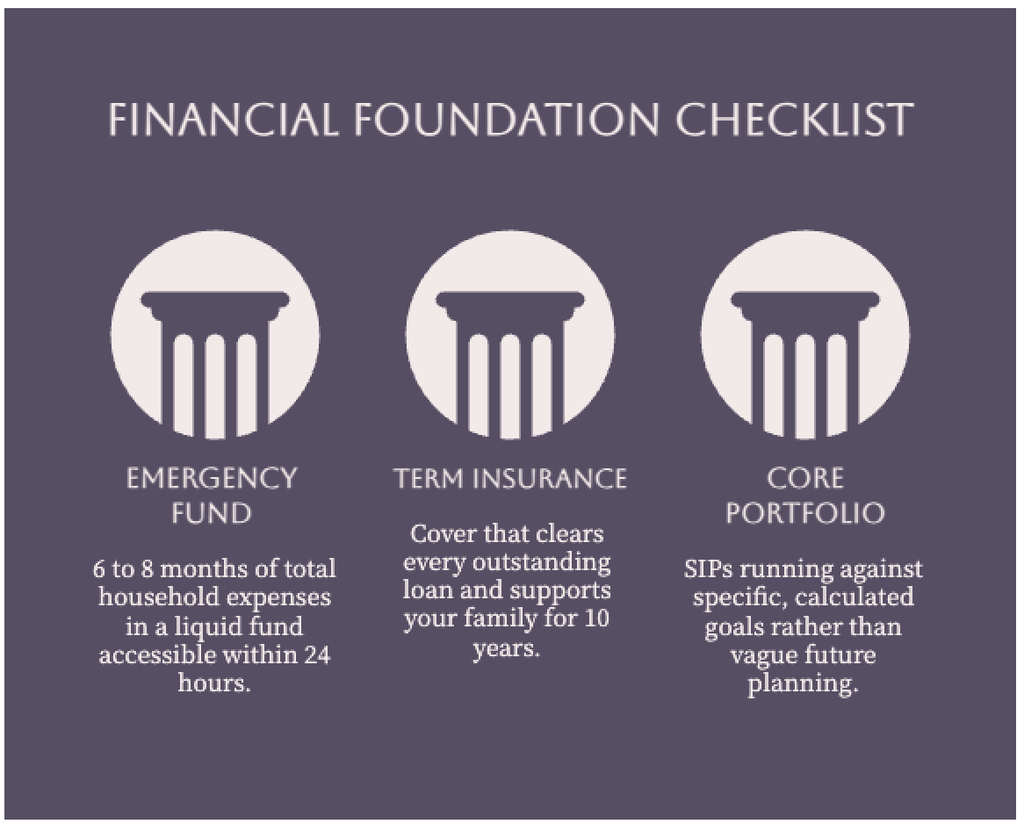
If all three are yes — REITs deserve a serious place in your financial plan. A Tactical allocation of 5 to 10% of your overall portfolio is a sensible starting range.
If even one is no — that gap is more urgent than any REIT allocation. Fix the foundation first. It will do more for your financial independence than any return REITs can deliver.
How to Buy REITs in India
REITs are listed on NSE and BSE. Buy them through your existing broking account — Zerodha, Groww, Upstox, HDFC Securities — exactly like a stock. No separate account or special permission needed.
Minimum lot sizes were reduced to one unit in 2023, making them accessible at entry-level amounts.
For investors who prefer not to pick individual names, multi-asset mutual funds that hold REITs within a diversified portfolio offer a simpler, professionally managed route.
Are REITs a Good Investment for Salaried Indians in 2026?
REITs have always offered what most salaried professionals want from real estate: rental income, professional management, and listed liquidity — without the crores, the paperwork, or the tenant calls at midnight.
What they lacked was fair tax treatment. That has now changed.
With equity classification in place, REITs finally sit where they always belonged — as a genuine, accessible, tax-efficient real asset in the portfolio of a disciplined salaried investor.
The buildings are real. The rent is real. And the tax treatment is now finally fair.
Begin your rebalancing review for you Portfolio [ Book a Call ] →

Founder R.S.W. Personal Finance Advisors.
Chartered Wealth Manager (CWM®)
AMFI Registered MFD ARN-244802
APMI Registered PMS Distributor APRN-07002
B.E. (Mechanical ) | PGDM (Marketing) | 9+ years in personal wealth management | Based in Pune
Specialising in Holistic Wealth Management for salaried professionals and NRIs — using the R.S.W. Financial Independence System.
Read more “About Me”