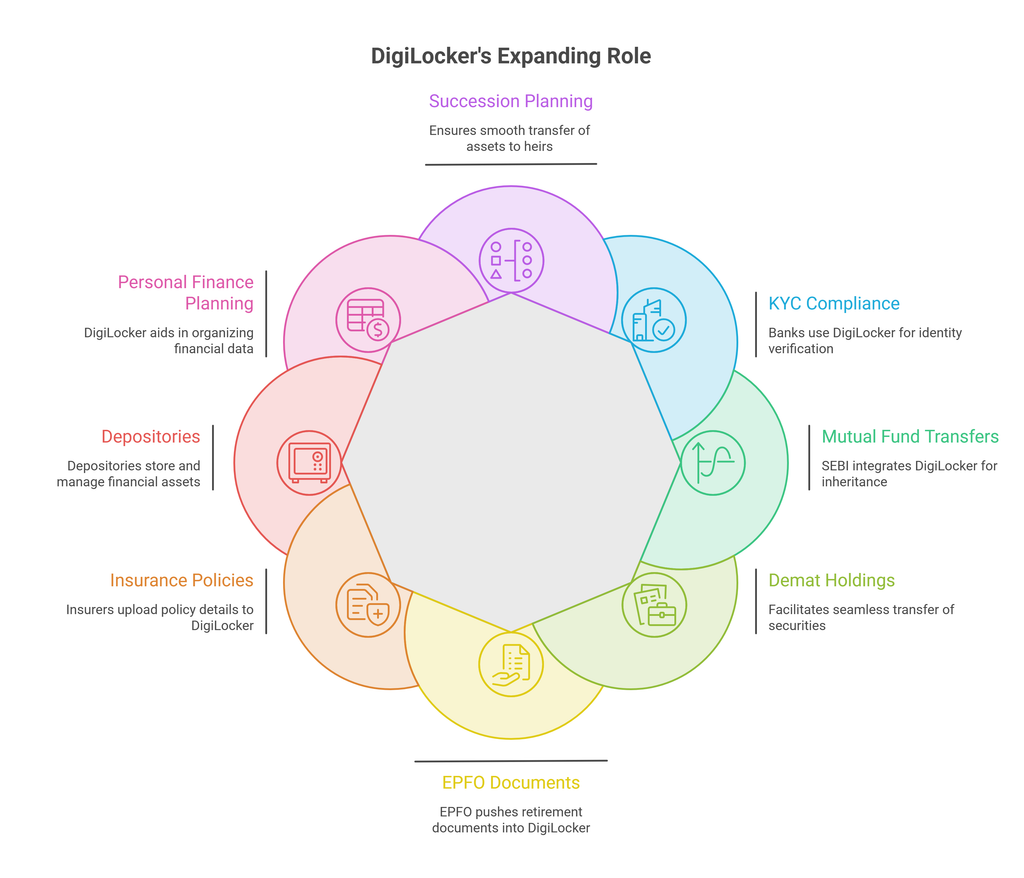
DigiLocker has quietly moved from “a place to keep your driving licence” to something closer to a national financial identity layer. Banks now accept it for KYC, SEBI has wired it into how mutual fund and demat holdings pass to your heirs, and EPFO, insurers, and depositories are all pushing documents into it. For personal finance planning specifically, DigiLocker deserves more attention than it gets — this guide covers what it actually is, which financial documents live there, and how to build it into your own financial and succession planning.
Quick Basics: What DigiLocker Actually Is
DigiLocker is a cloud-based digital document wallet operated by the National e-Governance Division (NeGD) under the Ministry of Electronics and Information Technology (MeitY), launched in July 2015 as part of Digital India. You sign in using your Aadhaar-linked mobile number and an OTP, plus a PIN you set yourself.
| Aspect | Detail |
|---|---|
| Legal validity | Section 9A of the IT Act, 2000, and Rule 9A of the 2016 Digital Locker Rules (notified February 2017) make DigiLocker-issued documents legally at par with the physical original |
| Architecture | A middleware layer between “issuers” (government bodies, regulators, banks, insurers) and “requesters” (employers, airports, banks, courts), connected via the API Setu gateway |
| Document authenticity | Every issued document is digitally signed by the issuer using a Digital Signature Certificate — this is what makes it tamper-proof, not just a photo or scan |
| Security | ISO 27001:2022-certified infrastructure, 256-bit encryption, Aadhaar-OTP plus PIN authentication, and explicit consent required before any organisation can access your documents |
| Scale (early 2026) | Over 67 crore users and 950+ crore documents issued |
The distinction that matters most: an issued document (fetched directly from the source via API, digitally signed) carries full legal weight. A document you upload yourself (an old paper certificate you’ve scanned) does not carry the same legal equivalence — it’s just storage. For personal finance purposes, you want to rely on the issued category wherever possible.
What Financial Services Can You Actually Access?
DigiLocker’s issuer list has grown well beyond identity documents.
For personal finance specifically, here’s what now runs through it:
| Category | What’s Available | Why It Matters Financially |
|---|---|---|
| Identity/KYC | Aadhaar, PAN, driving licence, voter ID | Accepted as an Officially Valid Document (OVD) for KYC at banks, brokers, and NBFCs |
| Retirement | EPFO passbook, UAN card, Pension Payment Order, Scheme Certificate (since July 2025) | One place to check PF balance and pension documents without the EPFO portal/UMANG app |
| Investments | Demat and mutual fund holding statements, Consolidated Account Statement (CAS) — mandated by SEBI from 1 April 2025 | Consolidates your investment footprint, and is the backbone of the nominee mechanism below |
| Insurance | Policy documents from LIC and several private insurers | A single place your family can find policies exist, without hunting through email or paper files |
| Banking | Bank account statements (select banks) | Useful for KYC re-verification and loan applications |
| NPS | NPS account statements | Complements the other retirement documents above |
| Property (select states) | Registered property documents | Availability depends on whether your state has integrated its land registry |
Not every issuer works reliably for every document — smaller insurers, some state land records, and a few EPFO edge cases still return errors in practice. Treat the “issuer list” as a strong starting point, not a guarantee.
DigiLocker as KYC Infrastructure
Because issued documents carry legal validity and are digitally signed at the source, banks and NBFCs can treat a DigiLocker-fetched Aadhaar or PAN as an OVD without separate physical verification. This is now formally linked to the Central KYC Registry (CKYC 2.0), making DigiLocker a structural part of account-opening — for a bank account, demat account, or insurance policy — rather than an optional shortcut. In practice, this is what lets many platforms open an account for you in minutes instead of days.
The Real Novelty: Succession Planning via DigiLocker
This is the part most investors haven’t caught up on yet. Under a SEBI circular effective 1 April 2025, DigiLocker now plays a direct role in what happens to your investments after you die.
Here’s the mechanism:
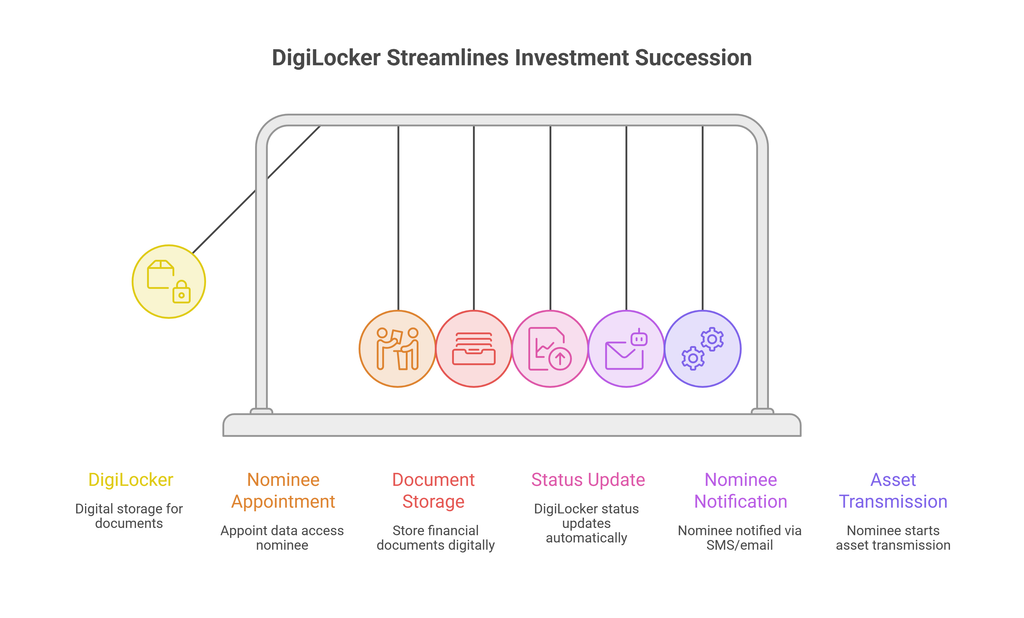
- You appoint a Data Access Nominee inside your DigiLocker account, while you’re alive.
- You store your financial documents in DigiLocker — demat/MF holding statements, CAS, insurance policies — since the nominee can only see what’s actually there.
- On your death, DigiLocker’s status updates automatically, cross-checked against death-registration data from the Registrar General of India or information shared by SEBI-registered KYC Registration Agencies (KRAs).
- Your nominee is notified by SMS and email, then verifies their own identity and gets read-only access to your stored financial documents.
- The nominee uses this information to approach the relevant AMC or Depository Participant and start the actual asset-transmission process.
A few things worth being precise about, since this is genuinely new and easy to misunderstand:
| Common Assumption | Reality |
|---|---|
| “The DigiLocker nominee inherits the assets” | No — they get read-only visibility. Actual ownership still follows your Will or the asset-level nominee/legal heir |
| “This replaces naming a nominee with my AMC or broker” | No — it’s a discovery layer, not a transfer mechanism. Asset-level nominations still matter |
| “It works automatically without me doing anything” | No — it only works if you’ve actually fetched and stored the relevant documents while alive, and named a nominee |
This directly addresses a real problem: SEBI has repeatedly flagged thousands of crores in unclaimed mutual fund and demat assets, largely because families simply didn’t know what existed or where. DigiLocker doesn’t fix the legal side of inheritance, but it fixes the “we don’t know where to even look” side — which is often the harder half of the puzzle in practice.
Building a Personal Finance Architecture Around DigiLocker
Treat DigiLocker as the index to your financial life, not the vault itself. A practical approach:
Fetch, don’t just upload. Prioritise issued documents (insurance, demat/MF, EPFO) over scanned uploads wherever an issuer exists — only fetched documents carry full legal weight and feed the nominee mechanism.
Appoint your Data Access Nominee and make sure it’s the same person you’ve named as nominee on your major accounts, so there’s no confusion about who does what.
Pair it with your Will, not instead of one. DigiLocker helps your executor and heirs find what you own; your Will still determines who legally receives it. As covered in our earlier guide on making a Will in India, a digital footprint like this is exactly what an executor needs to act quickly.
Review annually. New insurers, funds, and accounts don’t automatically appear — refetch periodically, especially after buying a new policy or opening a new folio.
Keep offline access credentials separate. DigiLocker itself is Aadhaar/OTP-gated, so don’t rely on it as your only record of login details for other platforms.
The Bottom Line
DigiLocker has evolved from a document-storage app into genuine financial infrastructure — it’s now an accepted KYC channel, a growing repository of investment and insurance records, and, since April 2025, part of how SEBI wants unclaimed assets to reach the right heirs. None of this replaces a Will or asset-level nominations, but used deliberately, it closes the gap between “the assets exist” and “the family knows where to look” — which is where a surprising amount of inheritance friction actually happens.
FAQ’s
Only if it’s an issued document — fetched directly from the issuer and digitally signed. Uploaded scans of your own paper documents are for personal storage only and don’t carry the same legal equivalence.
No. They get read-only access to your stored documents so they know what exists, and then they approach the AMC or Depository Participant to start the actual transmission process — which still follows the asset’s own nomination or succession rules.
Yes. You must appoint a Data Access Nominee in DigiLocker and actually fetch and store your financial documents (demat/MF statements, insurance policies, etc.) while you’re alive — the nominee can only see what’s already there.
No. Documents issued through DigiLocker are legally equivalent to physical originals under IT Act Rule 9A, and regulated entities are expected to accept them.
Not always. Coverage depends on whether your specific insurer or issuer has integrated with DigiLocker — LIC and several private insurers are on board, and EPFO added UAN, PPO, and passbook access in July 2025, but smaller or newer issuers may not yet be connected.

Founder R.S.W. Personal Finance Advisors.
Chartered Wealth Manager (CWM®)
AMFI Registered MFD ARN-244802
APMI Registered PMS Distributor APRN-07002
B.E. (Mechanical ) | PGDM (Marketing) | 9+ years in personal wealth management | Based in Pune
Specialising in Holistic Wealth Management for salaried professionals and NRIs — using the RSW Financial Independence System.
Read more “About Me”