Effective capital gains tax planning for mutual funds starts before you place a redemption request.
The instinct is to look at total portfolio value, but the tax outcome depends on which units get sold, how long they were held, and how much profit sits in each lot.
Two investors redeeming an identical ₹10 lakh can end up with very different tax bills, purely because of which scheme and purchase lot the redemption draws from.
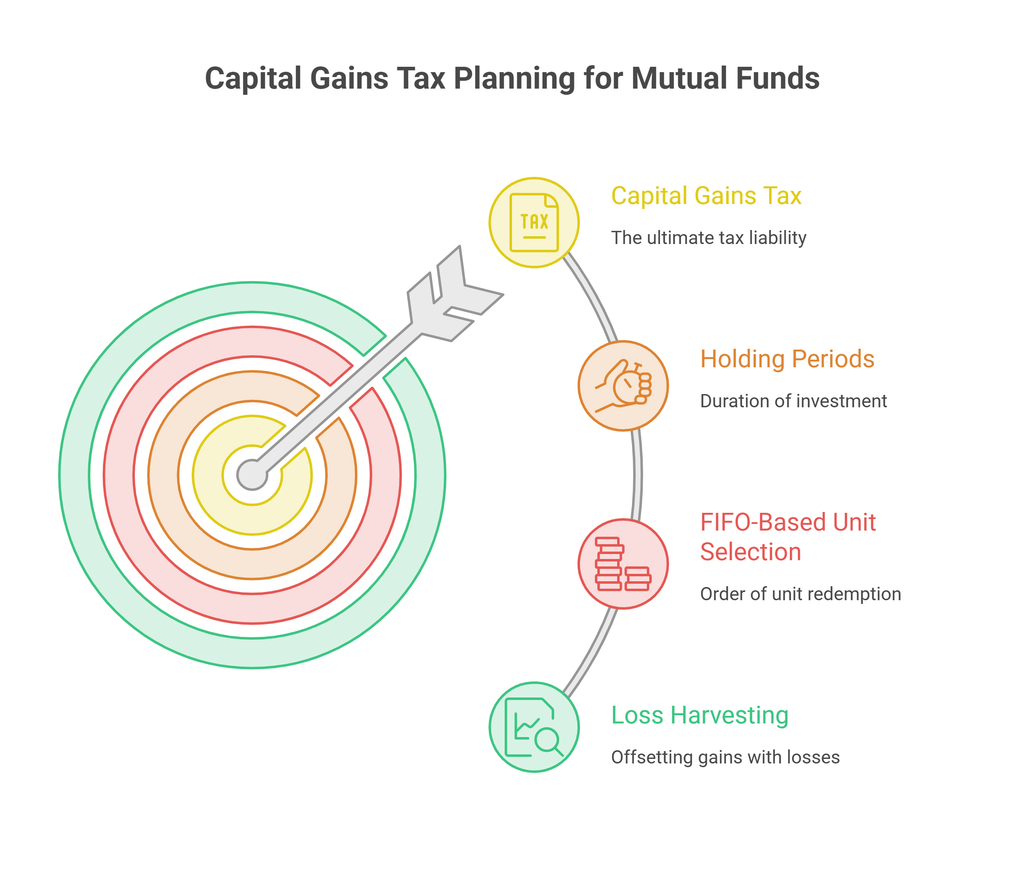
This article explains how holding periods, FIFO-based unit selection, and loss harvesting interact, and how capital gains tax planning for mutual funds can reduce unnecessary tax without compromising your goals.
LTCG vs STCG: The Basics of Capital Gains Tax Planning for Mutual Funds
For equity-oriented mutual funds (schemes investing at least 65% in domestic equity), the Income Tax Act draws a line at 12 months.
These rates, effective 23 July 2024, apply for FY 2025-26 and continue unchanged into FY 2026-27 under Budget 2026, with no indexation available.
Equity Oriented Funds (predominantly debt/money-market instruments)
| Holding Period | Gain Type | Section | Tax Rate |
|---|---|---|---|
| ≤ 12 months | STCG | 111A | Flat 20% |
| > 12 months | LTCG | 112A | 12.5% above ₹1.25 lakh/FY (exemption, not a slab) |
Surcharge (where applicable) and 4% cess apply on top. This should not be generalised across categories — debt, hybrid, and gold/international funds follow their own rules.
Debt-oriented funds (predominantly debt/money-market instruments)
These have no LTCG concept for units bought on or after 1 April 2023 — all gains are taxed at slab rate, regardless of holding period.
| Purchase Date | Holding Period | Tax Treatment |
|---|---|---|
| On/after 1 Apr 2023 | Any | Slab rate (no LTCG, no indexation) |
| Before 1 Apr 2023 | ≤ 24 months | Slab rate (STCG) |
| Before 1 Apr 2023 | > 24 months, sold on/after 23 Jul 2024 | 12.5%, no indexation (LTCG) |
A Section 87A rebate can make tax nil up to ₹12 lakh total income here; the old regime uses a different four-slab structure starting at ₹2.5 lakh.
Hybrid funds
They are taxed by equity allocation, not by label:
| Equity Exposure | Classification | LT Threshold | STCG | LTCG |
| ≥ 65% equity | Equity-oriented | 12 months | 20% | 12.5% above ₹1.25 lakh |
| 35–65% equity | Other-than-equity-oriented | 24 months | Slab rate | 12.5%, no indexation |
| > 65% debt/money-market | Specified (debt) fund | N/A | Slab rate | N/A |
Fund of Funds (FoF)
Follow the underlying scheme’s holdings, not the FoF label.
A domestic FoF investing ≥90% in another equity-oriented scheme qualifies as equity-oriented itself. International equity FoFs and gold/silver FoFs, which don’t meet that test, are non-equity-oriented: slab rate at STCG, and 12.5% LTCG after 24 months — a treatment that has applied since 1 April 2025 (before that, they were taxed at slab rate regardless of holding period).
Why Portfolio Value Alone Fails at Capital Gains Tax Planning
A common mistake is deciding “I need ₹10 lakh, so I’ll sell ₹10 lakh from my biggest fund.”
Taxable gain depends on the gap between sale value and cost of acquisition for the specific units sold — not the fund’s current value.
| Holding | Current Value | Cost of Acquisition | Unrealised Gain |
|---|---|---|---|
| Fund X | ₹10 lakh | ₹4 lakh | ₹6 lakh |
| Fund Y | ₹10 lakh | ₹9.5 lakh | ₹0.5 lakh |
Redeeming from Fund Y produces a far smaller taxable event for the same cash need.
Before redeeming, list per holding: purchase date(s), cost of acquisition, current value, units held, and unrealised gain or loss — this turns redemption into a tax-aware decision rather than a value-based guess.
FIFO: Why You Cannot Simply Choose Which Units to Sell
When units of the same scheme are bought across multiple dates — common with SIPs — Indian practice applies First-In-First-Out (FIFO): the oldest units are treated as redeemed first, for both holding period and cost of acquisition. Depositories (NSDL/CDSL) apply FIFO at the ISIN level for demat-held units; registrars such as CAMS or KFintech likewise generally use FIFO for statement-of-account units.
You generally cannot instruct your AMC, broker, or depository to redeem newer units first to preserve a long-term lot, nor is “specific identification” generally available for retail mutual fund redemptions in India.
If the same scheme sits in two separate folios or demat accounts, each is typically tracked independently, so which account you redeem from can matter, even though FIFO governs order within each.
When unsure, check your account statement.
Tax-Loss Harvesting: Using Losses to Reduce Tax on Gains
Selling a genuinely loss-making holding realises a capital loss that can be set off against gains in the same financial year: short-term losses offset both STCG and LTCG, while long-term losses offset only LTCG.
Unused losses carry forward for eight assessment years, but only against future capital gains, not other income. This is legitimate, but it should never be the sole reason to exit an otherwise sound investment — the holding’s future prospects and your goals should still drive the decision.
Worked Example 1: A ₹50 Lakh Portfolio Across Five Schemes (Hypothetical)
Figures below are illustrative only and do not represent real fund performance.
| Scheme | Current value | Unrealised gain/loss | Holding period |
|---|---|---|---|
| A | ₹12 lakh | ₹6 lakh gain | 3 years (LT) |
| B | ₹10 lakh | ₹0.6 lakh gain | 8 months (ST) |
| C | ₹9 lakh | ₹4 lakh gain | 2 years (LT) |
| D | ₹11 lakh | ₹0.3 lakh gain | 5 months (ST) |
| E | ₹8 lakh | ₹1 lakh loss | 18 months (LT) |
Suppose the investor needs ₹10 lakh:
| Redemption Choice | Gain Type | Taxable Gain | Tax Rate | Tax Payable* |
|---|---|---|---|---|
| ₹10 lakh from Scheme A | LTCG | ₹4.75 lakh (after exemption) | 12.5% | ≈₹59,375 |
| ₹10 lakh from Scheme D (+ balance) | STCG | ≈₹0.27 lakh | 20% | ≈₹5,400 |
There is no single “correct” choice; where the ₹10 lakh comes from changes the tax bill materially, so it’s worth comparing before defaulting to the largest or most convenient holding.
Worked Example 2: Offsetting a ₹10 Lakh Gain With a ₹5 Lakh Loss (Hypothetical)
Assume both Fund A and Fund B are equity-oriented mutual funds, both long-term holdings (over 12 months). Fund A shows a ₹10 lakh gain; Fund B shows a ₹5 lakh loss. Since both are long-term and in the same category, the loss can offset the gain:
| Step | Amount |
|---|---|
| Gross LTCG (Fund A) | ₹10,00,000 |
| Less: LTCG loss set-off (Fund B) | ₹5,00,000 |
| Net LTCG | ₹5,00,000 |
| Less: Annual exemption | ₹1,25,000 |
| Taxable LTCG | ₹3,75,000 |
| Tax at 12.5% (plus cess; surcharge if applicable) | ₹46,875 |
Without the set-off, the same gain (after exemption) would attract ₹1,09,375 — about ₹62,500 more. A long-term loss cannot offset a short-term gain, though a short-term loss can offset either.
Timing Redemptions Across Financial Years
Because the ₹1.25 lakh exemption and loss set-off rules apply per financial year, splitting a large redemption across two years — say, part in March and part in April — can sometimes use two years’ exemption instead of one.
This is a cash-flow tool, not a guaranteed saving, and only makes sense if it doesn’t conflict with when you need the money or delay a goal.
Selling purely to “save tax” against your objectives is usually not worthwhile.
Common Mistakes and the Role of Your Statements (Use Napkin here)
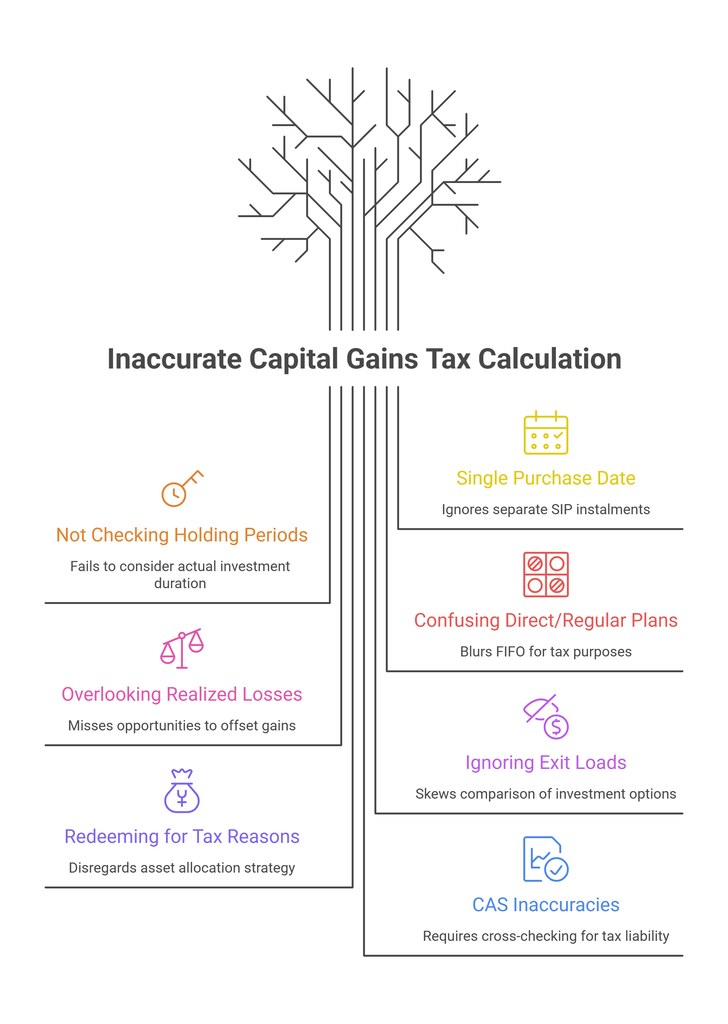
Frequent errors:
- Assuming all units in a scheme share one purchase date (ignoring separate SIP instalments);
- Not checking actual holding periods;
- Confusing direct and regular plans, distinct for FIFO purposes;
- Overlooking realized losses elsewhere that could offset a gain;
- Ignoring exit loads when comparing options; and redeeming purely for tax reasons without regard to asset allocation.
Your CAS (Consolidated Account Statement), AMC/RTA statements, and broker records together show purchase dates, units, cost of acquisition, redemption details, and plan type.
A CAS is a good starting point but doesn’t compute tax liability for you — cross-check figures, especially around plan switches or dividend reinvestments, which create fresh lots.
Year-End Portfolio Review Checklist
A disciplined year-end review is where capital gains tax planning for mutual funds actually pays off:
- List unrealised gains/losses across all holdings, not just totals
- Identify units approaching the 12-month long-term threshold
- Confirm actual purchase dates for each instalment or lump-sum purchase
- Review capital gains already realised this financial year
- Check the ₹1.25 lakh LTCG exemption used or remaining
- Identify genuine loss-harvesting opportunities without compromising quality
- Confirm whether a redemption is actually needed before year-end
- Check if splitting a redemption across financial years helps
- Keep CAS, AMC, and broker statements organised
- Consult a qualified tax professional for complex situations
Want more clarity about NRI and Other queries [ Book a Call ] →

Founder R.S.W. Personal Finance Advisors.
Chartered Wealth Manager (CWM®)
AMFI Registered MFD ARN-244802
APMI Registered PMS Distributor APRN-07002
B.E. (Mechanical ) | PGDM (Marketing) | 9+ years in personal wealth management | Based in Pune
Specialising in Holistic Wealth Management for salaried professionals and NRIs — using the RSW Financial Independence System.
Read more “About Me”