
INTRODUCTION
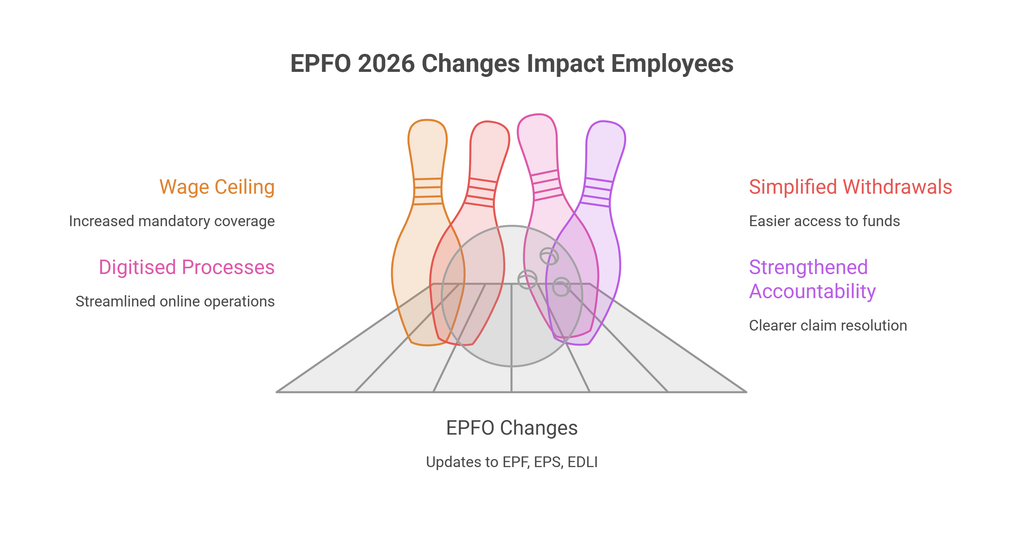
EPFO 2026 new rules bring together updates to the EPF, EPS and EDLI framework, with a focus on simplifying withdrawals, digitising processes and strengthening accountability around claims.
For employees, the most immediately relevant change is the increase in the wage ceiling for mandatory coverage from ₹15,000 to ₹25,000 a month, effective 17 September 2026.
The important point is not simply to know the new rules, but to understand what they mean for your own PF account.
Below are the eight key updates, followed by a practical section on what employees, recent job-leavers and employers should do now.
The 8 Key EPFO Updates
EPF Contribution Rules — Mostly Unchanged, One Number Updated
Employee contribution remains 12% of basic salary, with the employer continuing to match it under the applicable framework.
The mandatory wage ceiling referenced in the scheme is now ₹25,000 a month, updated from ₹15,000 with effect from 17 September 2026.
Contributions above the ceiling have been voluntary where applicable.
Wage Ceiling Can Be Revised Through Notification
The 2026 scheme text refers to the wage ceiling notified by the Central Government rather than hardcoding a particular figure in the scheme. This makes future revisions easier to implement through notification.
For employees, the practical point is to check the current notified ceiling rather than relying on an old ₹15,000 figure.
Withdrawal Rules Simplified: Multiple Reasons Grouped into Three
Withdrawal provisions have been consolidated into three broad categories:
- Essential Needs,
- Housing and
- Special Circumstances.
The supplied source also notes frequency limits for certain purposes, including education and marriage.
The new structure is intended to make eligibility easier to understand rather than requiring employees to navigate many separate provisions.
The New 25–75% Structure
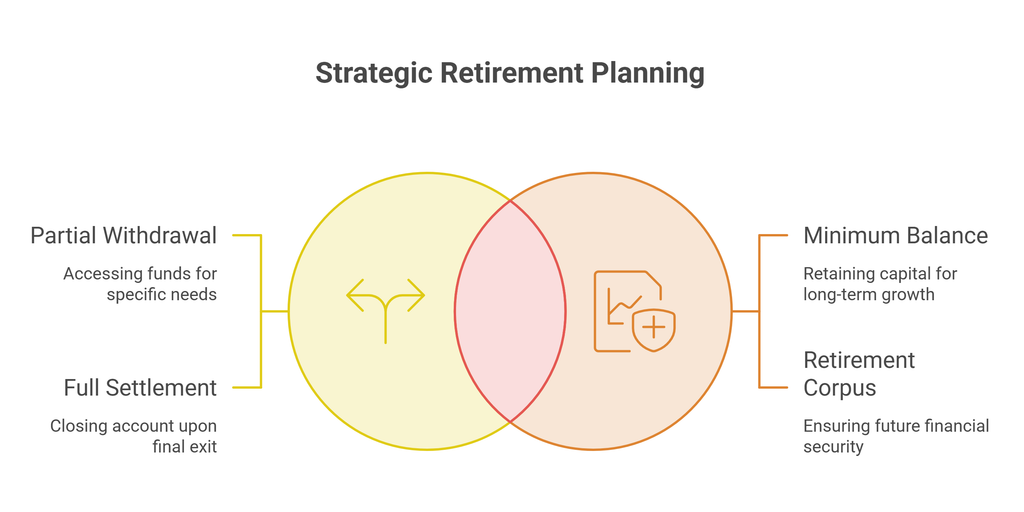
Under the new framework, EPFO retains 25% of your PF balance as a minimum protected balance. You can withdraw up to 75% through partial withdrawals, if you meet the conditions of the relevant category.
Don’t read the ‘75% withdrawal’ headline as an unconditional right to withdraw 75% for any purpose
One 12-Month Service Rule for Most Withdrawals
A uniform 12 months of service applies across most withdrawal categories. Medical withdrawals, which previously had more flexible treatment, are also described in the source as requiring 12 months.
Employees should therefore check both the service requirement and the specific withdrawal category before applying.
Longer Wait After Leaving a Job — But Partial Withdrawal Is Different
Full and final PF withdrawal after leaving a job now requires 12 months of continuous unemployment, compared with the earlier two-month waiting period described in the source.
The EPS pension withdrawal benefit waiting period is also extended to 36 months.
Importantly, the supplied draft distinguishes full closure from partial withdrawal: a person who has left a job should not assume that the entire PF balance is inaccessible for 12 months.
Nomination Goes Digital
Physical Form 2 is being phased out in favour of online e-nomination, which is formally recognised under the new scheme.
Employees who have not completed e-nomination should consider doing so through the EPFO member portal.
A current nomination can make it easier for the family to access applicable PF, pension and EDLI benefits.
Faster PF Claim Settlement With Accountability
The notified standard described in the source is 20 days for complete claims that do not require further verification.
The source also states that unjustified delays beyond the applicable timeline can attract 12% penal interest on the delayed amount, with accountability on the concerned EPFO side.
Employees should retain claim submission records so that a delay can be followed up properly.
Quick Comparison: What Has Changed?
| Area | Earlier position in supplied draft | 2026 position described in source |
|---|---|---|
| Mandatory wage ceiling | ₹15,000/month | ₹25,000/month from 17 Sep 2026 |
| Withdrawal structure | Multiple separate conditions | 3 broad categories |
| Minimum PF balance | No 25% structure described | 25% retained; up to 75% available subject to conditions |
| Most withdrawal service requirement | Varied by purpose | 12 months |
| Full withdrawal after leaving job | 2 months unemployment | 12 months continuous unemployment |
| EPS withdrawal benefit | Shorter waiting period | 36 months |
| Nomination | Physical Form 2 used | Online e-nomination formally recognised |
| Complete claim settlement | Existing service standard | 20-day notified standard described in source |
How to Check Your EPF Withdrawal Eligibility Online
- Visit the EPFO website and open the employee services section.
- Open Member UAN/Online Service to reach the Unified Member Portal.
- Log in with your UAN, password and OTP.
- Go to Online Services → Claim.
- Confirm that EPFO has verified your bank account and linked it to your UAN. Complete KYC if required.
- Choose the relevant claim type: PF Advance, PF Final Settlement or Pension Withdrawal Benefit.
- IIf you have multiple employer records, select the relevant account, unless you have already merged your previous PF accounts.
- Select the applicable withdrawal category. The portal will show the maximum amount you can claim based on the information available.
What Should You Do Now?
The 2026 changes are most useful when translated into a short checklist. Your next step depends on your situation.
| If you are… | Action to take now |
|---|---|
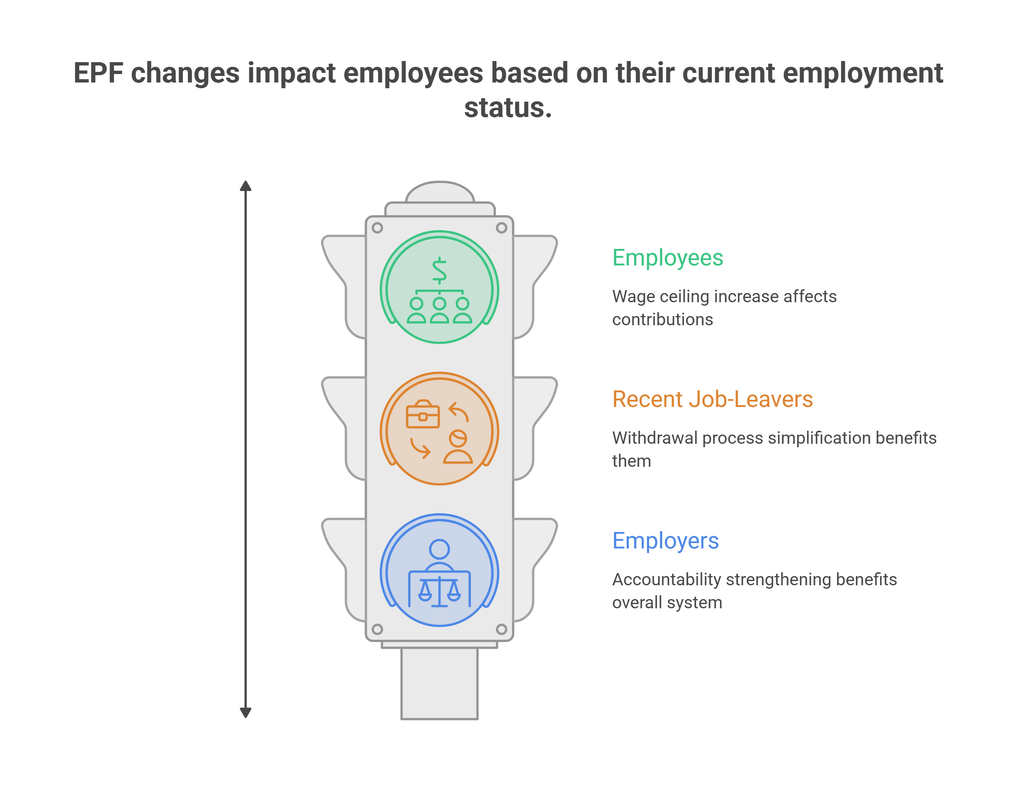
| A new joiner earning ₹15,000–₹25,000/month | Confirm with HR/payroll whether you are now covered under the applicable EPF, EPS and EDLI provisions following the 17 September 2026 wage-ceiling change. |
| An employer / payroll administrator | Review payroll settings and contribution calculations against the new ₹25,000 ceiling and identify employees who may newly fall within mandatory coverage. |
| Recently unemployed | Do not assume the entire PF account is inaccessible for 12 months. Check whether you qualify for a partial withdrawal under the applicable category, while noting that full closure has the longer waiting period described above. |
| Without an e-nomination | Log in to the EPFO member portal and complete your online nomination. Check that your nominee details are current. |
| Planning an education, housing or medical withdrawal | Identify the applicable withdrawal category, check the 12-month service requirement and review the amount shown as eligible on the portal. |
| Waiting for a PF claim | Keep the claim acknowledgement/submission date and monitor the status. If a complete claim remains unresolved beyond the applicable 20-day standard without a valid reason, use the EPFO grievance mechanism to follow up. |
| Any EPFO member | Keep KYC, Aadhaar linkage and bank-account seeding current so that future online services and claims are less likely to face avoidable delays. |
Why These Changes Matter for Personal Financial Planning
PF is not simply a withdrawal account; it is part of a long-term retirement portfolio.
The new 25% minimum-balance concept reinforces that role by retaining a portion of the balance rather than making the entire account immediately available for eligible partial withdrawals.
For someone planning a job change, early retirement or a major expense, the distinction between partial withdrawal and full settlement becomes particularly important.
Instead of assuming that the PF balance can either be fully withdrawn or not touched at all, employees should first determine the purpose, eligibility, amount available and impact on their retirement corpus.
FAQ
The supplied source states that the wage ceiling for mandatory EPFO coverage increased from ₹15,000 to ₹25,000 per month, effective 17 September 2026.
According to the supplied draft, full and final withdrawal requires 12 months of continuous unemployment. Partial withdrawal may remain available under the applicable category and conditions.
No. The 75% figure is an upper availability limit under the described framework, subject to the applicable withdrawal category, service requirement and other conditions. A 25% minimum balance is retained.
The supplied source describes a 20-day standard for complete claims that do not require further verification. Delays should be followed up through the appropriate EPFO mechanism.
Yes, if it has not already been completed. The new scheme formally recognises online e-nomination, and keeping nominee information current is an important administrative step.
First distinguish between full settlement and partial withdrawal. The supplied article notes that the 12-month waiting period applies to full closure, while eligible partial withdrawal remains possible under the applicable rules.
Want more clarity about PF and other Personal Finance Queries [ Book a Call ] →

Founder R.S.W. Personal Finance Advisors.
Chartered Wealth Manager (CWM®)
AMFI Registered MFD ARN-244802
APMI Registered PMS Distributor APRN-07002
B.E. (Mechanical ) | PGDM (Marketing) | 9+ years in personal wealth management | Based in Pune
Specialising in Holistic Wealth Management for salaried professionals and NRIs — using the RSW Financial Independence System.
Read more “About Me”