
Key Takeaways
- Making a will in India ensures your assets go to intended beneficiaries and avoids legal complications after your death.
- A valid will requires your full details, asset lists, executor information, and signatures from witnesses.
- You can write your will without a lawyer, but it should be clear and include both physical and digital assets.
- You must choose an executor wisely and inform them of the will’s location for smooth execution.
- If you die without a will, your estate will follow intestate succession laws, which may not align with your wishes.
Why You Need a Will
You have worked hard to build wealth. It’s important to understand the process of making a will in India to protect your assets for the future.
A Will is the only way to make sure it reaches exactly the people you intend, without delay, confusion, or family disputes.
Without a Will, your assets are distributed by law, not by your wishes.
The process can be slow, expensive, and stressful for the people you leave behind.
The good news: writing a Will takes just a few hours and a piece of paper.
“A Will is not only for the wealthy. Anyone who owns any asset, a bank account, a flat, jewellery, shares, or even a vehicle, should have one “
What Is a Will?
A Will is a written document that states who gets what from your estate after you pass away. The person making the Will is called the Testator. Those who receive the assets are called Beneficiaries or Legatees.
Any Indian who is mentally sound and above 18 years of age can write a Will. There is no stamp duty, no mandatory lawyer, and no court involved in writing one.
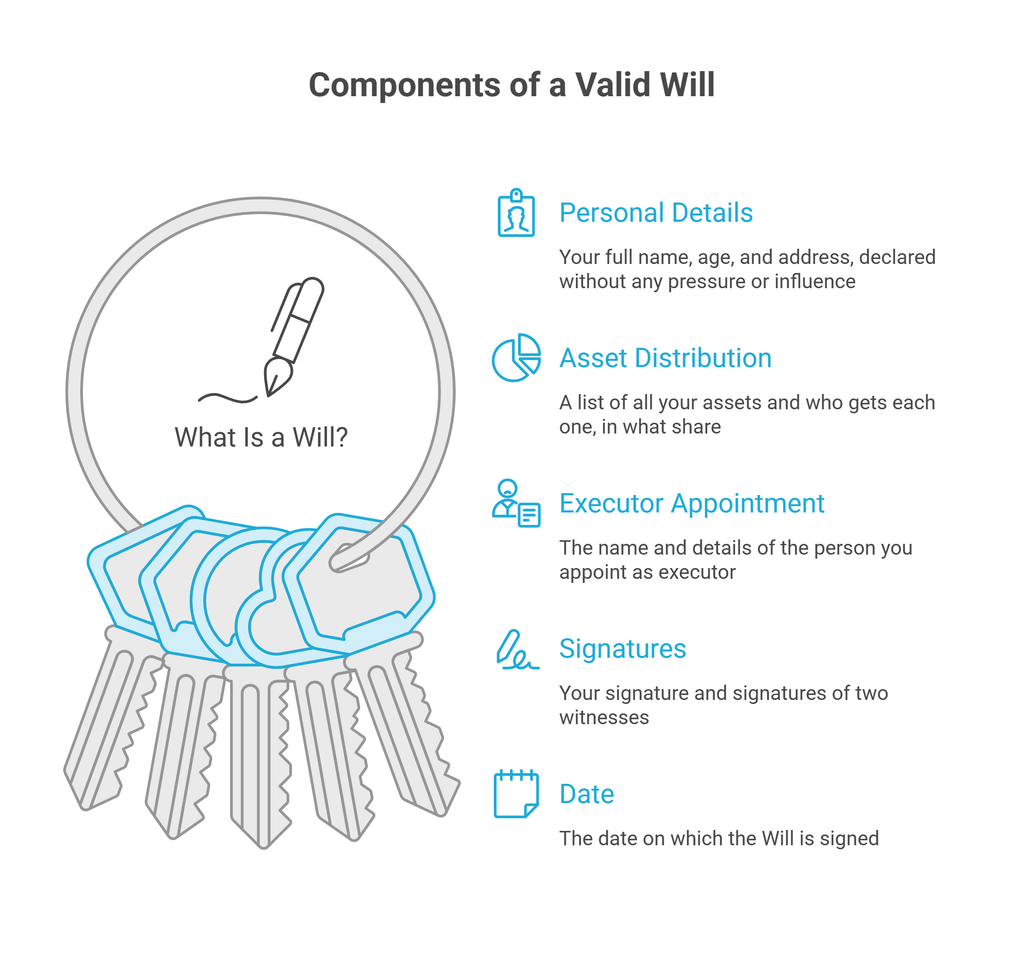
A valid Will should include:
- Your full name, age, and address, declared without any pressure or influence
- A list of all your assets and who gets each one, in what share
- The name and details of the person you appoint as executor
- Your signature
- Signatures of two witnesses
- The date on which the Will is signed
Writing Your Will
Be specific about your assets.
List each asset clearly so there is no room for confusion later.
Fixed deposits, mention the account number or maturity amount.
Jewellery, describe the item and its approximate weight or value.
Shares and mutual funds, mention the percentage each beneficiary should receive rather than a fixed number of units, since quantities change over time.
Identify beneficiaries properly.
Write each beneficiary’s full name, age, address, and relationship to you.
This avoids any dispute if two people share the same name.
Do not forget digital assets.
Cryptocurrency, online investment accounts, monetised websites, and other digital holdings are legally recognised as inheritable property in India (see Section 9).
Include them in your Will. Include them as much detail as possible, platform name, account details and instructions on how your extractor can access them.
You can also include:
- Loans or liabilities that need to be repaid from your estate
- A guardian for your minor children in case both parents pass away
- Instructions for pets or personal collections
Keep access credentials for digital accounts in a sealed envelope with your Will or share them only with your executor.
Do not write passwords directly in the Will itself if it will be seen by witnesses.
Choosing an Executor
The executor is the person who carries out the instructions in your Will — collecting assets, paying off debts, and distributing what remains to the beneficiaries. Naming one makes everything much smoother.
A good executor should be:
- Younger than you, so they are likely to outlive you
- Living in the same city, to handle paperwork without hassle
- Known to all your beneficiaries
- Someone whose permission you have taken before naming them
You can appoint more than one executor, and an executor can also be a beneficiary in the Will.
If you prefer, you can appoint a lawyer or a professional executor.
Signing, Registering, and Storing Your Will
Signing. Sign the Will in the presence of two witnesses.
They do not need to read the Will or know its contents, they are simply confirming that you signed it in their presence. Sign and number every page.
Witnesses cannot be beneficiaries in the Will.
For Older citizens, having a doctor as one witness is a good idea, it makes it harder for anyone to later claim you were not of sound mind.
Registering (optional but recommended).
Registration is not required for a Will to be valid. But a registered Will carries more weight in any dispute and is harder to challenge. To register, visit your nearest Registrar/Sub-Registrar of Assurances office.
Proposed, not yet law:
The Registration Bill, 2025 would digitise document registration nationwide, online submission, e-certificates, and Aadhaar-based e-authentication as one optional verification method among several (no one can be refused registration for lacking Aadhaar).
As of this update, the Bill is still in draft/consultation stage and has not been passed by Parliament. Once it is enacted, registering a Will is expected to become possible without an in-person office visit, but that is not yet the case.
Where to store your Will:
- A bank locker or a personal safe at home
- Upload a copy to DigiLocker (digilocker.gov.in) — courts now treat this as evidence that the document has not been tampered with
- Leave a copy with your executor or a trusted family member Always inform your executor where the original Will is kept.
Updating your Will. You can update your Will at any time. For small changes, attach a signed and witnessed addendum called a Codicil. For major life changes like marriage, divorce, birth of a child, or a significant change in assets, write a fresh Will and destroy the old one.
Probate: What Changed in December 2025
Probate is a court-issued certificate confirming that a Will is genuine and is the deceased’s final testament.
Until late 2025, it was mandatory under Section 213 of the Indian Succession Act, 1925 (Only for Hindu, Jain, Sikh, Buddhist and Parsi Testators and only where the will was made in, or dealt with property in Mumbai, Kolkata or Chennai.
Implemented change: The Repealing and Amending Act, 2025 (Act No. 37 of 2025, presidential assent on 20 December 2025) omitted Section 213 entirely.
Mandatory probate no longer exists anywhere in India, for any community. Executors can now act on a valid Will directly, collecting assets and distributing them, without first obtaining a court order, unless someone contests the Will.
Probate remains available on a voluntary basis and may still be worth seeking if you expect disputes, if the estate is large and complex, or if a bank or land registry insists on it as a matter of internal policy even though the law no longer requires it.
To pursue probate, submit an application to the relevant court through a lawyer.
What Happens If You Die Without a Will?
If you do not leave a Will, your estate (Properties, Cash and associated wealth) is distributed according to the succession law that applies to your religion.
The table below summarises which law applies:
| Religion | Law when Will exists | Law when no Will (intestate) |
|---|---|---|
| Hindu, Jain, Sikh, Buddhist | Indian Succession Act, 1925 | Hindu Succession Act, 1956 |
| Christian, Parsi, Jewish | Indian Succession Act, 1925 | Indian Succession Act, 1925 |
| Muslim | Muslim Personal Law (Shariat) Application Act, 1937 | Muslim Personal Law (Shariat) Application Act, 1937 |
| Interfaith marriages | Special Marriage Act, 1954 | Special Marriage Act, 1954 |
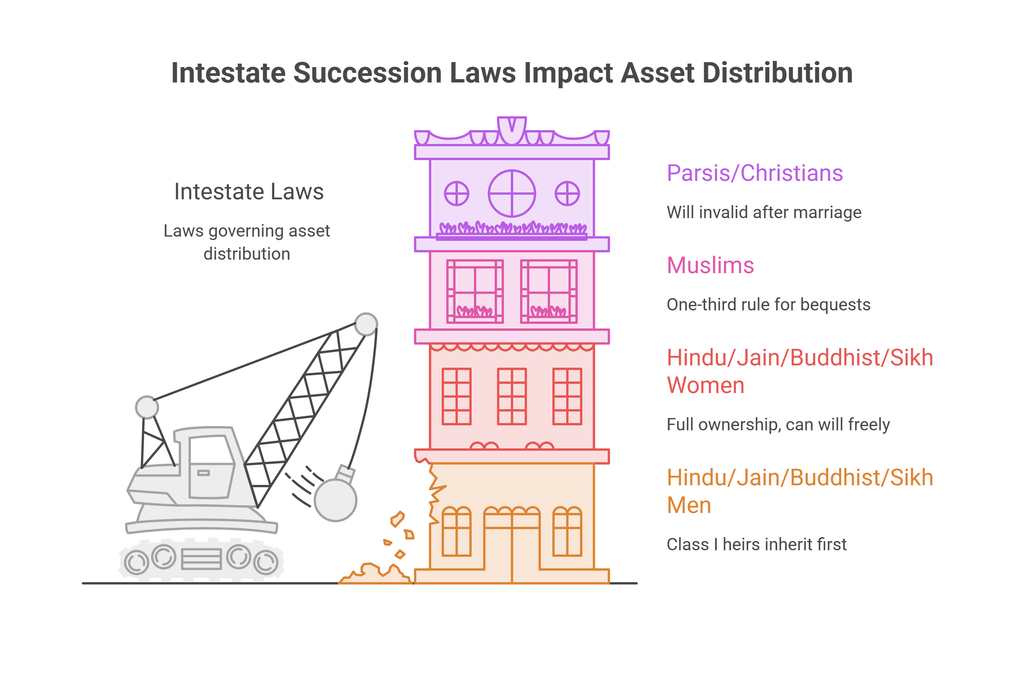
For Hindu, Jain, Buddhist, and Sikh men (dying intestate):
Assets go first to Class I heirs, Spouse, children, mother, and certain descendants of pre-deceased children.
Only if there are no Class I heirs do Class II heirs (father, siblings, and their descendants) inherit.
If neither class exists, assets pass to more distant relatives, and ultimately to the government.
A Hindu man cannot transfer ancestral (inherited) property to anyone outside his legal heirs through a Will.
Sons and daughters have equal rights under the Hindu Succession (Amendment) Act, 2005.
For Hindu, Jain, Buddhist, and Sikh Women (dying intestate):
A Hindu woman has full ownership of all property, both self-acquired and inherited, and can leave it to anyone through a Will.
Without a Will, her assets go to her children first, then her husband, and then progressively to the heirs of her husband and her parents.
For Muslims — the one-third rule.
Unlike Hindu, Christian, or Parsi testators, a Muslim does not have unrestricted freedom to will away their estate.
Under Muslim personal law (Wasiyat), a testator can bequeath only up to one-third of their net estate (after debts and funeral expenses) without needing anyone’s consent, and even that one-third is generally meant for non-heirs.
Bequeathing more than one-third, or bequeathing any amount to someone who is already a legal heir, requires the consent of all other legal heirs, given after the testator’s death.
A Will that exceeds these limits is not void outright, courts scale it back to what the law permits unless the heirs agree otherwise (Indian courts, including the Madras and Chhattisgarh High Courts, have repeatedly upheld this).
This limit does not apply if the Muslim has married under the Special Marriage Act, 1954, in which case the Indian Succession Act’s testamentary freedom applies instead.
For Parsis and Christians:
Any Will made before marriage is automatically invalid after marriage.
These communities must write a fresh Will after they wed. This rule does not apply to Hindus, Sikhs, Jains, or Buddhists.
Nominee vs. Heir: Who Actually Inherits?
Many people assume that appointing nominees everywhere is enough. It is not.
A nominee’s role is primarily to collect the asset from the institution after your death and hand it over to the rightful heirs.
In most cases, the nominee is a custodian, not an owner — the Will (or succession law, if there is none) decides who actually inherits.
| Asset Type | What the Nominee Can Do | Who Actually Inherits |
|---|---|---|
| Property (flat, land) | Nothing — property has no “nominee” mechanism in the same sense | The Will, or succession law if there is none |
| Life insurance | Receives the payout as beneficial owner — the main exception | Usually the nominee, unless the Will names a different beneficiary, which can override this depending on circumstances |
| Shares and demat accounts | Collects the holdings from the depository/registrar | Legal heirs — courts have confirmed the nominee is only a custodian |
| Mutual funds (SoA or demat) | Collects the units from the AMC/RTA or depository | Legal heirs, under the Will or succession law |
| Bank accounts (single holder) | Collects the balance from the bank | Legal heirs, under the Will or succession law |
| Joint bank/demat accounts | Not relevant while both holders are alive | The surviving joint holder, automatically— the nominee only comes into play after both holders have died |
Think of a nominee as a bridge that gets your assets safely out of an institution.
Your Will then decides where they go from there.
Both work best together, name nominees on every account and write a Will that clearly states who the final beneficiary should be, so there is no ambiguity between the two.
Also worth knowing: The Digital Personal Data Protection Act, 2023 allows you to separately appoint a nominee to manage your personal digital data, emails, photos, social media, after your death.
This is distinct from your financial Will and covers privacy, not property.
Digital Assets and Your Will
If you hold cryptocurrency, maintain online investment accounts, run a monetised website, or own digital content, these are part of your estate, and you need to plan for them.
In October 2025, the Madras High Court, in Rhutikumari v. Zanmai Labs Pvt. Ltd. (the WazirX case), became the first Indian High Court to rule that cryptocurrency is “property” under Indian law, capable of being owned, possessed, and held in trust.
While that specific case was about protecting frozen exchange holdings rather than inheritance directly, the ruling strengthens the position that crypto forms part of a deceased person’s estate, and exchanges do not automatically transfer holdings simply on production of a death certificate, so clear instructions matter.
What to include in your Will for digital assets:
- Name of each platform or exchange (e.g. WazirX, Zerodha, CoinDCX)
- The type of asset held (crypto, stocks, bonds, NFTs)
- Instructions for access, kept in a sealed envelope with your Will or with your executor
- Name of the beneficiary for each digital asset
Do You Need a Trust As Well as a Will?
For most people, a Will is enough.
But a Will only takes effect after death and hands asset over outright, it cannot manage money on an ongoing basis.
A trust may be worth discussing with an estate-planning professional alongside your Will if:
- You have a minor beneficiary and want assets managed until they reach a certain age, rather than handed over as a lump sum
- You have a dependent with a disability who needs lifelong, structured financial support
- Your estate is large or spans multiple properties/businesses and you want to avoid delays or disputes during administration
- You are in a blended family and want to balance the interests of a current spouse and children from an earlier relationship
A trust does not replace a Will, most people who set up a trust still need a Will for whatever isn’t placed into it. Setting one up involves separate documentation and, unlike a basic Will, generally does need professional legal help.
Quick Checklist Before You Sign
- Have I listed all assets, physical and digital?
- Have I named each beneficiary with full details (name, age, address)?
- If any beneficiary is a minor, have I appointed a custodian for their share?
- Have I named an executor and taken their consent?
- Have I signed in the presence of two non-beneficiary witnesses?
- Is every page numbered and signed?
- Have I dated the Will and stated that it overrides all earlier Wills?
- Have I destroyed all previous versions?
- Does my executor know where the original Will is kept?
Sample Will
Use this as a starting point. Replace everything in square brackets with your own details.
This sample is for reference only and is not legal advice. If your estate is large, includes multiple properties, business interests, or significant digital assets, we recommend consulting a qualified estate planning lawyer.
WILL
I, [Full Name], aged [Age], residing at [Full Address], being of sound mind and memory, declare this to be my last Will. I revoke all earlier Wills and Codicils made by me.
I make this Will freely, without any pressure or influence.
I am married to [Spouse’s Name], aged [Age]. We have [number] children: [names and ages].
Executor: I appoint [Name, Age, Address, Relationship] as the executor of this Will.
My bequests are as follows:
- I leave my property at [address] to [beneficiary/beneficiaries]. They may sell it or pass it to their heirs.
- I leave all jewellery in my bank locker at [bank name, locker number] to [beneficiary name].
- I leave my car [model, licence number] to [beneficiary name].
- I wish my shares, mutual funds, and demat holdings (account number: [number]) and life insurance proceeds (policy number: [number], sum assured: [amount]) to be divided as follows: [names and percentages].
- I leave [any other asset] to [beneficiary name, age, address].
Digital assets:
- I hold cryptocurrency on [exchange name]. Access details are in [location]. I leave these to [beneficiary name].
- I hold [other digital assets] at [platform]. I leave these to [beneficiary name]. Signature of Testator: Date:
Witness 1 — Signature: Name:
Address:
Witness 2 — Signature: Name:
Address:
FREQUENTLY ASKED QUESTIONS
No. Registration is optional and does not affect the Will’s validity.
A registered Will is simply harder to challenge and carries more evidentiary weight if there is ever a dispute.
Yes. A Will does not need stamp paper and does not require a lawyer to be valid.
It only needs to be in writing, signed by the testator, and attested by two witnesses.
Professional help is still worth it for larger or more complex estates.
No, except for life insurance in most cases. For property, shares, mutual funds, and bank accounts, a nominee is only a custodian who collects the asset from the institution — the Will (or succession law, if there’s no Will) determines who ultimately owns it.
No.
Under Muslim personal law, a Will can generally dispose of only up to one-third of the net estate without the heirs’ consent; anything beyond that, or any bequest to an existing legal heir, needs the other heirs’ consent after the testator’s death.
This is different from Hindu, Christian, or Parsi testators, who have full testamentary freedom.
Your estate is distributed under the intestate succession law that applies to your religion — the Hindu Succession Act, 1956 for Hindus, Jains, Sikhs and Buddhists; the Indian Succession Act, 1925 for Christians and Parsis; and Muslim personal law for Muslims.
This can result in assets going to relatives you did not intend, and the process is typically slower than administering a clear Will.
Begin your rebalancing review for you Portfolio [ Book a Call ] →

Founder R.S.W. Personal Finance Advisors.
Chartered Wealth Manager (CWM®)
AMFI Registered MFD ARN-244802
APMI Registered PMS Distributor APRN-07002
B.E. (Mechanical ) | PGDM (Marketing) | 9+ years in personal wealth management | Based in Pune
Specialising in Holistic Wealth Management for salaried professionals and NRIs — using the R.S.W. Financial Independence System.
Read more “About Me”
Estimated reading time: 14 minutes