
1. What is Financial Freedom and Why It Matters in Today’s World
Financial prosperity is not just about collecting wealth; it is about freedom from money worries.
To define financial freedom in simple terms, it means having enough savings, assets, and income to support your lifestyle without depending on a job.
It is the point where money no longer controls your decisions — instead, you control how money is used.
2. Why Financial Freedom Matters in Today’s World
The question is: why financial freedom matters in today’s world.
With uncertain markets, rising costs, and unstable jobs, financial freedom brings stability.
It provides peace of mind, helps you face unexpected challenges, and gives you the confidence to take opportunities without fear of money problems.
3. The Difference Between Financial Independence & Financial Freedom
It is also important to know the difference between financial independence and financial freedom. Independence means covering your basic needs through savings or passive income, without relying on a paycheck. Freedom goes further — it offers security, flexibility, and the ability to follow your passions without sacrifice. Independence gives sufficiency, while freedom creates abundance — a life shaped by choice, not by necessity.
True financial freedom is not about luxury; it is about strength and control. It is building a future where money is no longer a limit.
4.The F.R.E.E.D.O.M Model — A Framework for Financial Independence
Achieving financial freedom is not a matter of luck or income alone. It is the resul2t of following a structured, step-by-step framework — one that addresses every dimension of your financial life in the right sequence.
F — Foundation
Set your Life Goals — both short-term and long-term. Every financial decision must be anchored to a specific goal. Without a clearly defined foundation of goals, investing becomes directionless and discipline becomes impossible to sustain.
R — Responsibility
Get rid of high-interest debt. Debt — particularly credit card debt, personal loans, and high-cost borrowings — silently erodes your wealth faster than any investment can build it. Eliminating high-interest obligations is the first act of financial responsibility.
E — Earnings
Create multiple sources of income. A single salary is a single point of failure. Building supplementary income streams — through investments, side income, rental yield, or skill-based consulting — accelerates the journey to financial freedom and reduces dependence on employment alone.
E — Expert Guidance
Hire the services of a qualified financial advisor for holistic planning. A Chartered Wealth Manager brings structure, objectivity, and expertise that transforms a collection of random investments into a coordinated wealth plan aligned with your life goals.
D — Discipline
Pay yourself first — save and invest before you spend. The most powerful wealth-building habit is not earning more but consistently directing a defined percentage of every income inflow toward your financial goals before lifestyle expenses consume it.
O — Opportunities
Invest for contingencies, retirement, and healthcare. Financial freedom requires proactive preparation for life’s largest and most predictable expenses — a retirement that may last 25–30 years, healthcare costs that rise with age, and contingencies that arrive without warning.
M — Mindset
Embrace long-term thinking and consistency. Wealth is not built in a quarter — it is built over decades. The investor who stays invested through market cycles, avoids panic-driven decisions, and maintains consistency in their savings discipline will always outperform the investor who chases short-term returns.
4a. Stages of Life and Financial Freedom Planning
1. Early Career (20s – Early 30s)
Characteristics: First job, limited income, high aspirations, exposure to debt (education loans, credit cards).
- Build an emergency fund (3–6 months of expenses).
- Avoid high-interest debt; pay credit cards in full.
- Start investing early (mutual funds, retirement accounts).
- Buy essential health and term insurance.
- Focus on skill development to increase income.
2. Mid-Career (30s – Early 40s)
Characteristics: Higher earnings, family responsibilities, home loans, children’s education.
- Expand emergency fund to cover 6–12 months of expenses.
- Continue SIP investments for wealth creation.
- Create a family protection plan (life insurance, health insurance for dependents).
- Start saving for children’s education and higher goals.
- Avoid lifestyle inflation; live below means despite rising income.
3. Peak Earning Years (40s – Early 50s)
Characteristics: Highest income years, multiple financial commitments, but also opportunity for serious wealth building.
- Aggressively repay debts (home, education).
- Maximise retirement contributions (EPF, NPS, mutual funds).
- Diversify investments into equity, debt, and real estate.
- Review and update estate planning (will, nomination, trusts).
- Protect against health risks with adequate insurance coverage.
4. Pre-Retirement (50s – Early 60s)
Characteristics: Debt should be nearly eliminated, retirement planning takes priority.
- Focus on capital preservation along with growth.
- Rebalance portfolio to reduce risk exposure.
- Build retirement corpus that can generate passive income.
- Plan healthcare contingencies (medical insurance, long-term care).
- Prepare for succession: wills, trusts, and wealth transfer structures.
5. Retirement (60s – 70s)
Characteristics: No active employment, reliance on retirement corpus and passive income.
- Create a monthly withdrawal strategy from retirement funds.
- Rely on low-risk, income-generating investments (annuities, bonds, dividend-paying funds).
- Maintain liquidity for medical and lifestyle needs.
- Simplify financial portfolio for ease of management.
- Ensure estate planning documents are in place and updated.
6. Legacy Stage (70s and Beyond)
Characteristics: Focus shifts from accumulation to preservation and transfer of wealth.
- Ensure financial independence without relying on children.
- Consolidate assets and simplify accounts.
- Regularly review estate plan (will, trust, nominations).
- Consider charitable giving or philanthropy if aligned with values.
- Communicate clearly with family to avoid disputes
5. Core Principles of Financial Freedom
5. Core Principles of Financial Freedom
Financial freedom is not achieved through a single smart investment or a fortunate market timing. It is built on four foundational pillars — each one essential, each one interdependent. Remove any one of these pillars and the structure weakens. Build all four with discipline and your journey to financial independence becomes a matter of time, not chance.
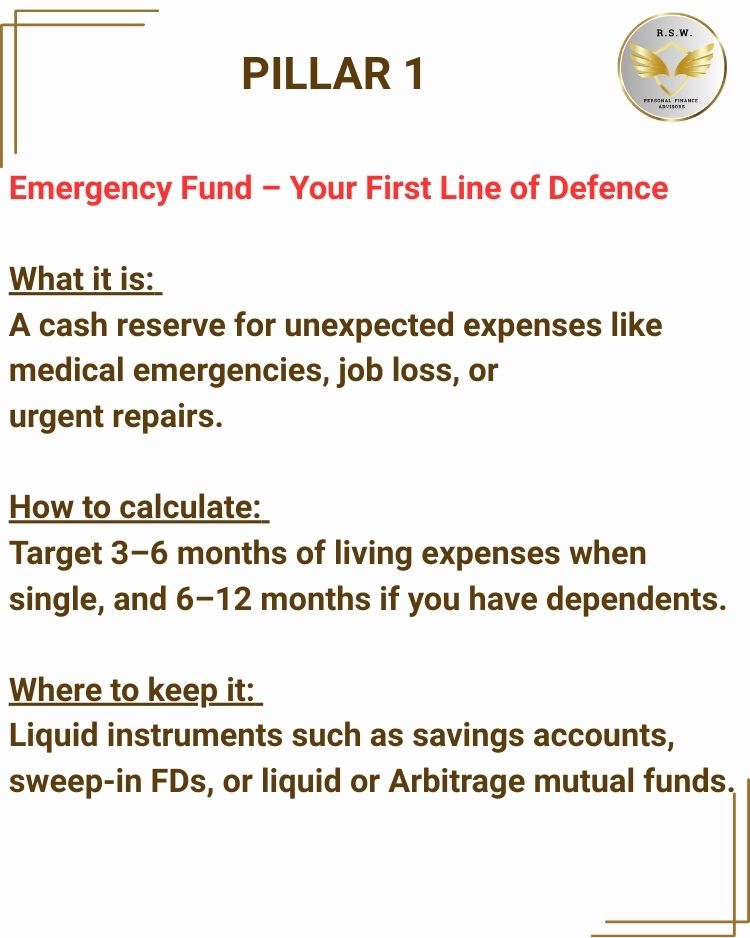
Pillar 1 — Emergency Fund: Your First Line of Defence
Before you invest a single rupee in equity, debt, or any other instrument, one financial foundation must be non-negotiable: a fully-funded emergency fund. It is not an investment. It is protection — the financial buffer that stands between an unexpected crisis and a derailed wealth plan.
What it is
A cash reserve set aside exclusively for unexpected expenses — medical emergencies, sudden job loss, urgent home or vehicle repairs, or any unplanned financial shock that life delivers without warning. This money is not meant to grow. It is meant to be available instantly, without penalties, and without requiring you to liquidate your investments at the wrong time.
How to calculate your emergency fund target
The right size of your emergency fund depends on your personal situation:
- If you are single with no dependents: Target 3–6 months of your total monthly living expenses.
- If you have dependents — spouse, children, or parents: Target 6–12 months of living expenses. The more people who depend on your income, the larger your buffer needs to be.
- If you are self-employed or in a variable income profession: Target a minimum of 12 months regardless of dependents — income unpredictability demands a larger safety net.
Calculate this on your actual monthly expenses — not your income. Include rent or EMI, groceries, utilities, school fees, insurance premiums, and essential transportation. Do not include discretionary spending like dining out or holidays.
Where to keep it
Your emergency fund must be liquid — accessible within 24 hours without penalty or market-linked risk. Appropriate instruments include:
- Savings account: Instant access, zero risk, but low returns of 3–4% per annum.
- Sweep-in Fixed Deposits: Linked to your savings account, automatically activated when the balance falls below a threshold. Offers better returns than a plain savings account while maintaining liquidity.
- Liquid Mutual Funds: Redemption typically processed within 1 business day. Returns of 6–7% per annum historically — significantly better than a savings account with comparable liquidity.
- Arbitrage Mutual Funds: Taxed as equity funds (LTCG at 12.5% after 1 year) while carrying debt-like risk. An efficient choice for investors in higher tax brackets who want better post-tax returns on their emergency reserve. Read our complete guide on where to park your emergency fund →
What your emergency fund should never be: Fixed deposits with long lock-in periods, equity mutual funds, stocks, real estate, or any instrument where accessing the money quickly either incurs a penalty or depends on market conditions at the time of withdrawal.
An emergency fund is not a financial decision. It is a commitment to protecting every other financial decision you make. Without it, one medical bill or one month of job loss can unwind years of disciplined investing.
Pillar 2 — Insurance: Protection Against Uncertainty
An emergency fund protects you from small financial shocks. Insurance protects you from catastrophic ones. No wealth plan is structurally sound without adequate coverage across three dimensions — health, life, and income.
Health Insurance
Rising medical costs are one of the most reliable destroyers of accumulated wealth in India. A single hospitalisation without adequate health cover can wipe out years of savings in days. Health insurance covers these rising medical costs and shields your investment portfolio from being liquidated to fund a medical emergency.
Important: Do not rely solely on your employer’s group health insurance. Corporate cover ends the day your employment ends — precisely when you may need it most. A personal health insurance policy is non-negotiable regardless of your employer cover. Read why term insurance is the first step in wealth planning →
Life Insurance — Term Plan
A term plan provides financial security for your dependents in the event of your premature death. It is the simplest, most cost-efficient form of life insurance — a large cover at a low premium with no investment component complicating the structure.
The RSW recommended coverage: a term plan of 15–20 times your annual income, active until your youngest dependent is financially independent or until your retirement corpus is fully built — whichever comes later. Do not conflate insurance with investment. ULIPs and endowment plans are neither good insurance nor good investments — a pure term plan does the protection job far more efficiently.
Disability Insurance
The most overlooked protection in Indian financial planning. Disability insurance ensures income replacement if you are unable to work due to an accident or illness — a risk that is statistically more likely than premature death during your working years yet almost universally unaddressed.
For a salaried professional whose entire wealth plan depends on continued income, the inability to work for 6–12 months without income replacement cover is a structural vulnerability. Review your employer’s disability benefit, and if it is insufficient, consider a standalone personal accident and disability policy.
Insurance is not an expense. It is the cost of protecting every other financial decision you make. A wealth plan without adequate insurance is a plan with a structural hole that one event can collapse entirely.
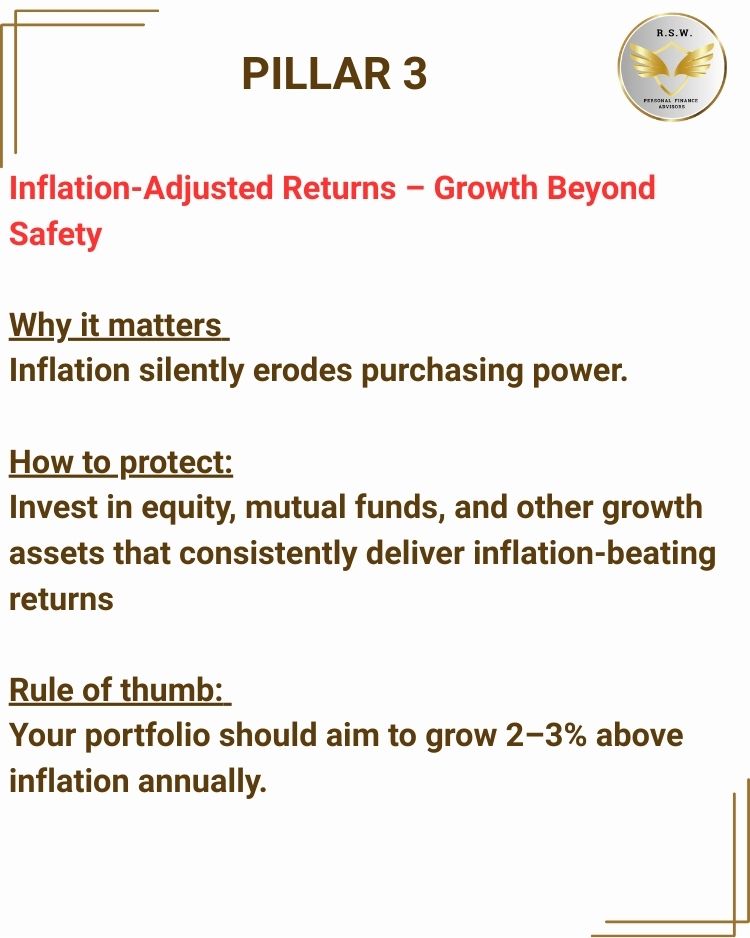
Pillar 3 — Inflation-Adjusted Returns: Growth Beyond Safety
Keeping your money safe is not enough. Money that does not grow faster than inflation is quietly losing purchasing power every year. This is the invisible tax that erodes the real value of conservative portfolios over time — and it is the reason why safety alone cannot be the basis of a financial freedom strategy.
Why it matters
Inflation in India has historically averaged 6–7% per annum. This means that ₹100 today will have the purchasing power of approximately ₹54 in 10 years if kept in an instrument that earns less than inflation. A savings account earning 3.5% in a 6% inflation environment is not a safe choice — it is a guaranteed slow loss of real wealth.
For long-term goals like retirement — where your corpus must fund 25–30 years of expenses after you stop earning — inflation is not a peripheral risk. It is the central risk that determines whether your corpus survives your lifetime.
How to protect your wealth from inflation
Invest in equity mutual funds, direct equity, and other growth-oriented assets that consistently deliver inflation-beating returns over long investment horizons. Indian equity markets — as measured by the Nifty 50 — have delivered approximately 12–14% CAGR over 20-year rolling periods, comfortably exceeding inflation across every long-term window.
The key instruments for inflation-beating growth within the RSW Financial Independence System™:
- Equity Mutual Funds — Flexi cap, multi cap, and index funds for long-horizon goal funding
- Direct Equity via Smallcase — Theme-based and factor-based equity exposure for investors ready to graduate beyond standard mutual funds. Read our guide on Smallcases in wealth management →
- Gold ETFs — Partial inflation hedge and portfolio diversifier
- NPS Equity allocation — Tax-efficient long-term equity exposure specifically for retirement corpus building
The RSW rule of thumb
Your overall portfolio should aim to grow at 2–3% above inflation annually on a real, after-tax basis. This means targeting a nominal return of approximately 9–10% per annum on a diversified portfolio — not chasing 20–30% short-term returns, but maintaining consistent, disciplined, inflation-beating growth over decades.
The goal is not to beat the market. The goal is to beat inflation — consistently, tax-efficiently, and with enough discipline to stay invested through every cycle that tests your conviction.
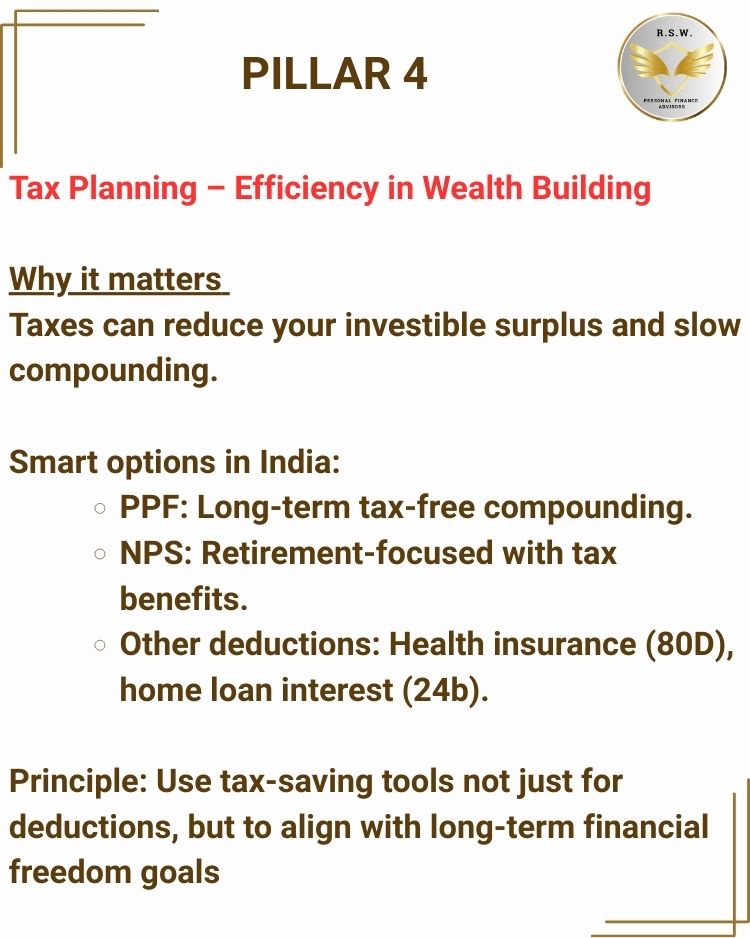
Pillar 4 — Tax Planning: Efficiency in Wealth Building
Two investors with identical incomes, identical investments, and identical returns can arrive at retirement with meaningfully different corpus sizes — purely because one planned their taxes and the other did not. Tax efficiency is not a peripheral concern in wealth building. It is a core lever that directly determines how much of your gross return you actually keep.
Why it matters
Taxes reduce your investible surplus at the point of earning and reduce your accumulated corpus at the point of withdrawal. Every rupee unnecessarily paid in tax is a rupee that does not compound for the next 10, 15, or 20 years. At a 12% compounding rate, ₹1 lakh of unnecessary tax today becomes ₹3.1 lakh of lost corpus in 10 years and ₹9.6 lakh in 20 years.
For a salaried professional earning ₹20–60 lakh annually, disciplined tax planning can legitimately reduce annual tax outgo by ₹1.5–3 lakh — money that, if invested systematically, meaningfully accelerates the journey to financial independence.
Smart tax-saving options in India
- PPF — Public Provident Fund: Long-term tax-free compounding under the EEE (Exempt-Exempt-Exempt) structure — contributions, returns, and maturity are all tax-free. A 15-year lock-in makes it a forced long-term savings discipline. Ideal as a debt component of your retirement corpus with sovereign safety and tax-free returns.
- NPS — National Pension System: Retirement-focused with tax benefits under Section 80CCD(1B) — an additional ₹50,000 deduction over and above the Section 80C limit. The new Multiple Scheme Framework offers greater flexibility in fund manager selection. Read our complete NPS strategy guide →
- Health Insurance Premium — Section 80D: Deduction of up to ₹25,000 for self and family, and an additional ₹25,000–₹50,000 for parents depending on their age. A deduction that pays you to do something you should be doing anyway.
- Home Loan Interest — Section 24(b): Deduction of up to ₹2 lakh per annum on home loan interest for a self-occupied property. For salaried professionals with an active home loan, this is one of the largest available deductions.
- ELSS — Equity Linked Savings Scheme: Tax deduction under Section 80C with the shortest lock-in of 3 years among all 80C instruments, combined with equity market returns. The most investment-efficient of all Section 80C options for long-term wealth builders.
The RSW tax planning principle
Use tax-saving instruments not merely as a last-minute March exercise to reduce this year’s tax bill — but as deliberate, goal-aligned investments that serve your long-term financial freedom objectives. PPF is not just a tax saving — it is your debt foundation. NPS is not just a deduction — it is your retirement corpus. ELSS is not just an 80C instrument — it is your equity allocation with a tax benefit attached.
Tax planning and wealth planning are not separate activities. In the RSW Financial Independence System™, every tax-efficient instrument is evaluated for its role in your overall portfolio architecture — not just its deduction value.
The most powerful tax saving strategy is not finding more deductions. It is building a portfolio where every rupee is working efficiently — growing, compounding, and being withdrawn in the most tax-efficient way possible across your entire financial lifetime.
Putting All Four Pillars Together
These four pillars do not operate independently — they reinforce each other. Your emergency fund protects your investments from forced liquidation. Your insurance protects your emergency fund from being depleted by catastrophic events. Your inflation-beating investments grow the corpus that funds your goals. And your tax planning ensures the maximum possible share of that growth stays in your hands.
This is the structural foundation of the RSW Financial Independence System™ — four pillars, built in sequence, maintained with discipline, reviewed annually.
A salaried professional who has all four pillars in place is not just investing — they are building financial independence with structural integrity.
Are All Four Pillars in Place in Your Financial Plan?
Most salaried professionals have some of these pillars partially built — an emergency fund that is too small, an insurance cover that has not kept pace with income growth, investments that are not inflation-adjusted, and tax planning that happens in a rush every March.
A structured review takes 60 minutes and tells you exactly where the gaps are — and what to do about them, in the right sequence.
Book your free 1-hour Financial Independence
Planning call with Nitin Wali, Chartered Wealth Manager,
Pune.
No commitment. No sales pitch. Just a clear, structured
assessment of where your four pillars stand today.
Book Your Free Planning Call → | WhatsApp Nitin Directly →

Also Read : ” PPF : An must have investment for a Truly Diversified Portfolio ”
Also Read : NPS : An Essential investment.
“Financial freedom is not a destination you reach by accident. It is the result of a structured plan, executed with discipline, reviewed annually, and adjusted as your life evolves. If you are a salaried professional between 30 and 50 and you are serious about building that structure — let us talk.
The first conversation is completely free. No sales pitch. No product pushing. Just clarity on where you stand and what your path to financial independence looks like.”
[Book Your Free 1-Hour Planning Call →]

Founder R S W Personal Finance Advisors.
B.E , PGDM [Marketing] ,
Chaterered Wealth Manager,
PMS Disributor, Mutual Fund Distributor.
Passionate about Personal Wealth Management. Practising 4+ Years.
Read more about me & my mission.