
1. Introduction: The Wealth Plan That Almost Collapsed
Rohit, a 38-year-old senior manager, had done everything most financial advisors recommend.
- SIPs in equity mutual funds
- A growing retirement corpus
- A home nearing completion
- Two children whose education planning had already begun
On paper, Rohit was doing excellent wealth planning.
But during a financial review, one question changed the conversation:
1a. What happens to this entire wealth plan if Rohit is not around tomorrow?
The answer was uncomfortable.
- Investments would stop
- Future goals would remain unfunded
- The family would struggle to maintain their lifestyle
This is where many people misunderstand wealth planning.
Wealth is not built by investments alone.
Wealth is built by income invested consistently over time.
If income disappears prematurely, the wealth creation journey collapses.
This is why the RSW Financial Independence Framework begins with protection.
Term insurance protects the income that fuels wealth creation.
2. Human Capital vs Financial Capital
Term insurance protects human capital until financial capital becomes sufficient.
| Life Stage | Human Capital [Your ability to earn money from your work] | Financial Capital [money and investments you already have] |
|---|---|---|
| Early Career | Very High – Strong earning potential over many years | Very Low – Limited investments accumulated |
| Mid Career | High but gradually declining | Growing steadily through savings and investments |
| Late Career | Declining as retirement approaches | High due to accumulated assets and investments |
This concept sits at the core of the Risk Protection stage in the RSW Financial Independence Framework.
3. What is Term Insurance?
Term insurance is the simplest form of life insurance. It provides pure financial protection.
If the policyholder dies during the policy term, the insurer pays the sum assured to the family.
Key characteristics include:
- No savings component
- No investment return
- Pure life protection
Because it focuses only on protection, term insurance offers large coverage at relatively low premiums.
Its purpose is simple: Protect the income that builds wealth.
4. The Core Insight: Term Insurance Protects Future Income
In the early and middle stages of life, the biggest financial asset is not the bank balance.
It is the ability to earn income over the next 20–30 years.
Example:
| Age | Annual Income | Remaining Working Years | Economic Value |
| 35 | ₹20 lakh | 25 years | ₹5–7 crore |
If this income disappears prematurely, the family loses the engine that was supposed to build wealth.
Term insurance protects this future earning potential. Within the RSW framework, this protection belongs in the Risk Protection Layer.
4a. Where Term Insurance Fits in the RSW Financial Independence Framework ?
Financial planning follows a sequence.
| Stage | Objective |
| Risk Protection | Protect income and family |
| Stability | Emergency fund and health insurance |
| Wealth Creation | Long-term investments |
| Financial Independence | Passive income replaces work income |
Term insurance belongs in the first stage.
Without protecting income, wealth creation becomes fragile.
5. How Much Term Insurance Do You Need?
One of the most common questions investors ask is:
How much term insurance should I buy?
Many rules of thumb suggest:
- 10× annual income
- 15× annual income
However, proper financial planning considers several factors.
| Component | Purpose |
| Income replacement | Family expenses |
| Outstanding liabilities | Loans |
| Future goals | Children’s education |
| Existing assets | Reduce coverage need |
A simple framework is:
Insurance Cover = Income Replacement + Liabilities + Goals − Existing Assets
5a. Example: Calculating Required Term Insurance Cover
Assume the following situation for a family.
| Component | Amount | Explanation |
| Income Replacement | ₹3.0 Cr | Family needs ₹12L per year × 25 years |
| Outstanding Liabilities | ₹70 L | Home loan balance |
| Future Goals | ₹80 L | Children’s education |
| Existing Assets | ₹50 L | Current investments and savings |
Calculation : Insurance Cover = Income Replacement + Liabilities + Goals − Existing Assets
Insurance Cover
= ₹3.0 Cr + ₹0.70 Cr + ₹0.80 Cr − ₹0.50 Cr
Required Term Insurance Cover ≈ ₹4.0 Crore
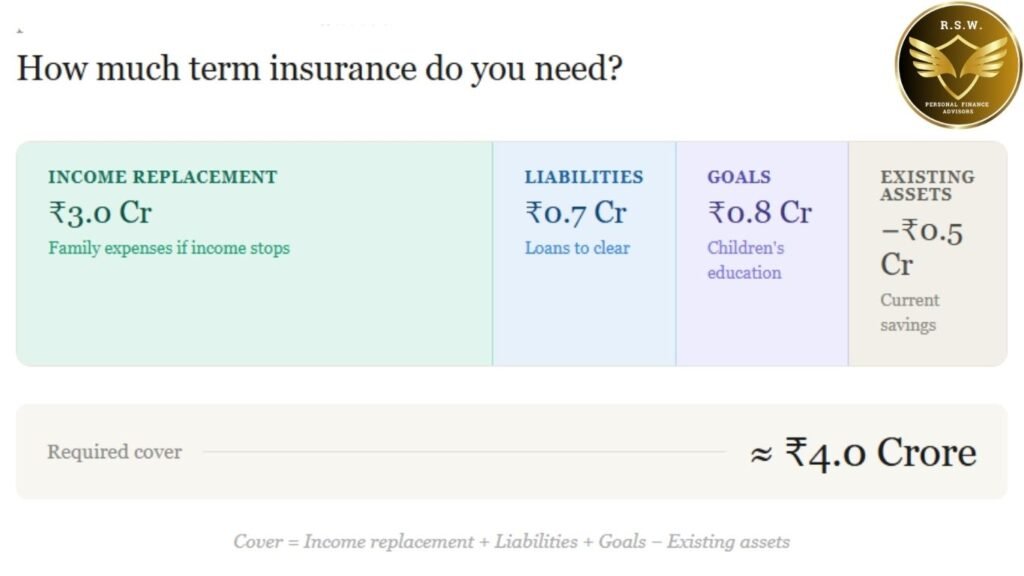
The term insurance cover should be around ₹4 crore so that if the income earner is not around:
- family expenses can continue
- loans can be cleared
- children’s education goals remain funded
This ensures the family’s financial plan remains intact even in the absence of the income earner.
6. Term Insurance Across Life Stages
| Key Situation | Relevance of Term Insurance | |
|---|---|---|
| Early Career [25–30] | Income is growing and dependents are usually limited | Buying early can lock in lower premiums |
| Family Formation [30–40 ] | Financial responsibilities increase (marriage, children, loans) | Most critical stage for term insurance |
| Wealth Accumulation [40–50] | Income at peak and investments growing | Insurance protects the family while wealth is still building |
| Pre-Retirement [50–60] | Investments becoming substantial | Importance gradually declines as financial assets grow |
| Financial Independence 60+ | Investments generate income and dependents are usually independent | Insurance becomes less necessary as wealth replaces income |
7. Optional Riders: Strengthening the Protection Layer
Riders are optional add-ons that extend the protection offered by a basic term insurance policy.
They provide additional financial support in specific situations such as accidents, critical illnesses, or disability.
By covering risks that may affect income even when death does not occur, riders help strengthen the overall protection layer in a financial plan.
| Rider | What It Does |
|---|---|
| 1. Accidental Death Benefit Rider | Provides an additional payout if death occurs due to an accident |
| 2. Accidental Disability Rider | Provides financial support if an accident leads to permanent disability |
| 3. Critical Illness Rider | Provides a lump-sum payment if the insured is diagnosed with major illnesses such as cancer or heart attack |
| 4. Waiver of Premium Rider | Future premiums are waived if disability or critical illness occurs while the policy continues |
These riders strengthen the risk protection layer of the RSW framework.
8. Modern Features in Term Insurance Policies
Modern term insurance policies are no longer completely static. Many insurers now offer flexible features that allow the coverage to adjust as responsibilities and financial needs change over time. These features help ensure that the protection remains relevant across different life stages.
| Feature | What It Means |
|---|---|
| Life Stage Benefit | Coverage can increase automatically after major life events such as marriage, childbirth, or taking a home loan |
| Increasing Cover Option | The sum assured gradually increases over time to help offset the impact of inflation |
| Terminal Illness Benefit | A portion of the sum assured may be paid early if the insured is diagnosed with a terminal illness |
9. What Term Insurance Covers and What It Does Not
Term insurance typically covers death caused by:
- illness
- accidents
- critical diseases
- sudden medical conditions
However, certain situations may lead to claim complications depending on policy terms.
These include:
- non-disclosure of medical conditions
- incorrect lifestyle declarations
- policy lapse due to unpaid premiums
- intentional misrepresentation
The most important rule when buying insurance is simple:
Always disclose health and lifestyle information honestly.
10. How to Evaluate an Insurance Company
India has a well-regulated life insurance industry overseen by the Insurance Regulatory and Development Authority of India (IRDAI).
Currently, there are 24 life insurance companies operating in India, including one public sector insurer and several private insurers.
Since a term insurance policy may remain in force for several decades, choosing a financially strong and reliable insurer becomes an important part of the decision.
Choosing a reliable insurer is important. Key indicators that help evaluate an insurance company include:
IRDAI publishes annual performance of these insurance companies
| Metric | Simple Explanation | What Is Preferable |
|---|---|---|
| Claim Settlement Ratio | How many claims the insurer has paid out of the total claims received in a year. | Higher is better |
| Amount Settlement Ratio | How much of the total claim amount requested by policyholders was actually paid by the insurer, Reflecting how well large claims are honored. | Higher is better |
| Complaint Ratio | Number of complaints received against the insurer relative to the number of policies issued, Gives an indication of customer service quality. | Lower is better |
| Solvency Ratio | Measures the insurer’s financial strength and its ability to meet future claim obligations even during adverse conditions. | Higher is better |
11. Medical Underwriting and Disclosures
When buying term insurance, insurers evaluate the applicant’s health profile.
This process is called underwriting.
Depending on age and coverage amount, insurers may require:
- medical questionnaires
- blood tests
- ECG or diagnostic tests
- disclosure of past illnesses
Accurate disclosure of conditions such as diabetes, smoking or hypertension is critical.
Failure to disclose health information may create problems during claims.
12. Can You Buy Multiple Term Insurance Policies?
Yes, individuals can purchase multiple policies. Some investors prefer this strategy for flexibility.
Example:
| Strategy | Benefit |
| Multiple insurers | Diversify risk |
| Staggered coverage | Match financial obligations |
| Different tenures | Adapt to life stages |
All policies must be fully disclosed during underwriting.
12a. Policy Limitations You Should Understand
Term insurance has certain limitations.
One important limitation in India is policy portability.
Unlike health insurance, term insurance policies usually cannot be transferred to another insurer.
If someone wants to change insurers, they must:
- buy a new policy
- undergo fresh underwriting
Choosing the right insurer initially is therefore important.
13. Why Some Term Insurance Claims Get Rejected
Claims can face issues due to:
- non-disclosure of health conditions
- incorrect lifestyle declarations
- unpaid premiums leading to policy lapse
- early claims requiring investigation
Honest disclosure at the time of purchase protects the family’s future claim.
14. How a Term Insurance Claim Works
In the unfortunate event of the policyholder’s death during the policy term, the nominee can file a claim with the insurance company. Most insurers follow a structured claim settlement process.
| Step | Process | Explanation |
| 1 | Inform the insurer | The nominee or family member should inform the insurance company or agent as soon as possible about the death of the policyholder. |
| 2 | Submit claim documents | Documents typically include the claim form, death certificate, policy document, identity proof of nominee, and bank details. |
| 3 | Claim verification | The insurer reviews the submitted documents and may conduct additional verification in certain cases, especially for early claims. |
| 4 | Claim settlement | Once the claim is approved, the insurer pays the sum assured to the nominee through bank transfer. |
Understanding this process helps families know what steps to follow and what documents may be required, which can make the claim process smoother during difficult times.
15. Term Insurance vs Other Life Insurance Products
You’re right — the current table is too abstract. For a pillar page, readers should understand what each product actually does and why efficiency differs.
Here is a more informative but still simple table.
| Product | Purpose | How It Works (Simple Explanation) | Efficiency |
|---|---|---|---|
| Term Insurance | Pure income protection | Provides a large life cover for a fixed period. If the policyholder dies during the term, the nominee receives the sum assured. No maturity benefit if the policyholder survives. | High |
| Endowment | Savings + insurance | Combines life insurance with a guaranteed savings component. Premiums are higher because part of the money goes toward savings and bonuses. | Low |
| ULIP | Market-linked investment | Part of the premium goes toward life insurance and the rest is invested in market-linked funds such as equity or debt. Returns depend on market performance. | Moderate |
| Whole Life | Lifetime coverage / estate planning | Provides life insurance cover for the entire lifetime of the insured, usually used for long-term protection or wealth transfer to heirs. | Niche |
Term insurance is considered the most efficient protection tool because it provides the highest coverage for the lowest premium, while other policies combine insurance with savings or investment features.
Term insurance remains the most efficient protection product.
16. Tax Treatment of Term Insurance
| Tax Section | Benefit |
|---|---|
| Section 80C | Premium deduction |
| Section 10(10D) | Death benefit tax-free |
Tax benefits improve cost efficiency but protection remains the primary purpose.
17. Term Insurance Within the Protection Ecosystem
A strong financial plan protects against multiple risks.
| Risk | Protection Tool |
| Death | Term insurance |
| Medical emergency | Health insurance |
| Disability | Riders |
| Income disruption | Emergency fund |
Together these protections form the foundation of the RSW framework.
18. Future Regulatory Improvements in Insurance
India’s insurance regulator is pushing reforms to strengthen consumer protection.
Important initiatives include:
- Insurance for All by 2047
- simplified products
- improved transparency in claims
- digital insurance documentation
These reforms aim to increase trust and accessibility.
19. Common Mistakes People Make With Term Insurance
Common mistakes include:
- delaying the purchase of insurance
- buying investment-linked policies instead of pure protection
- purchasing insufficient coverage
- not updating nominations or disclosures
Buying early ensures lower premiums and stronger protection.
20. Final Insight: Protect the Engine That Creates Wealth
Wealth planning begins with protecting income.
Income → investments → wealth → financial independence.
If income disappears prematurely, the entire plan collapses.
This is why the RSW Financial Independence Framework begins with risk protection.
Term insurance does not create wealth.
But it protects something far more important:
The income that makes financial independence possible.
In that sense, term insurance is not just an insurance product.
It is the first step towards sustainable wealth planning.
If you are investing in mutual funds, building toward a home, or planning for your children’s education — the first question is not which fund to pick. It is whether your income is protected if tomorrow does not go as planned.
That review takes one conversation. And it costs nothing.
Book your free one-hour wealth planning call →

Founder R S W Personal Finance Advisors.
B.E , PGDM [Marketing] ,
Chaterered Wealth Manager,
PMS Disributor, Mutual Fund Distributor.
Passionate about Personal Wealth Management. Practising 4+ Years.
Read more about me & my mission.