Where Large Cap Funds Fit in a Wealth Plan
Large Cap funds invest predominantly in the top 100 companies by market capitalisation — businesses with established revenue streams, institutional coverage, and relative price stability compared to mid and small cap peers.
In a structured wealth plan, Large Cap funds serve a specific and non-interchangeable role:
- Build Safety Net: Stability anchor within the equity allocation — particularly for goals with a 5–8 year horizon where capital preservation matters as much as growth.
- Accumulate Wealth: Core equity instrument for funding CORE life goals such as children’s education, retirement, and home corpus accumulation.
- Accelerate Wealth: Defensive equity layer within a blended portfolio, providing low-beta exposure while mid and small cap allocations drive alpha returns.
Within the RSW Financial Independence Framework, Large Cap funds are not a substitute for Flexi Cap or mid cap allocations — they are a complement.
Their role is to reduce portfolio volatility, maintain liquidity, and provide predictable compounding on the conservative end of the equity spectrum.
The 5-Parameter Evaluation Framework
Fund selection follows five structured parameters. A fund must satisfy all five to qualify as a core holding.
| Parameter | What It Measures | Why It Matters in Wealth Planning |
|---|---|---|
| Risk-Adjusted Returns | Sharpe & Sortino Ratios | Efficiency of return generation, not just quantum |
| Consistency | Rolling 3Y/5Y/7Y returns across cycles | Prevents performance-chasing; ensures structural capability |
| Volatility & Downside Risk | Std Dev, Beta & Max Drawdown | Protects compounding continuity during corrections |
| Cost Structure | Expense ratio & exit load | Cumulative drag on long-horizon SIP compounding |
| Fund Stability | AUM, fund age, manager tenure | Confirms cycle-tested credibility and strategy continuity |
Top 5 Large Cap Funds — 2026 Evaluation
| Fund | Mean Return (%) | Sharpe | Sortino | Alpha | Beta | Std Dev (%) | Expense Ratio (%) | Fund Age |
|---|---|---|---|---|---|---|---|---|
| DSP Large Cap | 15.04 | 0.69 | 0.91 | 2.64 | 0.89 | 13.27 | 2.52 | 23Y 2M |
| ICICI Pru Large Cap | 15.22 | 0.69 | 0.86 | 2.63 | 0.91 | 13.48 | 1.69 | 17Y 11M |
| SBI Large Cap | 12.39 | 0.47 | 0.59 | -0.40 | 0.94 | 13.85 | 1.47 | 20Y 3M |
| Nippon India Large Cap | 16.11 | 0.72 | 0.89 | 3.17 | 0.96 | 14.20 | 3.51 | 18Y 9M |
| HDFC Large Cap | 12.62 | 0.49 | 0.58 | -0.03 | 0.95 | 14.00 | 1.90 | 29Y 8M |
Risk ratios and fund data as of May 2026. Past performance does not guarantee future results. Source: Value Research.
ICICI Pru Large Cap — Core Portfolio Anchor
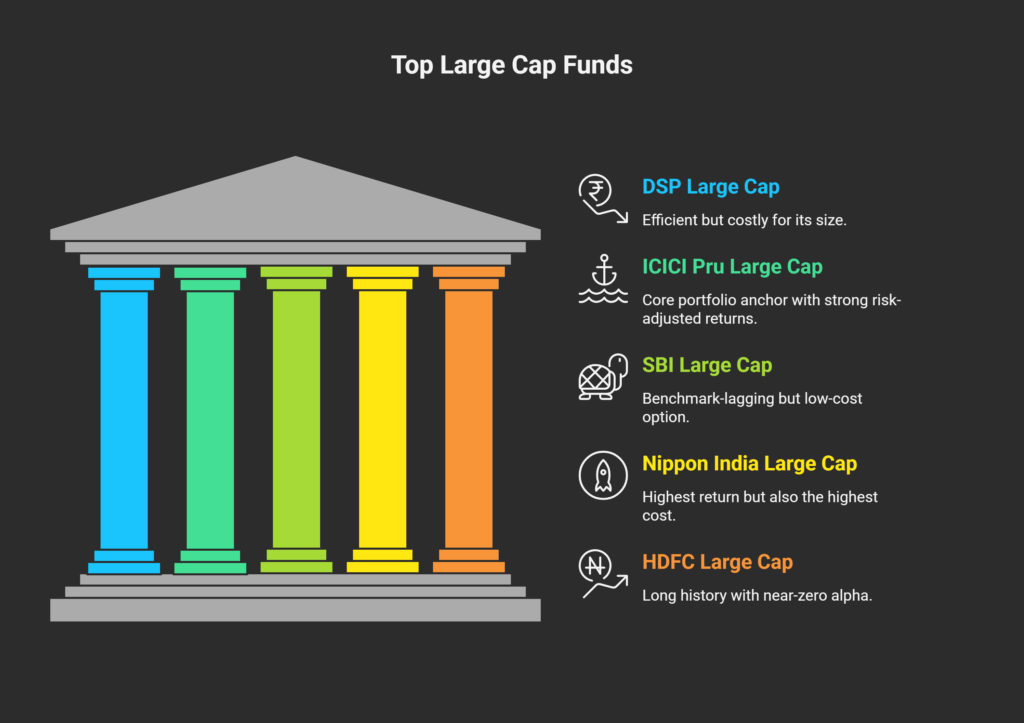
Best overall balance across parameters: mean return of 15.22%, Sharpe of 0.69, positive alpha of 2.63, and the lowest expense ratio among quality performers at 1.69%.
The shortest exit load window (30 days) offers rebalancing flexibility. AUM of ₹75,650 Cr reflects strong institutional confidence and operational scale.
Wealth management role: Primary Large Cap allocation within the Accumulate Wealth and Accelerate Wealth stages. Best cost-efficiency profile in the category.
Nippon India Large Cap — Highest Return, Highest Cost
Leads the group on mean return (16.11%), Sharpe (0.72), and alpha (3.17) — but carries the highest expense ratio in the group at 3.51%, which is a significant compounding drag over a 10+ year horizon. The very short exit load window (7 days) provides liquidity, but the cost structure requires explicit justification before inclusion.
Wealth management role: Suitable for investors prioritising return leadership, but only after a cost-adjusted return analysis. Monitor expense ratio trajectory — if it narrows, the case strengthens.
DSP Large Cap — Efficient but Costly for Its Size
Risk-adjusted profile mirrors ICICI Pru closely — Sharpe of 0.69, alpha of 2.64 — but the expense ratio at 2.52% is high relative to the AUM (₹7,192 Cr). Smaller fund size can introduce liquidity considerations for larger ticket investors. The 23-year track record provides reasonable cycle validation.
Wealth management role: Secondary allocation where ICICI Pru is already the core, or for investors seeking a second fund with an independent management approach.
SBI Large Cap — Benchmark-Lagging, Low Cost
Negative alpha of -0.40 is a structural concern — the fund is underperforming its benchmark on a risk-adjusted basis. While the expense ratio (1.47%) is competitive and the exit load minimal (0.25% for 30 days), a fund that does not generate positive alpha in the Large Cap category raises the question of whether a passive Index ETF would serve the investor better at a fraction of the cost.
Wealth management role: Not recommended as a core active holding. Investors in this fund should evaluate a Nifty 50 or Nifty 100 ETF as a lower-cost alternative.
HDFC Large Cap — Long History, Near-Zero Alpha
The longest track record in the group at 29Y 8M — but an alpha of -0.03 signals the fund is essentially delivering benchmark returns at active management cost (1.90%). The beta of 0.95 confirms near-full market correlation with no meaningful downside protection.
Wealth management role: Track record alone does not justify active management fees when alpha is absent. Like SBI Large Cap, this fund invites a direct comparison with passive index alternatives.
A Critical Observation: Active vs Passive in Large Caps
Two of the five funds evaluated — SBI Large Cap and HDFC Large Cap — carry near-zero or negative alpha. This is not incidental. It reflects a documented structural challenge: the Large Cap segment is the most efficiently priced part of the Indian equity market, making consistent alpha generation significantly harder than in mid or small cap categories.
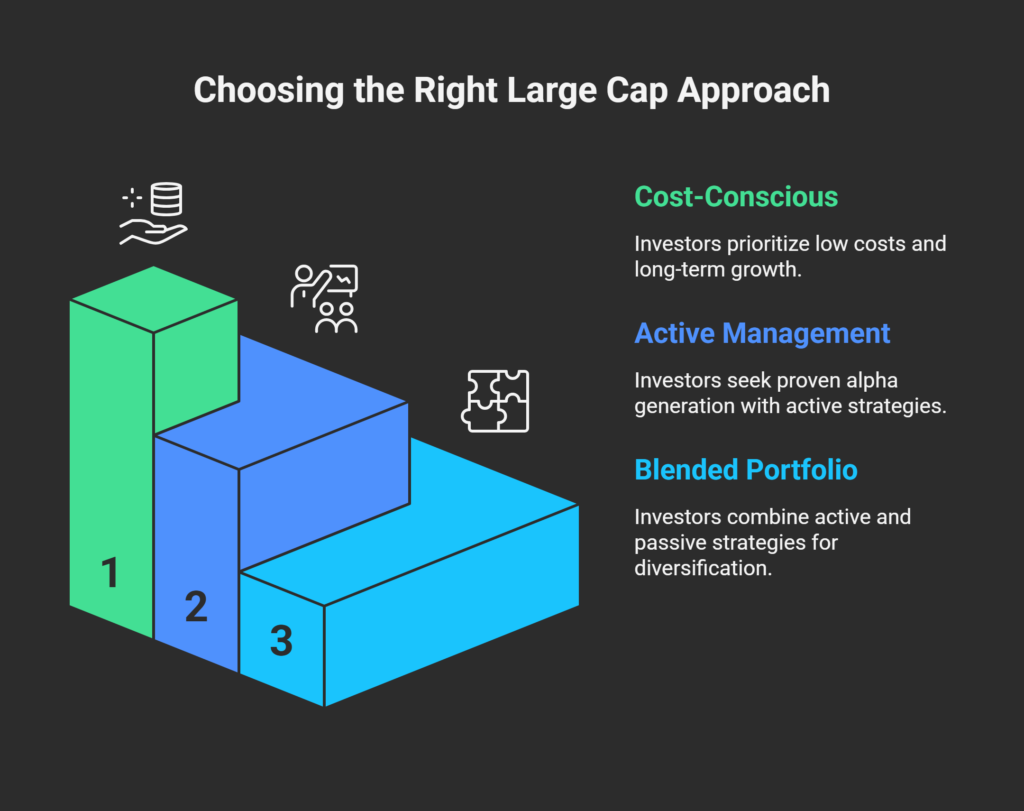
This creates a meaningful decision point in wealth planning:
| Investor Profile | Recommended Approach |
|---|---|
| Cost-conscious, 10Y+ horizon | Nifty 50 / Nifty 100 Index ETF as core Large Cap layer |
| Wants active management with proven alpha | ICICI Pru or Nippon India Large Cap (with cost monitoring) |
| Blended portfolio (active + passive) | ETF as base layer + ICICI Pru or Nippon as satellite |
Positioning Large Cap Funds by Goal
| Goal | Recommended Funds | Complementary Instruments |
|---|---|---|
| Capital Stability — 5–7Y horizon | ICICI Pru Large Cap | Hybrid fund for additional cushion |
| Retirement Corpus — defensive equity layer | ICICI Pru or Nippon India Large Cap | NPS equity allocation + Flexi Cap for growth |
| Accelerate Wealth — blended portfolio | ETF core + ICICI Pru as active satellite | Mid/Small Cap or Flexi Cap for growth engine |
A Fund Selection Is Not a Wealth Plan
In the Large Cap category more than any other, the choice between active and passive is a structured decision — not a default.
The right instrument, whether an actively managed Large Cap fund or a Nifty 50 ETF, depends on your cost sensitivity, return expectations, and how the Large Cap allocation fits within the full portfolio architecture. Once your Large Cap allocation is in place, maintaining it requires discipline. Learn how to rebalance your portfolio without triggering unnecessary tax →
Fund quality is one input. Your Wealth Personality, your current Stage in the RSW Framework, and your specific goal timelines determine the right combination.
Book your free wealth planning consultation →
Q If my Flexi Cap fund already holds Large Cap stocks, do I need a separate Large Cap fund?
A: Most Flexi Cap funds already hold 50–70% in Large Caps. Unless your Flexi Cap fund is actively tilting toward Mid and Small Caps, a separate Large Cap fund creates significant overlap with minimal diversification benefit. Check the actual portfolio allocation before adding one.
Q Should I choose an active Large Cap fund or a Nifty 50 Index ETF as my core holding?
A: For most investors, a Nifty 50 ETF is the more defensible core choice. Several active Large Cap funds generate near-zero or negative alpha — meaning they deliver benchmark returns at active management cost. A Nifty 50 ETF delivers the same exposure at a fraction of the expense ratio, compounding the cost saving significantly over a 10+ year horizon.
Q Should I shift from Mid Cap to Large Cap when markets are volatile?
A: No — tactical rotation based on market conditions is a wealth-destroying behaviour. Your Large Cap allocation should be determined by your RSW stage and goal horizon, not by short-term market sentiment. If your plan already has the right Large Cap weighting, corrections in Mid Cap are an opportunity to continue SIPs — not a signal to rotate.
Q How is a Large Cap fund taxed, and does switching from Flexi Cap to Large Cap trigger tax?
A: Gains held over 12 months are taxed at 12.5% LTCG — with ₹1.25 lakh annual exemption. Gains under 12 months at 20% STCG. Yes — switching from a Flexi Cap fund to a Large Cap fund is a redemption event and triggers capital gains tax immediately. Given the significant overlap between the two categories, the tax cost of switching rarely justifies the portfolio change.
Q At what stage of my wealth plan should I exit a Large Cap fund?
A: Later than Mid Cap and in line with Flexi Cap — begin a systematic transfer 3 years before a goal deadline. Large Cap funds experience shallower drawdowns of 20–30% and recover faster than Mid Cap funds, so the exit runway is shorter. Never exit abruptly — a phased shift into hybrid or debt funds protects your corpus from sequence-of-returns risk at the goal finish line.
Nitin R Wali is a Chartered Wealth Manager (CWM®), AMFI Registered Mutual Fund Distributor (ARN–244802), and APMI Registered PMS Distributor (APRN07002) based in Pune, India. This article is for educational purposes only and does not constitute personalised financial advice. Tax laws are subject to change — consult a qualified advisor before making investment decisions.
Book your free one-hour wealth planning call →

Founder R.S.W. Personal Finance Advisors.
Chartered Wealth Manager (CWM®)
AMFI Registered MFD ARN-244802
APMI Registered PMS Distributor APRN-07002
B.E. (Mechanical ) | PGDM (Marketing) | 9+ years in personal wealth management | Based in Pune
Specialising in Holistic Wealth Management for salaried professionals and NRIs — using the RSW Financial Independence System.
Read more “About Me”