Where Liquid Funds Fit in a Wealth Plan
Liquid funds are not an investment. They are a financial safety instrument.
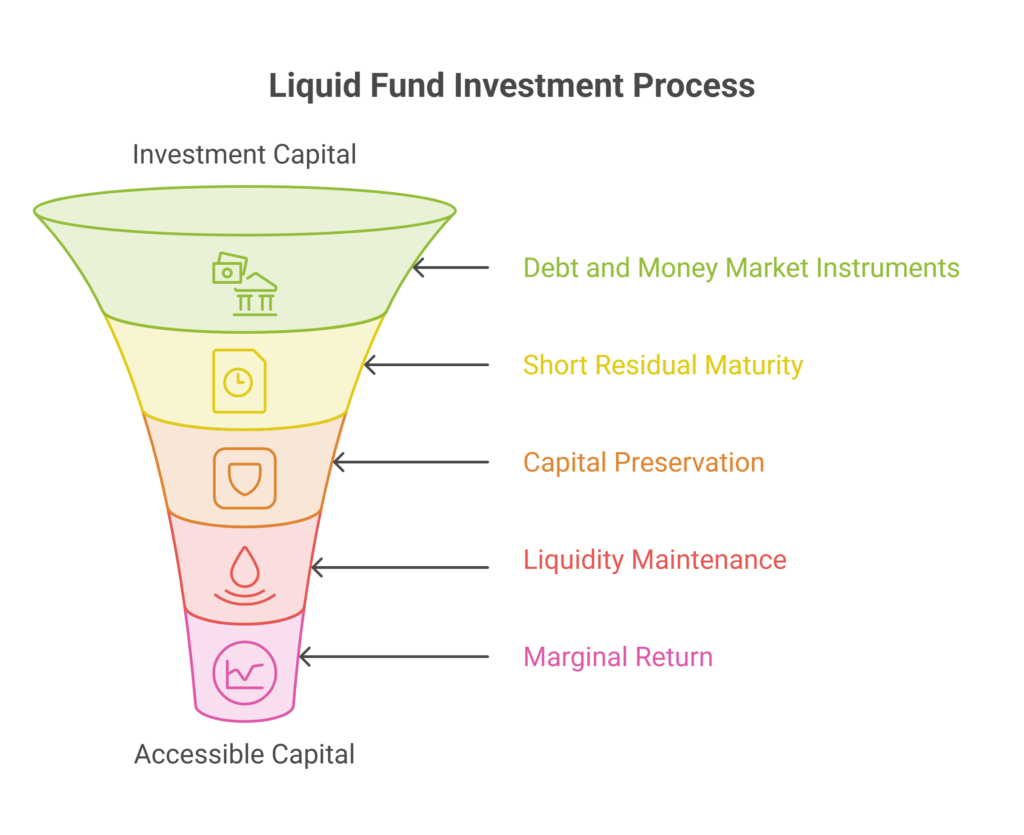
This distinction matters more than any return comparison. Liquid funds invest in debt and money market instruments with a residual maturity of up to 91 days — government securities, treasury bills, certificates of deposit, and commercial paper. The objective is not to generate wealth. The objective is to preserve capital, maintain liquidity, and earn a return marginally better than a savings account — with near-instant access when needed.
Within the RSW Financial Independence Framework, Liquid funds belong exclusively to one stage:
- Build Safety Net: The Emergency Fund — 6 to 12 months of monthly expenses — must be parked in a Liquid fund. This is not optional and not negotiable. An emergency fund sitting in a savings account earns 3–3.5% and loses purchasing power every year. A Liquid fund earns 6.5–7% with same-day or next-day redemption, zero exit load after Day 1, and capital safety as the primary mandate.
No other stage of the RSW framework requires a Liquid fund. Once the emergency fund is fully funded and parked correctly, the role of Liquid funds in your wealth plan is complete — all incremental capital moves to goal-based equity and debt instruments appropriate to Stage 3 and beyond.
Why the Emergency Fund Belongs in a Liquid Fund — Not a Savings Account
Most investors underestimate the cost of parking their emergency fund incorrectly.
| Instrument | Typical Return | Liquidity | Capital Safety |
|---|---|---|---|
| Savings Account | 3.00–3.50% | Instant | High |
| FD (premature withdrawal) | 5.50–6.00% | 2–3 days + penalty | High |
| Liquid Fund | 6.50–7.00% | Same day / T+1 | High |
The difference between a savings account and a Liquid fund on a ₹5 lakh emergency corpus over 3 years is approximately ₹50,000–₹60,000 in additional return — with no additional risk.
This is not a return optimisation decision. It is a basic hygiene decision.
The 5-Parameter Evaluation Framework
Liquid fund selection follows five parameters — adjusted for the debt context. Return maximisation is not the primary objective. Capital safety, cost, and liquidity come first.
| Parameter | What It Measures | Why It Matters for an Emergency Fund |
|---|---|---|
| Risk-Adjusted Returns | Sharpe & Sortino Ratios | Consistency of returns relative to near-zero volatility |
| Capital Safety | Std Dev & portfolio credit quality | Ensures the corpus is intact when an emergency strikes |
| Liquidity | Exit load structure & redemption timeline | Emergency fund must be accessible within 24 hours |
| Cost Structure | Expense ratio | In a low-return category, even 0.10% drag compounds meaningfully |
| Fund Stability | AUM & fund age | Large, established funds carry lower concentration and credit risk |
Top 5 Liquid Funds — 2026 Evaluation
| Fund | Mean Return (%) | Sharpe | Sortino | Std Dev (%) | Expense Ratio (%) | Riskometer |
|---|---|---|---|---|---|---|
| Bank of India Liquid | 6.77 | 4.47 | 6.98 | 0.18 | 0.14 | Low to Moderate |
| Edelweiss Liquid | 6.69 | 3.90 | 6.36 | 0.19 | 0.19 | Low to Moderate |
| Invesco India Liquid | 6.71 | 3.95 | 6.43 | 0.20 | 0.24 | Low to Moderate |
| ABSL Liquid | 6.71 | 3.89 | 6.51 | 0.20 | 0.35 | Moderate |
| Axis Liquid | 6.74 | 4.02 | 6.58 | 0.20 | 0.21 | Low to Moderate |
Risk ratios and fund data as of May 2026. Past performance does not guarantee future results. Source: Value Research.
Axis Liquid — Core Emergency Fund Recommendation
The strongest overall profile for an emergency fund allocation. Mean return of 6.74%, the second highest Sharpe (4.02) and Sortino (6.58) in the group, and a large AUM of ₹51,643 Cr providing institutional scale and portfolio diversification. The expense ratio at 0.21% is competitive and the 16-year track record confirms operational consistency. The Low to Moderate riskometer rating is the appropriate classification for an emergency corpus instrument.
Wealth management role: Primary emergency fund vehicle within the Build Safety Net stage. Best balance of return, cost, scale, and credit safety.
Edelweiss Liquid — Stable and Cost-Efficient
Competitive mean return (6.69%), Low to Moderate risk rating, and an 18-year track record. The expense ratio at 0.19% is among the lower in the group. AUM of ₹15,091 Cr is adequate for operational stability without the concentration concerns of very small funds.
Wealth management role: Reliable alternative to Axis Liquid for the emergency fund. Suitable for investors who prefer a secondary AMC relationship for their safety net corpus.
Invesco India Liquid — Solid Profile, Higher Cost
Mean return (6.71%) and risk ratios are competitive, and the 19-year track record provides strong cycle validation. However, the expense ratio at 0.24% is the third highest in this evaluation — in a category where returns are compressed into a 6.50–7.00% band, every basis point of cost matters more than in equity funds.
Wealth management role: Acceptable emergency fund vehicle, but cost drag of 0.24% vs 0.21% for Axis Liquid should be factored in. The difference compounds over a multi-year emergency fund horizon.
ABSL Liquid — Largest AUM, Only Moderate Rating
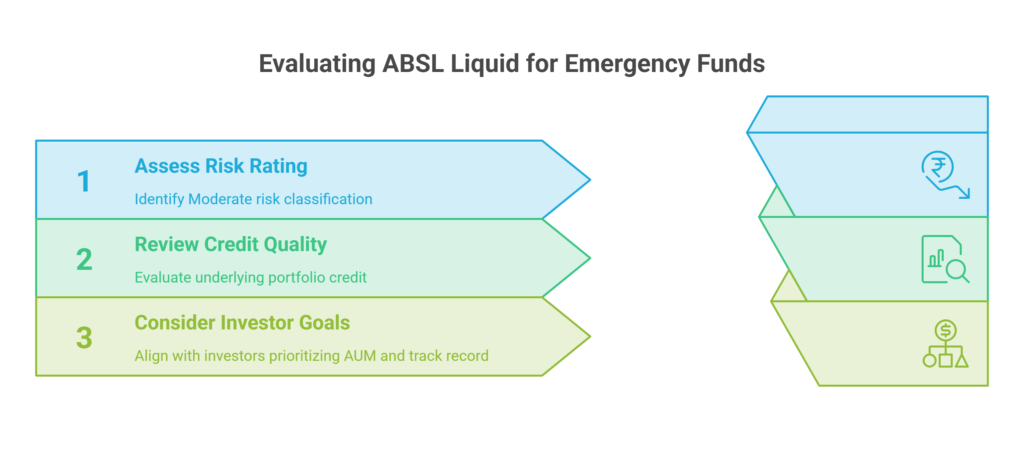
The largest fund in this evaluation at ₹56,604 Cr with a 22-year track record — the deepest institutional history in the group. However, ABSL Liquid carries a Moderate riskometer rating — the only fund in this evaluation classified above Low to Moderate. For an emergency fund, where capital safety is the non-negotiable priority, a Moderate risk classification warrants scrutiny of the underlying portfolio credit quality before inclusion.
Wealth management role: Suitable for investors who prioritise AUM scale and track record. However, the Moderate risk rating requires an explicit credit quality review before use as a primary emergency fund vehicle.
Bank of India Liquid — Best Risk-Adjusted Returns, Smallest Fund
Leads the group on both Sharpe (4.47) and Sortino (6.98) — the best risk-adjusted return profile in this evaluation — with the lowest expense ratio (0.14%) and lowest standard deviation (0.18%). However, the AUM of ₹1,735 Cr is significantly smaller than peers. In the Liquid fund category, smaller AUM can introduce portfolio concentration risk — fewer instruments, less diversification, higher sensitivity to any single credit event.
Wealth management role: The risk-adjusted and cost metrics are exceptional, but the AUM constraint limits its suitability as a primary emergency fund vehicle for larger corpus sizes. Suitable as a secondary allocation or for smaller emergency fund amounts under ₹3 lakh.
A Critical Observation: Expense Ratio Impact in Liquid Funds
In equity funds, a 0.10% difference in expense ratio is a rounding error. In Liquid funds, it is material.
When returns are compressed into a 6.50–7.00% band, cost efficiency directly determines net return. The spread between the lowest expense ratio (0.14% — Bank of India) and the highest (0.35% — ABSL) is 21 basis points — representing approximately 3% of the total return being consumed by costs.
| Fund | Expense Ratio (%) | Net Return Impact on ₹5L corpus over 3Y |
|---|---|---|
| Bank of India Liquid | 0.14 | Highest net return |
| Edelweiss Liquid | 0.19 | ₹750 lower than Bank of India |
| Axis Liquid | 0.21 | ₹1,050 lower than Bank of India |
| Invesco India Liquid | 0.24 | ₹1,500 lower than Bank of India |
| ABSL Liquid | 0.35 | ₹3,150 lower than Bank of India |
For an emergency fund that will sit untouched for years, cost optimisation is the single most controllable variable.
How to Structure Your Emergency Fund in a Liquid Fund
The emergency fund is not a lump sum parked and forgotten. It requires a simple structure:
Step 1 — Determine the corpus size Calculate 6 months of fixed monthly expenses — EMIs, rent, insurance premiums, household costs. This is your minimum. 12 months is preferred for salaried professionals with a single income household.
Step 2 — Build it systematically If the corpus is not yet fully funded, set up a monthly STP (Systematic Transfer Plan) from your salary account into the Liquid fund until the target is reached. Do not divert emergency fund contributions to equity until Stage 2 is complete.
Step 3 — Do not touch it for returns The emergency fund is not available for short-term investment opportunities, festival purchases, or planned expenses. These require separate goal-specific allocations. Mixing purposes destroys the function of the safety net.
Step 4 — Review annually As your monthly expenses grow — salary increments, new EMIs, lifestyle changes — recalculate the required corpus and top up accordingly.
A Fund Selection Is Not a Wealth Plan
A Liquid fund is the foundation of a structured wealth plan — not a component of the growth engine. Getting it right means your emergency corpus is safe, accessible, and not silently losing purchasing power in a savings account.
But the emergency fund is Stage 2. Once it is funded, the next decision is where the remaining monthly surplus goes — and that requires a structured plan across goal funding, equity allocation, and tax efficiency.
Fund quality is one input. Your Wealth Personality, your current stage in the RSW Framework, and your specific financial situation determine the complete picture.
Book your free wealth planning consultation →
Frequently Asked Questions
Q: How much should I keep in a Liquid fund as an emergency fund?
A: A minimum of 6 months of fixed monthly expenses — EMIs, rent, insurance, and household costs. For single-income households or those with dependants, 12 months is the recommended target. Calculate the number based on actual fixed outflows, not total income.
Q: Is a Liquid fund safer than a Fixed Deposit for an emergency corpus?
A: Both are safe — but Liquid funds offer better liquidity. A premature FD withdrawal typically attracts a penalty of 0.5–1% and takes 2–3 business days. A Liquid fund redemption after Day 1 carries zero exit load and credits to your account within T+1. For an emergency corpus where instant access is the priority, Liquid funds are structurally superior.
Q: Should I stop contributing to my Liquid fund once my emergency corpus is fully funded?
A: Yes — once the target corpus is reached, stop directing fresh capital into the Liquid fund. All incremental monthly surplus should move to Stage 3 goal-based instruments. Revisit the Liquid fund only when your monthly expenses increase significantly — a new EMI, lifestyle change, or addition of a dependent — requiring a corpus top-up.
Q: How is a Liquid fund taxed?
A: Liquid funds are debt funds for taxation purposes. Gains are added to your income and taxed at your applicable income tax slab rate — regardless of the holding period. There is no LTCG benefit as available in equity funds. For most salaried investors in the 30% tax bracket, the post-tax return from a Liquid fund is approximately 4.7–4.9% — still meaningfully better than a savings account after tax.
Q: Can I use a Liquid fund for short-term goals beyond the emergency fund?
A: Yes — but with a clear distinction. Liquid funds are appropriate for any corpus needed within 3–6 months: advance tax payments, insurance premium reserves, or planned large expenses. For goals beyond 6 months, better-yielding short-duration or ultra-short-duration debt funds are more appropriate. Never park long-horizon goal money in a Liquid fund — the return opportunity cost over 3–5 years is significant.
Begin your rebalancing review for you Portfolio [ Book a Call ] →

Founder R S W Personal Finance Advisors.
B.E , PGDM [Marketing] ,
Chaterered Wealth Manager,
PMS Disributor, Mutual Fund Distributor.
Passionate about Personal Wealth Management. Practising 4+ Years.
Read more “About Me”