
Buying, selling or renting property in India while living abroad can look straightforward. In practice, an NRI property transaction involves more than agreeing on a price and signing a sale deed.
Tax treatment, the bank account used for receiving proceeds, Power of Attorney (POA), documentation, TDS and repatriation rules can all affect how smoothly the transaction is completed.
The first step is to distinguish an NRI’s residential status from the transaction itself.
An individual who does not satisfy the applicable residence conditions is treated as a non-resident for Indian income-tax purposes; the Income Tax Department provides the relevant residence framework for NRIs.
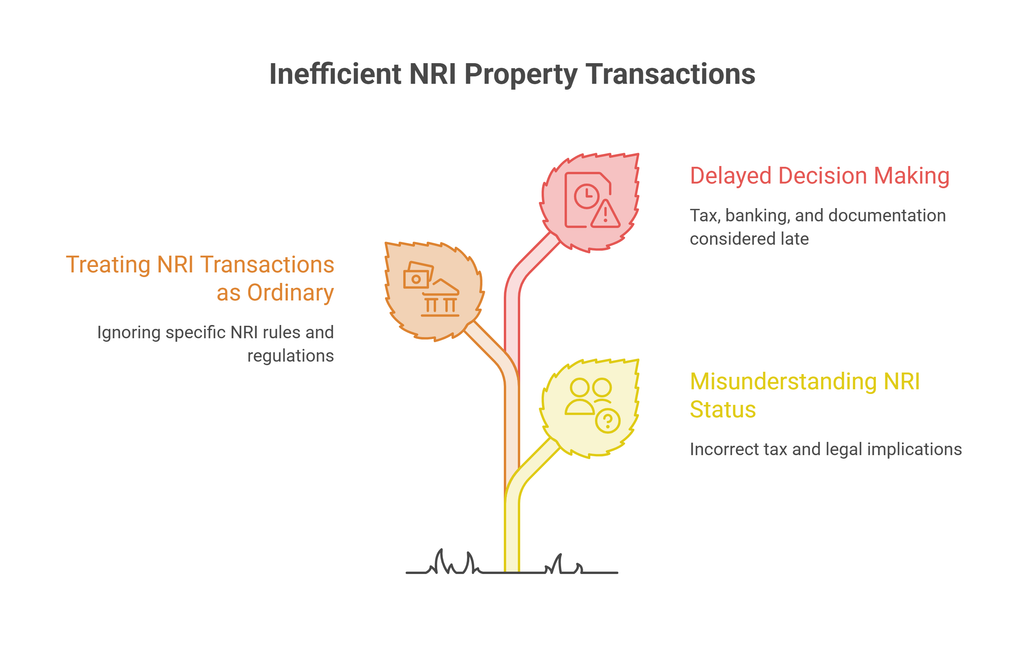
The biggest mistake is to treat an NRI property transaction exactly like an ordinary resident-to-resident transaction. The right tax, banking and documentation decisions should be considered before the transaction, not after it.
The Rupee Return Illusion: Look Beyond the Property Price
An NRI may look at an Indian property and see a substantial rupee gain. Suppose a property purchased for ₹50 lakh is eventually sold for ₹1 crore. On the surface, that appears to be a ₹50 lakh increase.
But an NRI living overseas ultimately thinks about the money in another currency as well.
Currency movement does not automatically change the Indian capital-gains computation. It changes the economic value of the proceeds when measured in the NRI’s overseas currency.
Therefore, two questions should be kept separate:
a. What is the the taxable gain in India ?
b. What is the investment return in the currency in which the NRI ultimately uses the money ?
| Measure | Illustration |
|---|---|
| Original property cost | ₹50 lakh |
| Sale value | ₹1 crore |
| Rupee increase | ₹50 lakh |
| Indian tax/transaction costs | Need separate calculation |
| Currency movement | May increase or reduce overseas-currency return |
| Final overseas-currency value | Depends on exchange rate |
The practical lesson is simple: measure the investment return in the currency in which you ultimately use the money, while keeping the Indian tax calculation separate.
Pick the Right Account: NRE, NRO or FCNR
Bank-account selection becomes particularly important when an NRI sells Indian property.
An NRO account is commonly used to manage income and assets arising in India.
RBI rules provide a framework under which an NRI/PIO may remit up to USD 1 million per financial year from eligible NRO balances or sale proceeds of assets, subject to applicable taxes, documentation and the satisfaction of the authorised dealer bank.
| Account / route | Typical relevance |
|---|---|
| NRE | Rupee account for eligible foreign-sourced funds; repatriation is subject to applicable rules. |
| NRO | Common route for Indian income and eligible sale proceeds. |
| FCNR(B) | Foreign currency deposit account for eligible foreign-currency funds. |
| NRO → overseas account | May be possible subject to RBI conditions, taxcompliance, documentation and applicable limits. |
The repatriation treatment can also depend on how the property was acquired.
RBI guidance distinguishes property acquired using foreign exchange from property acquired out of rupee funds or through inheritance/legacy.
For eligible residential property acquired with foreign exchange, repatriation is subject to the amount originally paid in foreign exchange and a restriction of not more than two such residential properties.
Therefore, ‘NRO account means the money can always be sent abroad’ is too broad. The source of funds, acquisition history, taxes and supporting documents matter.
Route Sale Proceeds Correctly
The bank-account route is not merely an administrative detail.
For eligible NRI/PIO cases, RBI permits remittance up to USD 1 million per financial year from eligible NRO balances/sale proceeds, subject to the applicable conditions.
RBI also provides a separate route for eligible sale proceeds of residential property acquired using foreign exchange.
| Situation | Key consideration |
|---|---|
| Property acquired out of rupee funds (As Resident) | Eligible repatriation may fall under the USD 1 million per financial year facility, subject to conditions. |
| Property acquired using foreign exchange | Repatriation can be linked to the eligible foreign-exchange-funded acquisition amount and is subject to applicable conditions. |
| Inherited property / assets | Documentary evidence and applicable remittance conditions become important. |
| Tax due on sale | Applicable Indian taxes and compliance should be addressed before remittance. |
Keep original purchase documents, bank-payment records and evidence of how the property was funded. These records can become important years later when the property is sold and the owner wants to repatriate the proceeds.
Don’t Ignore TDS When an NRI Sells Property
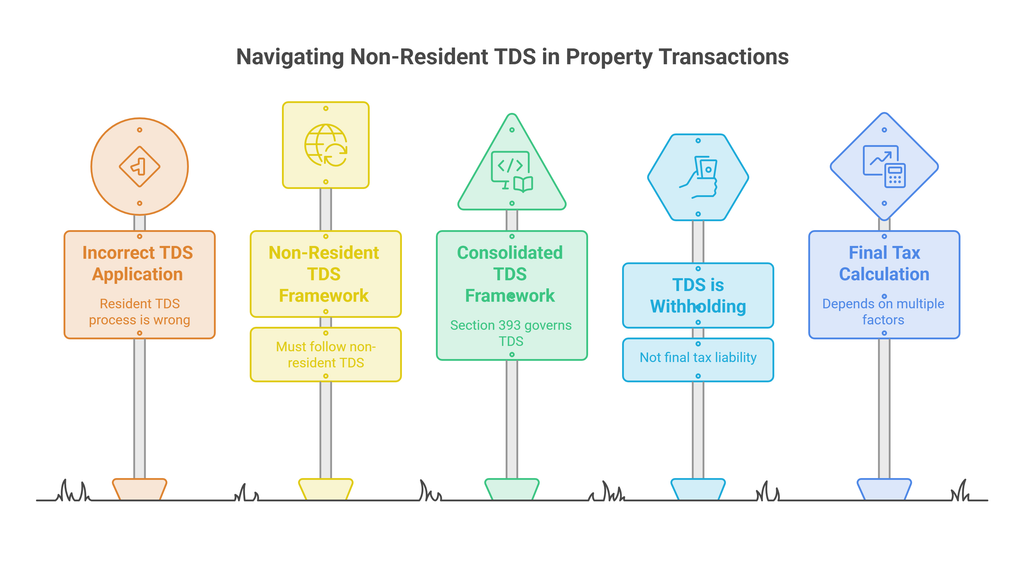
When the seller is a non-resident, the buyer should not simply apply the resident-seller property TDS process. The Income Tax Department’s current guidance states that where the deductee is a non-resident, the applicable non-resident TDS framework must be followed.
From 1 April 2026, the Income-tax Act, 2025 governs applicable TDS obligations for sums paid or credited on or after that date.
The Department explains that Section 393 contains the consolidated TDS framework for payments including rent and transfer of certain immovable property, with a separate table for non-resident payees.
An important distinction is that TDS is withholding; it is not automatically the seller’s final tax liability. The final capital-gains tax calculation depends on the property’s holding period, cost of acquisition, eligible transfer expenses, applicable exemptions and the seller’s specific tax circumstances.
| Question | Why it matters |
|---|---|
| Is the seller resident or non-resident? | Determines the applicable withholding framework. |
| How long was the property held? | Immovable property generally has a 24-month long-termthreshold. [5] |
| What is the actual capital gain? | Final tax is based on the applicable capital-gainscomputation, not simply the sale value. |
| Is a lower/nil deduction certificate relevant? | May affect the amount withheld where the law permits. |
| Does a DTAA apply? | A cross-border tax position may require treaty analysis. |
For a non-resident seller, the payer may need to use the prescribed non-resident reporting mechanism.
The Income Tax Department states that Form 27Q is applicable where the seller/landlord/deductee is a non-resident for the relevant TDS reporting.
Because incorrect withholding can create compliance consequences for the buyer as well as the seller, the TDS position should be checked before the sale is completed.
Selling to Family? A Sale May Not Always Be the Only Route
NRIs sometimes want to transfer Indian property within the family rather than sell it to an unrelated buyer. Depending on the circumstances, a transfer may involve a gift deed, relinquishment deed or family settlement rather than a conventional sale deed.
| Situation | Possible instrument | Important point |
|---|---|---|
| Genuine gift to an eligible relative | Gift deed | Tax and stamp-duty treatment must be checked separately. |
| One co-owner gives up rights | Relinquishment deed | Applicability depends on ownership and relationship. |
| Family members settle competing rights | Family settlement | Legal and stamp-duty consequences depend on the facts and state law. |
| Property transferred for consideration | Sale deed | Normal sale, tax and registration considerations apply. |
It is important not to assume that a family transfer automatically avoids stamp duty, registration or tax. Appropriate instrument depends on the relationship between the parties, ownership structure, consideration, succession circumstances and the state in which the property is located.
The safer approach is to decide the legal structure before executing the transfer and have the proposed deed reviewed by a property lawyer or other appropriate professional.
How a Power of Attorney Works for NRIs
An NRI does not necessarily have to return to India personally for every stage of a property transaction. A properly executed Power of Attorney can authorise a person in India to act on the NRI’s behalf, subject to the scope of authority and applicable registration requirements.
The Registration Act, 1908 permits documents to be presented for registration by an agent duly authorised by a Power of Attorney executed and authenticated in the prescribed manner.
For a principal residing outside India, Section 33 specifies recognised methods of authentication, including authentication before a Notary Public, Court, Judge, Magistrate, Indian Consul or Vice-Consul, or an appropriate Central Government representative.
Where a POA is executed abroad, authentication requirements should be checked for the country concerned. The Ministry of External Affairs states that apostille is available for eligible documents, including Power of Attorney, from countries covered by the Hague Apostille Convention; normal attestation applies where apostille is not accepted.
| Before executing a POA | What to check |
|---|---|
| Person appointed | Is the attorney trustworthy and suitable? |
| Powers granted | Are the powers specific and sufficient for the intended transaction? |
| Execution abroad | Is the required authentication/apostille completed? |
| Indian stamping | Is stamping required in the relevant state? |
| Registration | Is registration required for the intended transaction? |
| Sale authority | Does the POA clearly cover the acts the attorney mustperform? |
A POA gives someone authority to act on behalf of the principal; it does not by itself become a substitute for the substantive document that legally transfers ownership.
Rental Income: Living Abroad Does Not Remove Indian Tax Compliance
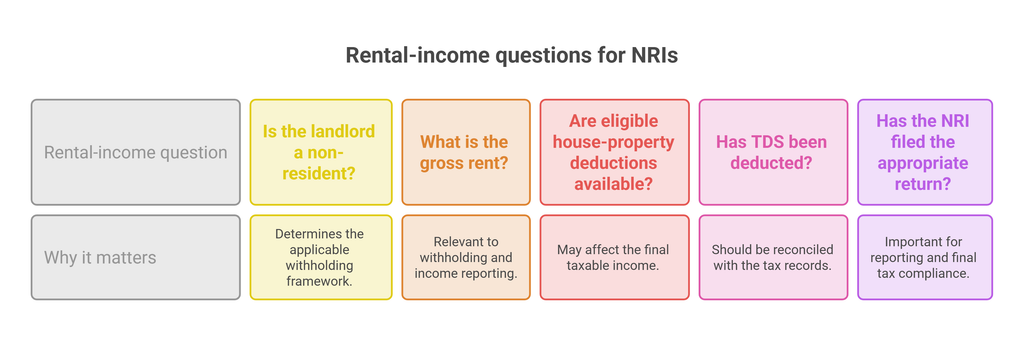
An NRI who owns property in India and earns rent generally needs to consider Indian tax compliance. Rental income from property situated in India can remain taxable in India even when the landlord lives overseas.
TDS is also important. The Income Tax Department confirms that when the landlord/deductee is a non-resident, the ordinary resident-landlord TDS forms are not the applicable route; the non-resident framework, including Form 27Q where applicable, needs to be considered.
| Rental-income question | Why it matters |
|---|---|
| Is the landlord a non-resident? | Determines the applicable withholding framework. |
| What is the gross rent? | Relevant to withholding and income reporting. |
| Are eligible house-property deductions available? | May affect the final taxable income. |
| Has TDS been deducted? | Should be reconciled with the tax records. |
| Has the NRI filed the appropriate return? | Important for reporting and final tax compliance. |
The amount withheld at source should not automatically be treated as the landlord’s final tax liability. The final computation can depend on the applicable house-property provisions, deductions, tax regime and the individual’s circumstances.
Keep Key Documents Ready to Avoid Delays
Many NRI property transactions are delayed not because the buyer or seller changes their mind, but because a document is missing or cannot be properly verified.
A basic document checklist should therefore be prepared well before the transaction.
| Document | Why it matters |
|---|---|
| PAN and identity documents | Tax, KYC and transaction compliance. |
| Original sale deed | Evidence of ownership and transaction history. |
| Previous title documents | Helps establish the title chain. |
| Legal-heir / succession documents | Important where the property is inherited. |
| Power of Attorney | Required where an authorised person acts for the NRI. |
| Property-tax records | Useful for ownership/compliance verification. |
| Bank statements / payment records | Evidence of acquisition and payment trail. |
| Conversion documents | Relevant where a property has been converted tofreehold, if applicable. |
The NRI should also retain purchase agreements, payment records, bank statements and tax documents. These records can later help establish the cost of acquisition, ownership history and source of funds, and can support repatriation documentation where required.
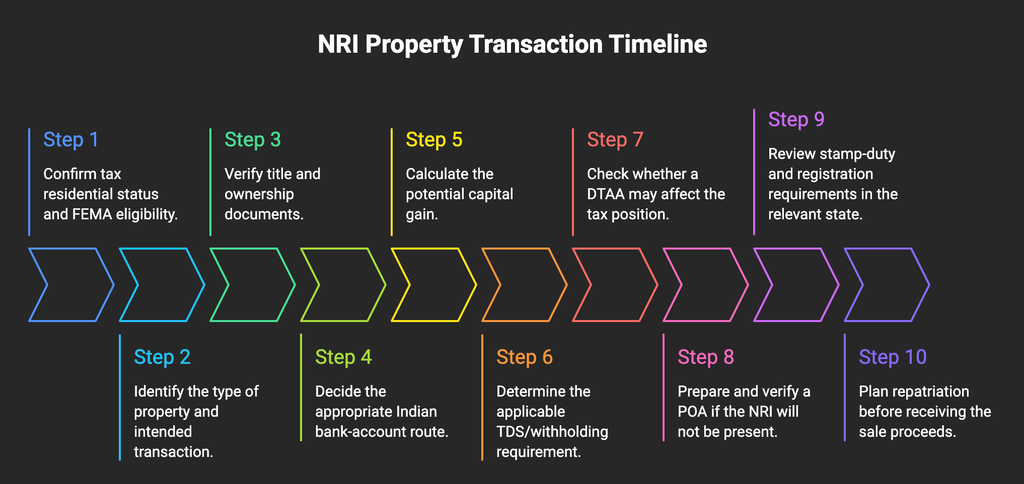
NRI Property Deal: A Pre-Transaction Checklist
| Step | What to check |
|---|---|
| 1 | Confirm tax residential status and FEMA eligibility. |
| 2 | Identify the type of property and intended transaction. |
| 3 | Verify title and ownership documents. |
| 4 | Decide the appropriate Indian bank-account route. |
| 5 | Calculate the potential capital gain. |
| 6 | Determine the applicable TDS/withholding requirement. |
| 7 | Check whether a DTAA may affect the tax position. |
| 8 | Prepare and verify a POA if the NRI will not be present. |
| 9 | Review stamp-duty and registration requirements in therelevant state. |
| 10 | Plan repatriation before receiving the sale proceeds. |
| 11 | Preserve purchase, sale and banking records. |
| 12 | Take professional advice for complex transactions. |
The Bottom Line
For an NRI, an Indian property transaction is not just a buyer-seller transaction. It is simultaneously a tax, banking, FEMA, documentation and legal transaction.
The eight issues covered here—currency returns, bank accounts, sale proceeds, TDS, family transfers, POA, rental income and documentation—are interconnected. A decision made at one stage can affect what happens at the next.
Before signing the agreement, know three things: how the transaction will be taxed, where the money will move, and what documents will be required. That preparation can prevent a relatively simple property transaction from becoming an expensive compliance problem.
Want more clarity about NRI and Other queries [ Book a Call ] →

Founder R.S.W. Personal Finance Advisors.
Chartered Wealth Manager (CWM®)
AMFI Registered MFD ARN-244802
APMI Registered PMS Distributor APRN-07002
B.E. (Mechanical ) | PGDM (Marketing) | 9+ years in personal wealth management | Based in Pune
Specialising in Holistic Wealth Management for salaried professionals and NRIs — using the RSW Financial Independence System.
Read more “About Me”