Almost every Indian household has a story attached to its gold. The bangles passed down from a grandmother, the coins bought at Dhanteras, the chain kept aside “just in case” — gold in India has rarely been just an asset.
It’s a hedge against a currency that has, in living memory, lost value; a form of collateral that doesn’t need a credit score; and, for a lot of families, the one thing that’s genuinely theirs, sitting in a locker rather than a bank’sbalance sheet.
That emotional weight is precisely why so much of it stays locked away, uninsured, unproductive,and increasingly expensive to simply hold onto safely.
Electronic Gold Receipts (EGR) are a regulatory attempt to let that same gold do more — without asking Indians to give up the thing they actually want, which is the option to hold, and eventually touch, real metal.
The Idea, in One Line
An EGR is a digital receipt for real gold sitting in a SEBI-regulated vault.
It lives in your demat account, trades on the exchange like a share, and can be converted back into physical bars or coins if you want them.
NSE frames it as an exchange-traded security linked to standardised gold — enabling market-based price discovery, electronic
holding, and the flexibility to buy, sell, and convert to and from physical gold through a prescribed process.
How It Became a Security
The Ministry of Finance notified EGRs as “securities” in December 2021. SEBI followed with the Vault Managers Regulations, 2021, then the Framework for Operationalising the Gold Exchange in January 2022. BSE launched India’s first EGRs during Muhurat trading in 2022; NSE launched its own EGR segment on 4 May 2026.
The ecosystem connects five parties:
a. SEBI regulates;
b. NSE provides the trading platform;
c. NSE Clearing settles trades, transferring EGRs to the buyer and cash to the seller;
d. Depositories hold EGRs in demat and coordinate withdrawal so electronic holdings always match vault gold; and
e. Vault Managers physically store the gold and handle deposits and withdrawals.
There are currently three SEBI-registered vault managers: Sequel Logistics, Malca-Amit JK Logistics, and Brinks India
Product Specifications
| Item | Detail |
| Asset class | Securities under SCRA, 1956 |
| Purities | 999 and 995 |
| Denominations | 10 mg, 100 mg, 1 g, 10 g, 100 g and 1 kg, in each purity |
| Market timings | Monday to Friday, 9:00 am to 11:30 pm / 11:55 pm depending on US daylight saving |
| Settlement | T+1 |
| Margins | VaR + ELM + MTM (see below) |
| Price band | Initially 10% of previous close, relaxed in 5% increments in a trending market |
| Quality | LBMA Good Delivery standard or other NSE-approved suppliers, with a supplier quality certificate |
| Delivery logic | Compulsory delivery in demat form on the designated delivery day |
The margin structure has three layers, standard to exchange-traded securities:
a. VaR (Value at Risk) margin covers the statistically expected one-day loss based on price volatility;
b. ELM (Extreme Loss Margin) is an additional buffer for tail-risk price moves beyond what VaR captures; and
c MTM (Mark-to-Market) margin settles the actual daily gain or loss on your open position.
Together, they’re what let NSE Clearing guarantee settlement even if a counterparty defaults — you don’t need to trust the person on the other side of the trade, only the clearing corporation.
Benefits NSE Lists
| Benefit | What It Means in Practice |
| Unified pricing | One national gold price via exchange discovery, replacing city-by-city jeweller quotes |
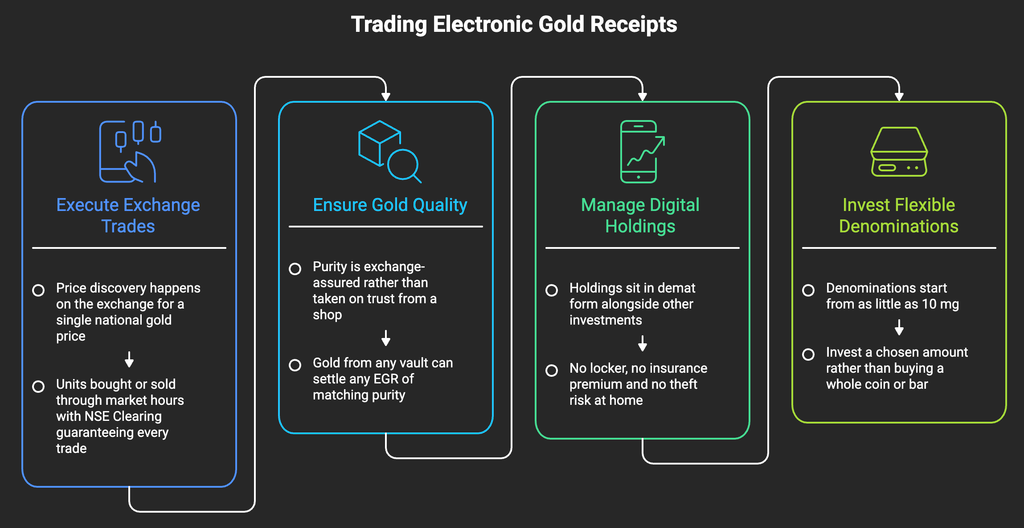
| Easy tradability | Buy and sell like a listed security, during market hours |
| Convenience vs. physical gold | No locker, no insurance, no risk of theft at home |
| Liquidity and assured quality | Exchange-guaranteed purity, unlike unverified jewellery-shop gold |
| Fungibility | Gold from any vault can settle any EGR of matching purity |
| Settlement guarantee | NSE Clearing backs every trade |
| Portfolio diversification | Gold exposure sits alongside your other demat holdings |
| Demat holding | No separate physical storage arrangement needed |
| Denomination flexibility | Invest from 10 mg upward, not a full coin or bar |
Withdrawal and Conversion to Physical Gold
This is where EGRs genuinely differ from a Gold ETF, and where most of the practical friction sits.
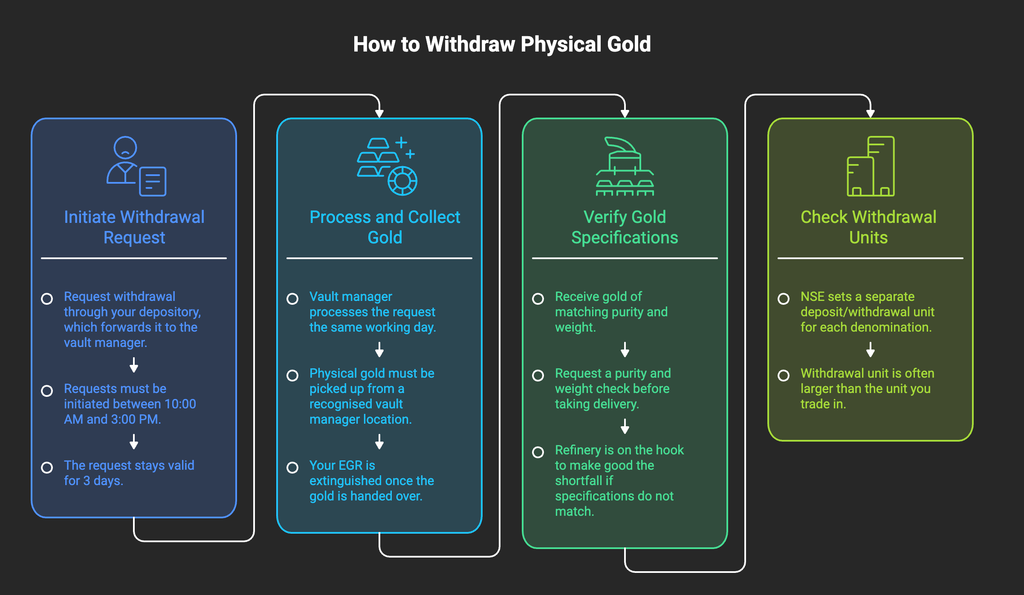
How it works. You request withdrawal through your depository, which forwards it to the vault manager.
Thevault manager arranges delivery, and your EGR is extinguished once the gold is handed over. The request stays valid for 3 days.
There’s a daily window. Requests must be initiated between 10:00 AM and 3:00 PM, and are processed by the vault manager the same working day.
You collect it; it isn’t couriered. Physical gold must be picked up from a recognised vault manager location —doorstep delivery isn’t standard, and delivery isn’t instant.
You get equivalent gold, not your original piece. Because EGRs are fungible, you receive gold of matching purity and weight, but not necessarily the exact bar or coin you originally deposited — and you’re not restricted to the vault where your gold went in.
You can insist on assaying first. You may request a purity and weight check before taking delivery. If it doesn’t match the EGR’s specification, the refinery responsible is on the hook to make good the shortfall.
Watch the withdrawal unit, not just the trading unit — this is the detail most guides skip. NSE sets a separate deposit/withdrawal unit for each denomination, which is often larger than the unit you actually trade in.
| Product | Trades In | Deposit/Withdrawal Unit | What This Means |
| GOLD10MG99 | 10 mg | 100 mg | You need 10 units before you can withdraw any metal |
| GLD100MG99 | 100 mg | 1 gram | You need 10 units before you can withdraw any metal |
| 1 kg contract | 1 kg | 1 kg | Physical exit means taking out a full kilo, no partial option |
In other words: buying the smallest denomination is great for building a position cheaply, but you’ll need to accumulate enough units to hit the withdrawal threshold before physical conversion is even possible.
If your goal is eventually holding metal, work backward from the withdrawal unit, not just your entry budget.
Costs at withdrawal. Converting to physical gold attracts withdrawal and delivery charges plus 3% GST on the gold’s value at redemption.
Vault managers may separately charge for storage, withdrawal, and assaying — CDSL cites storage charges of roughly ₹15 per kg per day per beneficial owner.
Grievances are routed by issue type. Quantity or weight disputes go to the vault manager directly, with resolution required within one working day; EGR transaction or demat issues go to your depository or DP; purity/quality issues fall on the refinery.
Tax: The Standout Feature
This is arguably the strongest reason for an existing physical-gold holder to look at EGRs at all.
Conversion is not a “transfer.” The Finance Act 2023 inserted clause (viid) into Section 47 of the Income Tax Act, covering both the conversion of physical gold into an EGR and the reverse — an EGR back into gold. Neither direction is treated as a transfer for capital gains purposes, so no tax event is triggered by the conversion itself. The cost of acquisition of the EGR is deemed to be the original cost of the gold, and the holding period includes however long you already held the physical gold before converting.
Here’s what that looks like across the full lifecycle:
| Step | What Happens | Tax Event? |
| You hold physical gold bought years ago | Original cost and purchase date are on record | — |
| You deposit it with a vault manager and receive an EGR | In-kind conversion under Section 47(viid) | No — cost and holding period carry forward unchanged |
| You hold the EGR in demat, or sell it on the exchange | Treated as a sale of the underlying gold | Yes — capital gains computed against your original gold cost and original purchase date |
| You instead withdraw the EGR back into physical gold | Reverse conversion under Section 47(viid) | No — cost and holding period again carry forward |
So an investor can take gold that’s been sitting in a family locker for a decade, deposit it into the EGR system, hold it electronically for a while, and later withdraw it as metal again — without a tax event at either conversion step. The only taxable moment is if you actually sell the EGR on the exchange instead of converting it back.
GST works the same way. Buying EGRs on the exchange doesn’t attract the 3% GST that a jeweller purchase does; the GST only applies at the point of physical redemption.
Selling on the exchange is still taxable, computed against your original gold cost. You’ll see claims that EGRs, as a listed security, carry a 12-month long-term holding threshold versus 24 months for physical gold — a meaningful difference if it applies to you, but this is worth confirming with your CA for the specific assessment year rather than trusting a blog post, and you should separately confirm current STT treatment on EGR trades with your broker.
Things to Flag Before Recommending EGRs to Anyone
| Risk | Detail | Practical Takeaway |
| Liquidity, not credit risk | Gold ETFs held about ₹1.78 lakh crore in AUM by May 2026, across 1.24 crore folios, with ₹3,040 crore of net inflows in April 2026 alone. EGRs have no comparable volume data yet | Use limit orders, not market orders, and expect wider spreads until volumes deepen |
| Operational dependency | You’re relying on vault managers to safeguard gold, reconcile records, and process withdrawals correctly. SEBI’s framework reduces this risk but doesn’t eliminate it | Treat vault manager financial soundness as part of your due diligence, not a given |
| Broker enablement isn’t automatic | The EGR segment must be separately activated on your broker’s platform. ICICI Direct’s own FAQ states it doesn’t currently support the segment; Groww says the same | Check with your specific broker before assuming you can trade EGRs |
| Limited vault/collection points | Only three vault managers are SEBI-registered, and actual EGR withdrawal points remain concentrated in a handful of metros — Mumbai, Delhi, Ahmedabad, Chennai. As recently as mid-2026, Malca-Amit JK Logistics had only one active vault (Ahmedabad), with a Mumbai facility still “in process” | If you’re outside a major metro, confirm your nearest actual collection point — don’t assume convenient access |
| Storage cost is small, but real | At roughly ₹15/kg/day, storage costs work out to under 0.05% a year at current gold prices (~₹15 lakh per 100g) — genuinely cheaper than a Gold ETF’s 0.5%–0.8% expense ratio | EGRs win on pure holding cost; ETFs still win on ease of small, liquid trades |
Where EGR Fits Versus the Alternatives
| Option | How It Compares |
| Gold ETF | A mutual fund tracking gold prices, generally without retail physical delivery. Wins on liquidity today; EGR wins on optionality and the Section 47(viid) tax treatment |
| Sovereign Gold Bonds (SGB) | Paid 2.5% annual interest and tax-free capital gains at maturity, but fresh issuance has been paused since February 2024. EGRs pay no interest at all |
| “Digital gold” apps | SEBI issued advisories in late 2025 flagging the unregulated nature of fintech “digital gold” offerings. EGRs, by contrast, are SEBI-notified securities with formal investor recourse |
Practical Checklist
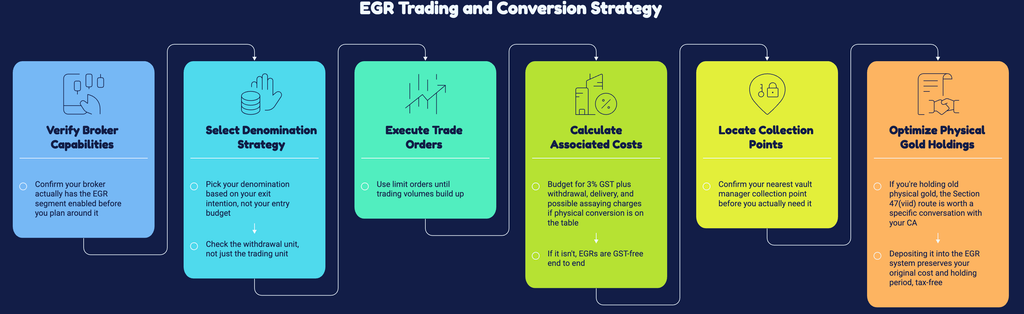
- Confirm your broker actually has the EGR segment enabled before you plan around it
- Pick your denomination based on your exit intention, not your entry budget — check the withdrawal unit, not just the trading unit
- Use limit orders until trading volumes build up
- Budget for 3% GST plus withdrawal, delivery, and possible assaying charges if physical conversion is on the table; if it isn’t, EGRs are GST-free end to end
- Confirm your nearest vault manager collection point before you actually need it
- If you’re holding old physical gold, the Section 47(viid) route is worth a specific conversation with your CA — depositing it into the EGR system preserves your original cost and holding period, tax-free
The Bottom Line
EGRs solve a real problem: gold that’s emotionally important but practically dead weight — uninsured, untraceable in value, and costly to keep safe. They let that same gold earn a market-discovered price, sit safely in demat form, and convert back to metal without a tax hit either way.
What they don’t yet solve is scale — thin trading volumes, limited vault coverage, and inconsistent broker support mean this is still an early-stage product, best approached as a genuine alternative for a segment of your gold holding, not a wholesale replacement for how you hold it today.
FAQs
No. Section 47(viid) of the Income Tax Act treats conversion between physical gold and an EGR, in either direction, as exempt from capital gains — your original cost of acquisition and holding period carry forward unchanged
No. EGRs are fungible, so you receive gold of the same purity and weight, but not necessarily the specific item you originally deposited — and you can collect from any vault manager location, not just where you deposited.
No. The EGR segment has to be separately enabled by each broker. Some major platforms, including ICICI Direct and Groww, have stated they don’t currently support it — check with your broker first.
You’ll pay 3% GST on the gold’s value at redemption, plus withdrawal, delivery, and possible assaying charges from the vault manager. Buying and holding EGRs without converting to metal attracts no GST at all.
Neither is universally better. Gold ETFs currently offer far deeper liquidity and simpler small trades; EGRs offer the option to hold and eventually convert to real metal, plus a distinct tax advantage for existing physical-gold holders under Section 47(viid). The right choice depends on whether physical convertibility matters to you.

Founder R.S.W. Personal Finance Advisors.
Chartered Wealth Manager (CWM®)
AMFI Registered MFD ARN-244802
APMI Registered PMS Distributor APRN-07002
B.E. (Mechanical ) | PGDM (Marketing) | 9+ years in personal wealth management | Based in Pune
Specialising in Holistic Wealth Management for salaried professionals and NRIs — using the RSW Financial Independence System.
Read more “About Me”