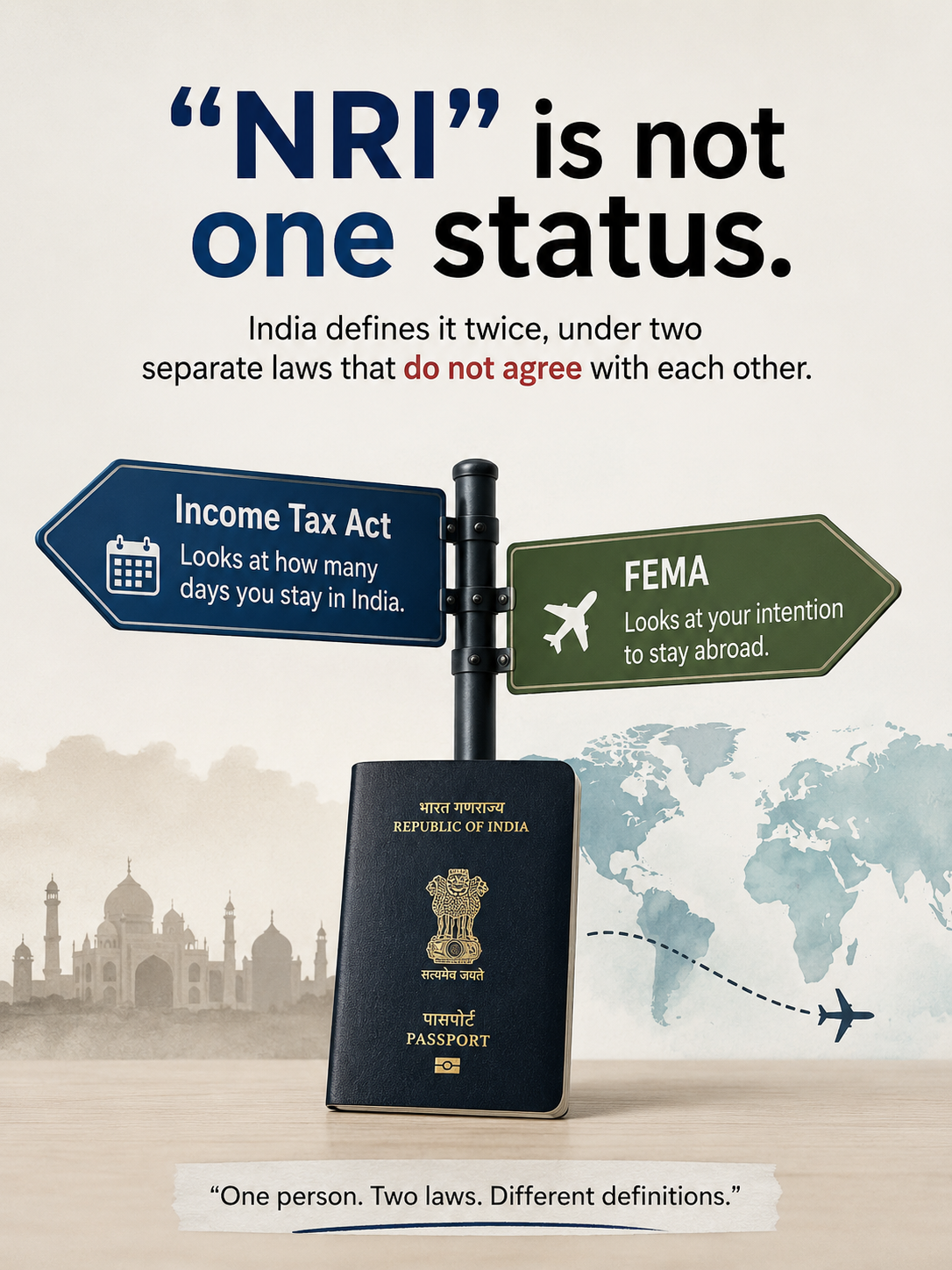
Once your status changes to NRI, FEMA does not permit you to operate a regular resident savings account — it must be converted to an NRO account, or you must open fresh NRE/NRO accounts. Continuing with a resident account is a FEMA violation that attracts heavy penalties. Which account you need depends entirely on where your money comes from.
The Basics
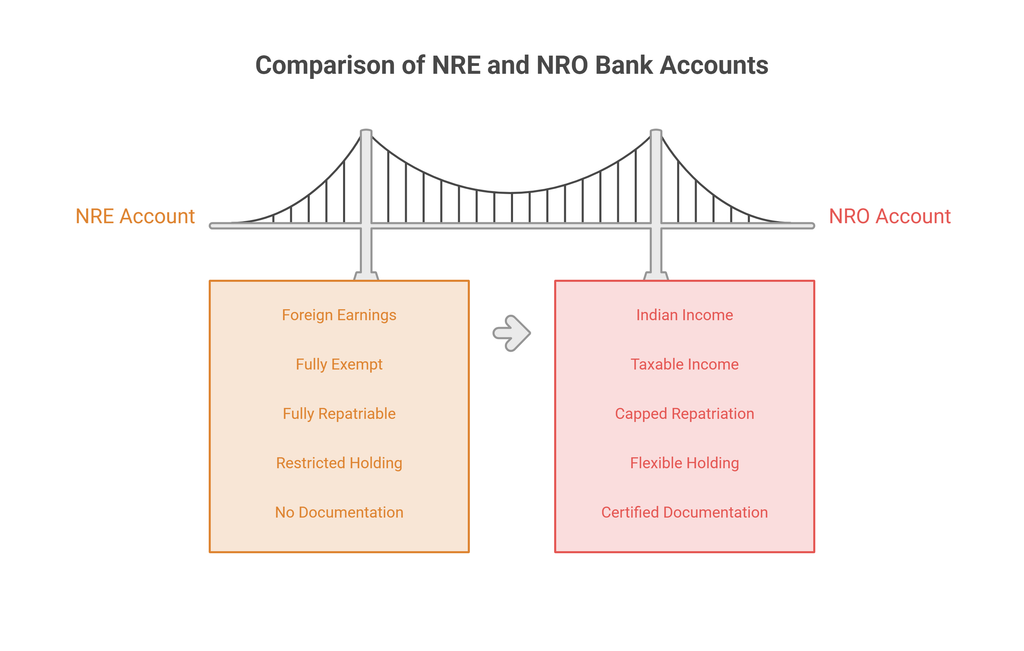
| Parameter | NRE Account | NRO Account |
|---|---|---|
| What it is | Rupee account for parking your foreign earnings in India— you remit foreign currency, the bank converts it to INR | Rupee account for managing income earned in India — rent, dividends, pension, interest, or sale proceeds |
| Credits allowed | Only foreign income or transfers from other NRE/FCNR accounts; Indian income like rent gets reversed by the bank | Both Indian income and foreign remittances |
| Account types | Savings, current, recurring or fixed deposit | Savings, current, recurring or fixed deposit |
| Joint holding | Only with another NRI/PIO; a resident close relative on former-or-survivor basis only | With another NRI/PIO/OCI, or with a resident Indian |
| Tax on interest | Fully exempt in India (no TDS) while you remain a non-resident | Taxable; TDS at 30% + surcharge + 4% cess (-31.2% effective), irrespective of total income |
| Tax abroad | India exemption doesn’ t travel— US/UK tax residents on global income; Gulf countries generally don’ t | Same: your country of residence may still tax this income |
| Rate relief | Not applicable (already exempt) | DTAA can cut TDS to -10—15% by submitting a Tax Residency Certificate + Form 10F before interest is credited |
| Refunds | Not applicable | Excess TDS refundable by filing an ITR in India; Form 15G/15H not available to NRIs |
| ITR filing | Not required on account of NRE interest | May be mandatory if Indian income exceeds the basic exemption limit, even after TDS |
| Repatriationlimit | Fully repatriable — principal and interest, no limits, no approvals | Capped at USD 1 million per financial year |
| Documentation | None | Taxes paid + Form 15CA/15CB (CA-certified); budget weeks, not days |
| Transfers between accounts | NRE → NRO: freely allowed | NRO → NRE or abroad: within the USD 1 million limit, with tax proof and CA certification |
| Property saleproceeds | Cannot be credited directly | Must land here first, repatriable only after tax computation and certification |
Converting Your Existing Account — Step by Step
This is the part most guides skip, and it’ s exactly where new NRIs get anxious for no reason.
Your account isn‘t closed and reopened — it‘s redesignated in place. Across every major bank, the account number stays the same after conversion.
Existing balance carries over automatically; you don’ t withdraw and redeposit anything.
Existing fixed deposits are not broken. FEMA does not allow directly converting a resident FD into an NRE FD — but it also doesn’ t force you to break one. Your resident FD is redesignated as an NRO FD and continues at the same contracted interest rate you already locked in, running to its original maturity date rather than restarting.
The process itself: (Put this in Napkin)
- Contact your bank’ s NRI desk (most banks have one specifically for this).
- Submit a resident-to-NRO conversion form, along with passport, visa/work permit or OCI card, and overseas address proof.
- If your Indian address hasn’ t changed, you typically don’ t need to resubmit Indian address proof — only the new overseas address is mandatory.
- The bank redesignates the account; many banks will also open a linked NRE account and register you for outward remittance services at the same time
— worth asking explicitly whether this happens automatically or needs a separate request.
Start this within 30 days of your status changing rather than waiting for a visit home — an unredesignated account is a live FEMA violation from the day your status changes, not from the day you get around to fixing it.
Staying Accessible From Abroad: The OTP Problem
This is arguably the single most common practical complaint from NRIs in 2026, and it has nothing to do with which account you choose.
Most Indian banks still tie net banking and UPI transaction OTPs to an Indian–registered mobile number. NRIs who let their Indian SIM lapse from inactivity or missed recharges can find themselves locked out of their own bank
accounts — sometimes requiring a full re-KYC across every linked financial account, not just banking.
What actually works: activate international roaming on your Indian SIM before you leave India, not after, and keep it recharged periodically even if you rarely use it. This remains the most reliable fix.
A genuine 2026 development worth knowing:
UPI now supports link UPI international mobile numbers directly for NRI’s in a of countries including the UAE, US, UK, Singapore, Australia, and Canada — through several major banks (SBI, HDFC, ICICI, Axis, and IDFC First among them).
This is a structural fix rather than a workaround, though reliability and country coverage still vary by bank, so don’ t treat it as a guaranteed substitute for keeping your Indian number active.
Which Account Should You Open?
Most NRIs need both. Overseas salary flows into the NRE account (tax-free, freely repatriable); rent, dividends and pension flow into the NRO account, which also pays your Indian bills and EMIs. The accounts are not interchangeable.
If you also want to shield foreign savings from rupee depreciation, an FCNR(B) fixed deposit — held in foreign currency with tax-free interest — complements the NRE account.
Your Investments: Existing Holdings vs Fresh Purchases
Your bank account isn’ t the only thing that needs sorting out — and this is where NRE vs NRO stops being just a banking question and starts shaping every investment decision you make from here on.
Existing investments — made while you were still a resident.
These were bought with resident, India-sourced money, so they’ re non-repatriable by definition, and redesignating your bank account does nothing to them automatically:
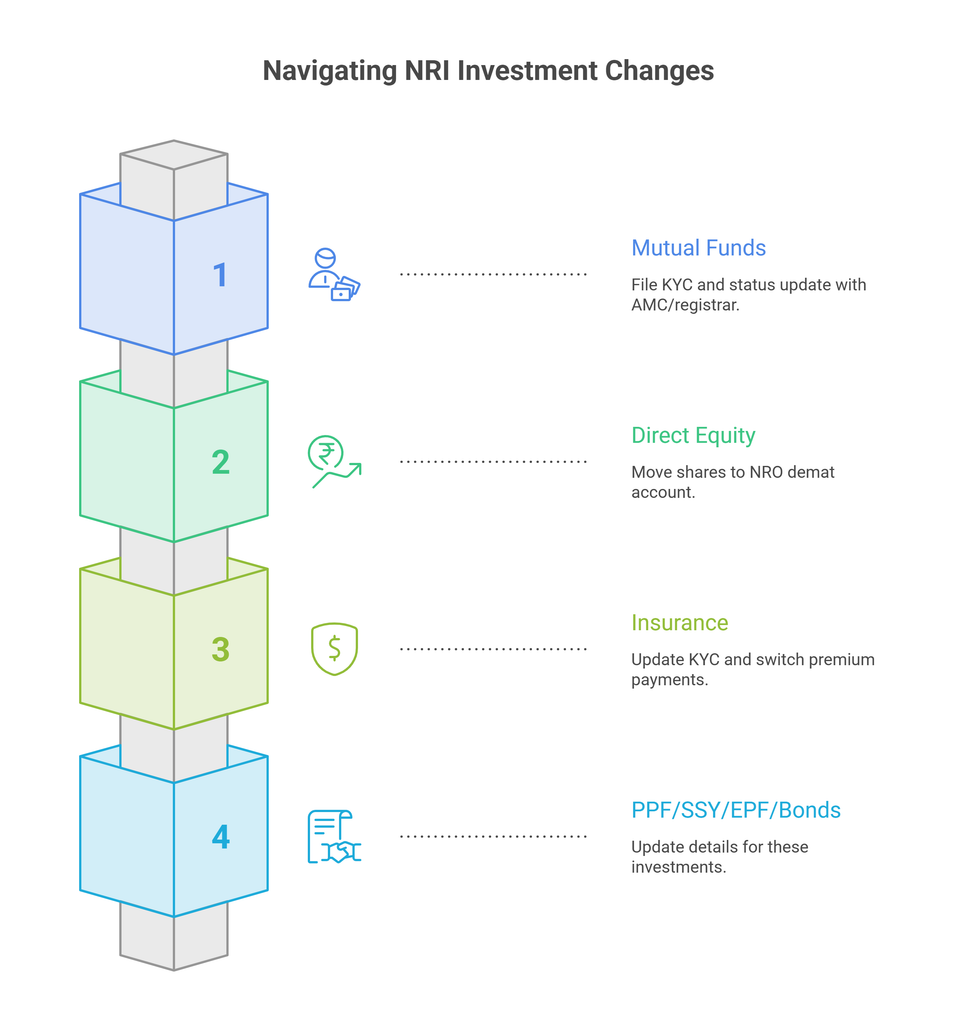
- Mutual funds: your existing folios need a separate KYC and status-update request filed directly with the AMC or registrar (CAMS/KFintech), changing
your status from Resident to NRI and adding your FATCA declaration. Skip this and redemption proceeds can get stuck or delayed.
- Direct equity / demat holdings: shares bought as a resident must be moved into an NRO demat account, not NRE — and this is one of the few cases where PIS never applies, since these holdings are non-repatriable regardless of what you do next.
- Insurance / ULIPs: update your KYC and switch future premium payments to an NRE or NRO account as appropriate.
- Need to update about PPF, SSY, EPF, Bonds,
Bottom line: existing holdings stay tied to India-sourced money and settle through NRO, even after your status changes.
Fresh investments — anything you buy from here on.
This is where the account you fund from actually decides your future flexibility, not the investment itself:
- Want it repatriable later? Fund it from your NRE account — but for listed equity specifically, that means an NRE–PIS account, not just any NRE account. An NRE savings account alone does not let you buy stocks. Mutual funds and IPOs, by contrast, need no PIS at all and can be bought directly through NRE.
- Investing Indian-sourced income, or don’ t need the money to leave India again? Fund it from NRO — no PIS required for any instrument.
The one rule that decides everything here: repatriability is fixed by the source of funds at the time of purchase — not by the instrument, and not by where you hold it afterward. Buy with NRO money today, and that investment stays non-repatriable permanently, regardless of which account you later want to route it through. Get this right before you invest, not after — it cannot be fixed retroactively.
Common Mistakes to Avoid
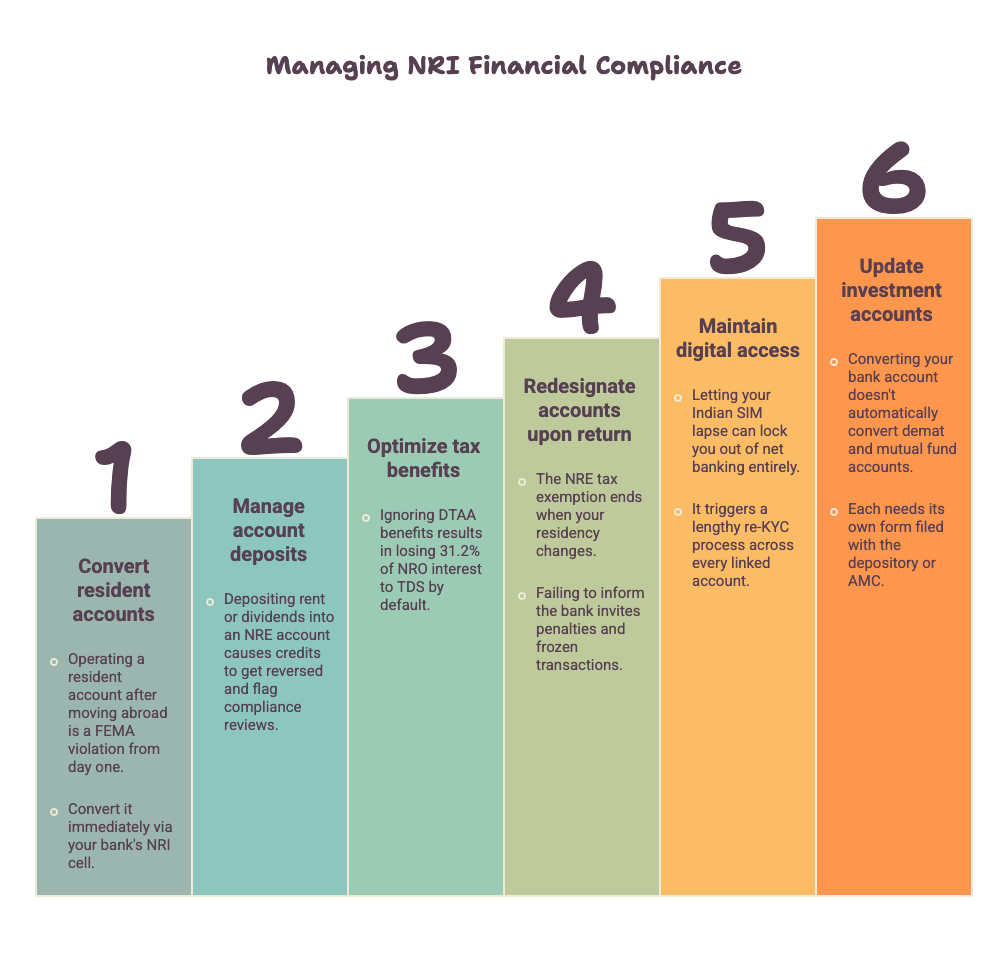
- Operating a resident account after moving abroad — a FEMA violation from day one; convert it immediately via your bank’ s NRI cell.
- Depositing rent or dividends into an NRE account — credits get reversed and flag compliance reviews.
- Ignoring DTAA benefits and losing 31.2% of NRO interest to TDS by default.
- Not redesignating accounts after returning to India — the NRE tax exemption ends when your residency changes; failing to inform the bank invites penalties and frozen transactions.
- Letting your Indian SIM lapse without a plan — this can lock you out of net banking entirely and trigger a lengthy re-KYC process across every linked account, not just your bank.
- Forgetting to redesignate demat and mutual fund accounts separately — converting your bank account doesn’ t automatically convert these; each needs its own form filed with the depository or AMC.
Frequently Asked Questions
Can I have both an NRE and an NRO account?
Yes — and most NRIs actually need both rather than choosing one.
The two accounts serve legally distinct purposes: NRE holds foreign earnings you want fully repatriable and tax-free, while NRO holds Indian-sourced income like rent, dividends, or pension that FEMA won’ t let you route through an NRE account at all.
Picking only one usually means either turning away legitimate Indian income (if you only have NRE) or needlessly paying 31.2% TDS on foreign salary that should have been tax-free (if you only have NRO).
The core list is the same for both: passport, a valid visa or work permit (or OCI card), PAN card, overseas address proof, and recent photographs.
The one practical snag people hit is attestation — these documents generally need to be notarised or attested by the Indian consulate or an overseas bank branch before an Indian bank will accept them, which can add days to the process if you haven’ t arranged it in advance.
The two directions are not equally easy. NRE → NRO is freely allowed — no paperwork beyond a normal transfer.
NRO → NRE runs the other way: it’ s capped at USD 1 million per financial year and requires proof that tax has been paid on those funds plus a CA-certified Form 15CB, because you’ re effectively asking FEMA to let non-repatriable money become repatriable.
This asymmetry is exactly why choosing the right account at the time you first deposit money matters more than people expect — fixing it later costs time and paperwork that opening the correct account from day one avoids entirely.
Neither is objectively better — the right one depends entirely on where the money comes from, not on which has better features. NRE wins on every metric (tax-free, freely repatriable) but legally cannot hold Indian-sourced income.
NRO is the only account that can legally hold your rent, dividends, or pension, even though it costs you TDS. Asking “which is better” is the wrong question; “where is this specific money coming from” is the right one, and it answers itself once you ask it that way.
It depends which account. On an NRO account, yes — a resident Indian can be a full joint holder, which is why many NRIs use NRO jointly with a parent who manages bills or property locally.
On an NRE account, a resident close relative can only be added on a “former or survivor” basis — meaning they can operate the account only after the primary NRI holder’ s death, not day-to-day while you’ re both alive. If you need a family member actively co-managing funds in India right now, that has to go through the NRO account.
Tax rates and FEMA rules are as of 2026 and subjectto change. Consulta qualified tax advisor for your
Want more clarity about NRI and Other queries [ Book a Call ] →

Founder R.S.W. Personal Finance Advisors.
Chartered Wealth Manager (CWM®)
AMFI Registered MFD ARN-244802
APMI Registered PMS Distributor APRN-07002
B.E. (Mechanical ) | PGDM (Marketing) | 9+ years in personal wealth management | Based in Pune
Specialising in Holistic Wealth Management for salaried professionals and NRIs — using the RSW Financial Independence System.
Read more “About Me”