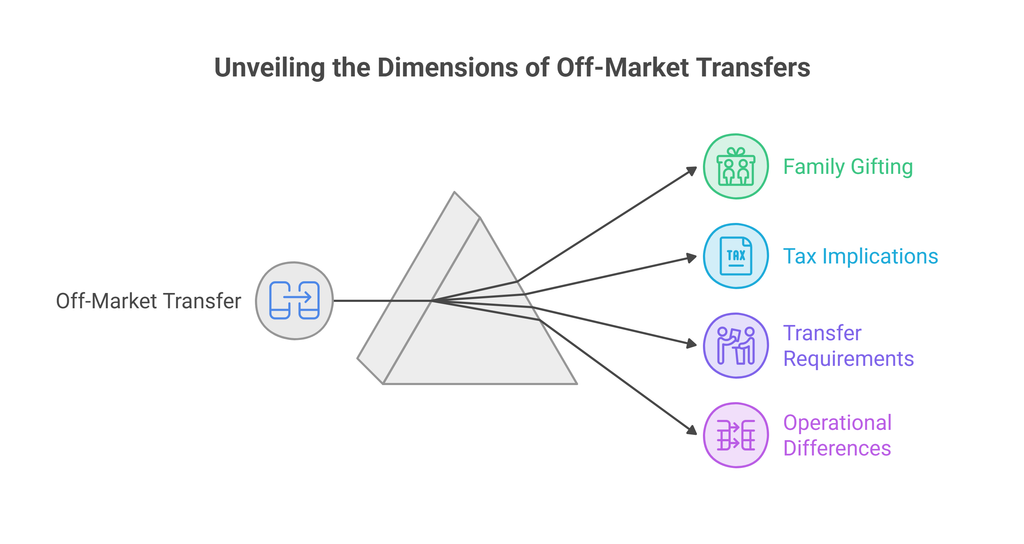
What Is an Off-Market Transfer of Mutual Fund Units?
An off-market transfer is a transfer of securities from one demat account to another without selling the units on a stock exchange. People also use this process frequently to transfer mutual fund units between different account holders.
In a family-gifting context, the donor transfers eligible mutual fund units to the recipient instead of redeeming the investment and handing over cash.
This distinction matters because a transfer is not the same transaction as a redemption.
Analyze separately the tax consequences of the gift itself and the tax consequences when the recipient later sells the units.
Units held in dematerialized form are transferable subject to the applicable depository rules, scheme restrictions and the recipient’s eligibility.
The exact operational route can differ between the depository, DP, AMC and RTA.
Why Families Use Mutual Fund Gifting?
Gifting mutual fund units can be useful when the objective is family wealth transfer rather than immediate liquidation of an investment.
- Transfer an existing investment to a spouse, child or other eligible family member without first redeeming the units.
- Preserve the investment rather than converting it into cash solely for gifting.
- Plan inter-generational wealth transfer while the donor is alive.
- Create a documented transfer of ownership rather than relying on an informal promise.
- Separate the ownership of an investment from the donor’s personal portfolio where legally and tax-wise appropriate.
However, gifting is not automatically a tax-saving strategy.
Transfers to a spouse can trigger clubbing provisions.
Transfers to minor children can have separate clubbing implications.
Check the recipient’s tax position before you make a large gift.
Is a Gift of Mutual Fund Units Taxable?
Under the income-tax framework, the recipient may owe tax on a gifted capital asset if they receive it for no consideration, or for inadequate consideration, and the statutory conditions apply.
However, the rule excludes gifts from specified ‘relatives’. So the tax authorities generally do not tax a genuine gift of mutual fund units from a qualifying relative as income merely because the recipient received the units.
| Situation | General treatment / planning point |
|---|---|
| Gift to specified relative | Generally not treated as taxable income merely because the gift was received, subject to the applicable statutory conditions. |
| Gift to a person who is not a specified relative | The recipient can potentially face tax under the gift provisions if the statutory thresholds and conditions are met. |
| Later sale by recipient | Capital-gains tax can arise when the recipient disposes of the units. |
| Spouse / minor child | Separate clubbing provisions can attribute income from the gifted asset back to the donor in specified circumstances. |
Never read ‘no tax on the gift’ as ‘no tax will ever arise.’
The tax analysis has at least two stages: receipt of the gift and eventual income/capital gain from the gifted asset.
Cost Basis and Holding Period: The Most Important Rule
When you receive a capital asset as a gift and later transfer it within the relevant provisions, you generally inherit the previous owner’s cost for tax purposes.
You do not get a fresh cost equal to the market value on the date of the gift.
Similarly, you generally add the previous owner’s holding period to your own when you determine the holding period.
This is why a gift does not normally create a tax-free ‘step-up’ in the investment’s cost simply because the NAV has increased.
| Question | Practical answer |
|---|---|
| Does the recipient get today’s NAV as cost? | Generally no. For assets covered by the gift provisions, the previous owner’s cost is carried forward, subject to the applicable tax rules. |
| Does the holding period restart? | Generally no. The previous owner’s holding period is included for determining the recipient’s holding period. |
| When does capital-gains tax arise? | Typically when the recipient later transfers/redeems the units, based on the applicable tax rules. |
| Should the donor’s original purchase statement be retained? | Yes. It is important evidence for cost and holding-period records. |
Worked Example 1: Transfer Between Spouses
Assume a husband owns mutual fund units currently worth ₹30 lakh. His original cost for the entire holding was ₹15 lakh, and he has held the units for two years. He gifts units worth ₹10 lakh to his wife.
| Item | Illustration |
|---|---|
| Current value transferred | ₹10 lakh |
| Proportionate original cost | ₹5 lakh |
| Gift consideration | Nil |
| Recipient | Wife |
| Immediate capital-gains event on the gift | The gift itself is not treated as a sale merely because ownership changes; applicable gift and clubbing rules must still be checked. |
| Recipient’s cost basis | Generally ₹5 lakh under the previous-owner cost rule |
| Holding period | Previous owner’s holding period is generally included |
If the wife later sells the units for ₹10 lakh, you calculate her capital gain using the carried-forward cost and holding period.
But there is an important additional issue: income arising from an asset transferred to a spouse without adequate consideration can be subject to clubbing provisions.
Therefore, do not automatically assume that the wife’s lower slab applies to the resulting tax.
This is a critical correction to a common planning assumption: simply gifting a mutual fund to a spouse does not necessarily shift the tax burden to the spouse.
Worked Example 2: Transfer to a Child
Suppose a parent owns mutual fund units currently worth ₹20 lakh and wants to transfer wealth to an adult child.
| Option | What happens |
|---|---|
| Option A — Direct gift of units | Eligible units are transferred to the child’s account. The gift itself can be exempt where the recipient qualifies as a specified relative. The parent’s historical cost generally carries forward for the recipient. |
| Option B — Sell units and gift cash | The parent first redeems the units. Any applicable capital-gains tax on that sale is the parent’s responsibility. The parent then gifts the cash and the child purchases fresh mutual fund units at the then-current NAV. |
The two routes can therefore produce very different tax timing.
Direct gifting generally preserves the historical cost, while selling and repurchasing resets the child’s cost to the new purchase price but may trigger capital-gains tax for the parent immediately.
If the child is a minor, clubbing provisions need separate consideration.
If the child is an adult, the income-tax analysis generally differs, but you should still record the recipient’s own tax position and the source and documentation of the gift.
Off-Market Transfer vs Selling and Gifting Cash
| Factor | Direct MF gift | Sell MF → gift cash → child buys |
|---|---|---|
| Existing investment | Continues with recipient | Old investment is sold |
| Donor’s capital gain at transfer stage | Generally no sale/redemption merely due to gift | Capital gain may arise on donor’s sale |
| Recipient’s cost | Generally carries forward previous owner’s cost | Fresh cost equals child’s purchase price |
| Holding period | Previous owner’s period generally included | New holding period begins from child’s purchase |
| Market exposure | Investment remains invested during transfer | Market exposure can change between sale and repurchase |
| Documentation | Gift + transfer records | Sale + gift + purchase records |
How Valuation Works
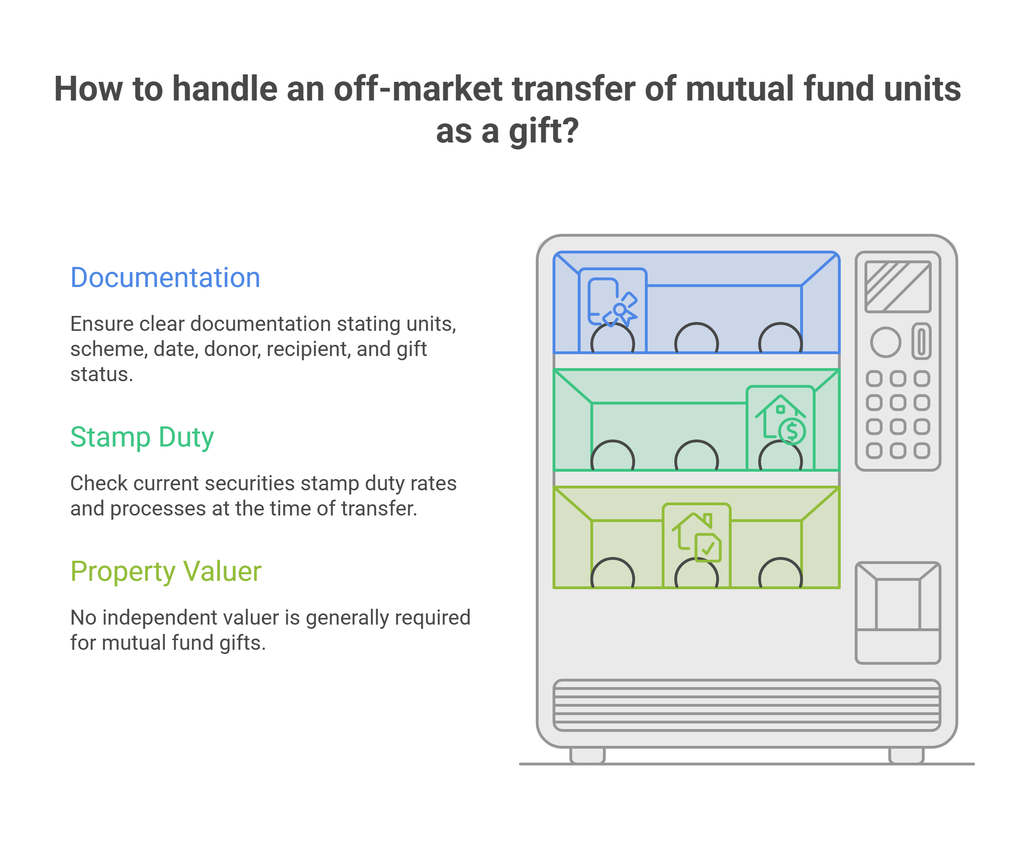
For an off-market transfer of mutual fund units, the number of units transferred and the applicable NAV/market value provide the economic value of the gift. Unlike a property transfer, a mutual fund gift generally does not require an independent property valuer.
The documentation should nevertheless clearly state the units transferred, the scheme, the date, the donor, the recipient and the fact that the transfer is a gift without consideration.
Also note that stamp-duty treatment for securities transfers is separate from income-tax treatment.
SEBI material states that off-market transfers of securities through depositories can attract securities stamp duty. Check the applicable rate and rules at the time of transfer.
Do not rely on a generic ₹100–₹1,000 figure without checking the current applicable law and state/depository process.
Documentation Checklist
| Document | Why it matters |
|---|---|
| Gift deed | Records the donor, recipient, intention to gift, units and consideration. |
| Folio / holding statement before transfer | Establishes the donor’s original holding. |
| Purchase statements / transaction history | Supports original cost and holding period. |
| DP transfer instruction | Authorises the demat transfer. |
| PAN / KYC records | Supports identity and compliance requirements. |
| Recipient’s demat details | Ensures the units are transferred to the correct account. |
| Transfer confirmation | Evidence that ownership changed. |
| Tax working papers | Useful when the recipient later sells the gifted units. |
A formal gift deed is strongly recommended even where family members have a close relationship.
The exact stamp-paper and registration requirements can vary by state and the nature of the instrument, so the local requirements should be verified.
Worked Example 3: Multi-Generation Wealth Transfer
Consider a simplified family wealth-transfer example:
| Stage | Value | Original cost carried forward | Tax planning point |
|---|---|---|---|
| Grandparent acquires units | ₹5 lakh cost in 2010 | ₹5 lakh | Original acquisition records retained. |
| Grandparent gifts to parent | ₹50 lakh current value | Generally ₹5 lakh | Gift and applicable relative exemption assessed. |
| Parent gifts to grandchild | ₹60 lakh current value | Generally ₹5 lakh | Second transfer does not ordinarily create a fresh cost step-up. |
| Grandchild later sells | ₹70 lakh sale value | Generally ₹5 lakh cost | Taxable gain is broadly based on the carried-forward cost, subject to the applicable law and holding-period rules. |
The example demonstrates the core principle: repeated gifting does not repeatedly reset the tax cost to the market value. It can transfer ownership, but the embedded gain generally travels with the asset.
Spousal Gifting and Clubbing Provisions
Spousal gifting requires special care.
Although a qualifying gift to a spouse generally falls outside the gift-taxation provisions, the tax authorities can club the income from an asset you transfer to your spouse without adequate consideration back into your income under the applicable income-tax provisions.
- Do not assume that transferring units to a lower-income spouse automatically moves future capital gains into the spouse’s lower tax bracket.
- Keep a clear record of the donor, recipient, date, units and original cost.
- Use a formal gift deed rather than relying only on an informal family arrangement.
- Obtain tax advice for large transfers, particularly where the portfolio contains substantial unrealised gains.
Timing and Tax Planning: What Not to Assume
The source brief suggested that gifting from a high-income family member to a low-income family member could automatically produce a tax saving of ₹5–10 lakh on a ₹50 lakh-plus portfolio.
That should not be presented as a guaranteed outcome.
The actual result depends on who receives the asset, whether clubbing applies, the recipient’s status, the asset’s acquisition date and tax category, the capital gain, other income, applicable tax regime and the year of sale.
| Planning question | Better approach |
|---|---|
| Can I lower tax by gifting to my spouse? | First test the clubbing provisions; do not assume the spouse’s slab will apply. |
| Can I gift to an adult child to spread gains? | Potentially useful for genuine wealth transfer, but model the recipient’s tax position and future sale. |
| Should I gift just before a sale? | Do not do this solely for tax arbitrage without professional review. |
| Should I sell and repurchase instead? | Compare immediate donor tax against future recipient cost basis and holding period. |
Gift vs Will/Succession
A lifetime gift and a transfer through a will are different estate-planning tools.
| Consideration | Lifetime gift | Will / succession |
|---|---|---|
| When ownership changes | During donor’s lifetime | Generally after death through succession process |
| Control after transfer | Donor normally gives up ownership of gifted units | Donor generally retains ownership during lifetime |
| Reversibility | Generally not freely reversible once validly completed | A will can generally be changed while the testator has capacity |
| Tax / documentation | Gift and applicable tax, stamp and transfer rules | Succession/transmission and estate documentation apply |
| Best suited for | Immediate inter-generational transfer where the donor is comfortable giving up ownership | Retaining control while documenting future inheritance wishes |
For a substantial family portfolio, consider your will, nominations, ownership structure and lifetime gifts together. Don’t treat any one method as universally better.
Can You Reverse a Gift?
A completed gift is generally not something the donor can simply cancel because circumstances changed. The legal position depends on how you structured the gift and which law applies.
- Do not gift assets that you may need for your own retirement spending.
- State the intention and terms clearly in the gift documentation.
- Where the amount is significant, obtain legal advice before execution.
- Do not use a gift arrangement merely as a temporary nominee structure.
Benami and Beneficial Ownership Considerations
A genuine gift should represent a genuine transfer of ownership. The donor should not use an apparent gift to conceal the real beneficial owner, evade tax or defeat a legal obligation.
The transaction should therefore have a clear commercial/family purpose, proper documentation, identifiable parties and an actual change in ownership.
Complex family structures should be reviewed by a qualified legal/tax professional before execution.
Common Mistakes
| Mistake | Why it can cause problems |
|---|---|
| Assuming gifting is always tax-free | The recipient’s relationship to the donor and the later sale matter. |
| Assuming cost resets to today’s NAV | Gifted assets generally carry forward the previous owner’s cost under the applicable provisions. |
| Ignoring clubbing | Spouse/minor-child transfers can have income-attribution consequences. |
| Using informal documentation | It can create ownership, tax and succession disputes later. |
| Ignoring stamp duty / DP charges | Demat transfers can have applicable statutory or intermediary charges. |
| Failing to retain original purchase records | The recipient may later struggle to establish cost and holding period. |
| Treating every MF unit as transferable in the same way | Scheme, holding mode, lock-in and depository/RTA procedures can differ. |
| Gifting retirement assets without a cash-flow plan | The donor may compromise their own financial security. |
FAQ
Yes, subject to the holding mode, scheme/depository rules and the recipient’s eligibility.
You can transfer demat-held units through the depository mechanism, while non-demat holdings may follow a different AMC/RTA process.
A genuine gift to a specified relative is generally outside the recipient’s taxable gift provisions, subject to the conditions in the tax law. Gifts to non-relatives can have different consequences.
Generally no. For assets covered by the relevant gift provisions, the recipient carries forward the previous owner’s cost.
Generally yes.
The recipient adds the previous owner’s holding period to their own.
No. Clubbing provisions can attribute income arising from assets transferred to a spouse back to the transferor in specified circumstances.
A genuine gift to an adult child can generally qualify as a gift to a specified relative.
The future tax consequences on sale and any documentation requirements should still be planned.
Minor-child clubbing provisions can apply to income arising from assets transferred to the minor, subject to the applicable law and exceptions.
A formal gift deed is strongly recommended for significant transfers because it documents the intention, parties, asset and lack of consideration.
Exact stamp/registration requirements vary.
The units and applicable NAV/market value provide the economic value. The transfer documentation should clearly identify the units and date.
Securities stamp duty can apply to off-market transfers through depositories. The applicable rate and collection mechanism should be checked at the time of transfer.
Do not assume so. A completed gift is generally not freely reversible, so the donor should transfer only assets they are comfortable giving away.
Neither is universally better. A lifetime gift gives up ownership now, while a will generally preserves ownership and control during the donor’s lifetime.
Keep the gift deed, original purchase statements, folio/demat statements, transfer instruction, confirmation of transfer, PAN/KYC records and a tax working showing original cost and holding period.
Want more clarity[ Book a Call ] →

Founder R.S.W. Personal Finance Advisors.
Chartered Wealth Manager (CWM®)
AMFI Registered MFD ARN-244802
APMI Registered PMS Distributor APRN-07002
B.E. (Mechanical ) | PGDM (Marketing) | 9+ years in personal wealth management | Based in Pune
Specialising in Holistic Wealth Management for salaried professionals and NRIs — using the RSW Financial Independence System.
Read more “About Me”