For decades, the EPF’s greatest strength was that you couldn’t touch it. Withdrawals were hard, so the money compounded.
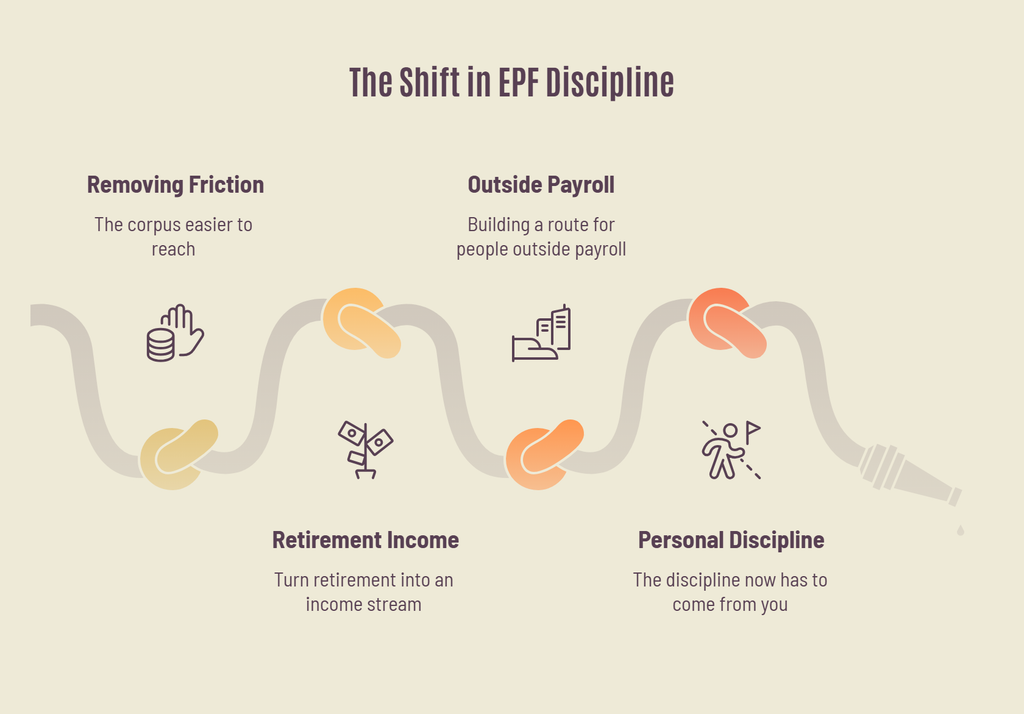
On November 19, EPFO’s board began to remove that friction. The EPFO changes 2026 make the corpus easier to reach, turn retirement into an income stream, and start building a route for people outside payroll.
The product is the same, but the discipline now has to come from you.
What Are the EPFO Changes 2026?
| Item | Before | Now | What it means |
|---|---|---|---|
| Minimum balance | 25% of contributions had to stay in the account | 10% | A much larger share of the corpus can be withdrawn |
| Final-settlement wait | 12 months (a tightening from October 2025, per Business Standard) | 2 months | Someone out of work can reach the full balance quickly |
| Retirement payout | Mainly one lump sum | Voluntary Systematic Withdrawal Plan (SWP): monthly, quarterly or half-yearly | Retirement can become an income stream while the balance keeps earning |
| Voluntary contributions | Tied to employer payroll | UAN-linked direct and third-party micro-contributions (such as customer tips) approved | A first step toward people outside payroll; eligibility is not yet stated |
| EDLI exemptions | Legacy cases pending | Six-month window to renew lapsed exemptions | Possible relief from contributions, interest and penal damages, subject to verification |
| AIF investment (Alternative Investment Funds) | Not stated in the release | Up to 3% of fresh accretion in eligible AIFs | Starts mainly through government-backed entities; signals a search for higher yield |
The EPF rate for FY26 is 8.25%. The SWP’s initial target is about 6.32 lakh members above 55 with balances over ₹5 lakh.
EPFO Changes 2026: What Is Confirmed and What Is Still Open
Headlines said the self-employed can now join. The official release does not name them. Here is where things stand.
| Topic | Confirmed (PIB) | Reported only | Still open |
|---|---|---|---|
| Voluntary contributions | Mechanism approved | Gig and unorganised workers at a later stage | Who is eligible, including proprietors and partners |
| SWP | Voluntary; periodic payouts | Up to 20 years; annual option; start in about two months | Tax treatment of instalments |
| Partial withdrawal | No new rules announced | Limit raised from 75% to 90% | Whether the 90% limit is official |
| Legal status | Scheme amendments to be notified | Legal vetting to follow | Income Tax Act amendment and contribution limits |
In short, this is a direction, not yet a product.
EPFO Changes 2026 by Age: Up to 45 and Above 45
| Up to 45, salaried | Up to 45, business owner | Above 45, salaried | Above 45, business owner | |
|---|---|---|---|---|
| Main risk | Early withdrawals that break compounding | One asset (the business) funds everything | Unplanned payout at retirement | No income once the business is sold or slowed |
| First action | Transfer PF on a job change, don’t cash out | Build a non-business debt leg | Map monthly needs to the EPFO SWP and NPS annuity | Decide what you will draw from the business |
| Also do | Keep term cover separate | Hold a reserve of 4–6 months of fixed costs | Check KYC and nominees | Find any old EPF account |
| Avoid | Using PF for monthly cash gaps | Planning around EPF eligibility | Committing before tax rules are clear | Mixing reserve and retirement money |
Up to 45: Protect the Compounding
You have 15 years or more, so time is your biggest asset. Money withdrawn at 40 stops compounding for decades. A lower minimum balance is not a reason to withdraw.
Use PF for goals, not cash-flow gaps. If you run a business or work independently, build a retirement leg that does not depend on it, and keep a separate reserve so a delayed receivable never becomes a reason to touch retirement money.
Above 45: Plan How the PF Pays You
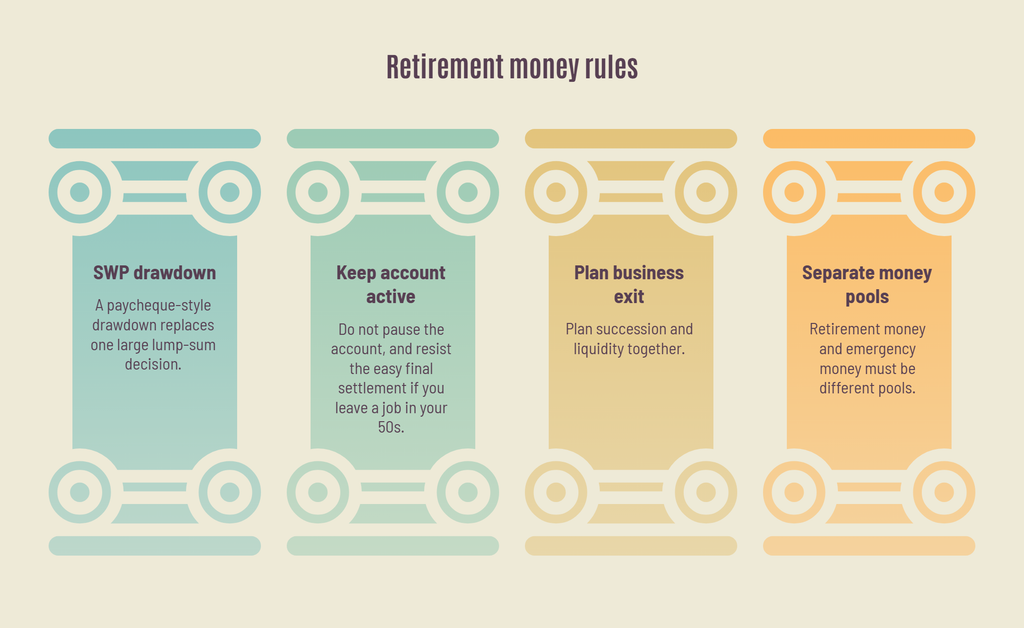
The question changes from how much you have to how it will be paid out. The SWP replaces one large lump-sum decision with a paycheque-style drawdown, which reduces the risk of investing a big sum at the wrong moment.
Do not pause the account, and resist the easy final settlement if you leave a job in your 50s. If you run a business, your retirement plan is your exit, so plan succession and liquidity together.
The same rule at every age: retirement money and emergency money must be different pools. When the lock was in the rules, that separation was automatic. Now you have to create it deliberately.
EPFO SWP and NPS Annuity: Your Monthly Income After Retirement
If you are salaried and hold both an EPF account and an NPS account, retirement can now be paid from two sources. The EPFO SWP can give you a flexible income from your provident fund. The NPS annuity can give you a fixed one from your pension account. Together, they change how you arrange the rest of your finances.
How the Two Sources Differ
| Source | How it pays | Strength | Watch-out |
|---|---|---|---|
| EPFO SWP | Monthly, quarterly or half-yearly instalments; the balance keeps earning the EPF rate (8.25% for FY26) | Flexible, and the rest of the corpus stays invested | Approved but not yet live; tax treatment not yet decided |
| NPS annuity | A fixed pension from an insurer, bought with part of your NPS corpus | Predictable, contractual income | The payout is fixed, so its real value falls with inflation, and it is taxed at your slab rate |
For non-government NPS subscribers, up to 80% of the corpus can be taken as a lump sum at normal exit, and at least 20% must go into an annuity. Government employees remain limited to a 60% lump sum. NPS also offers systematic withdrawal routes, so the annuity is one choice among several. If you hold only an EPF account, the SWP is your main option for now.
How to Rearrange Your Finances After the EPFO Changes 2026
- Start with the monthly number. Split your retirement spending into essentials (food, rent, insurance, EMIs) and flexible spending (travel, gifts). Meet essentials from sources that do not move with markets, such as the NPS annuity and any pension. Meet flexible spending from the EPFO SWP.
- Choose the annuity share deliberately. The 20% minimum is a floor, not a recommendation. A larger share buys certainty, but it is fixed and taxable, so size it to your essentials rather than your fear.
- Let the EPF keep compounding until you retire. The SWP keeps the remaining balance earning, so withdrawing everything at exit is no longer the default. Wait for the tax rules before you commit to a structure.
- Keep an inflation leg. Fixed annuity payouts lose purchasing power over time, so hold part of your other savings, such as equity mutual funds, to raise your income later.
- Revisit what you hold for income. With two predictable sources in place, you may need less in fixed deposits and debt funds, and can hold more for growth.
This is a planning framework, not a rule. The right mix depends on your expenses, health, dependants and tax position.
What to Watch After the EPFO Changes 2026
| Open question | Why it matters | Who is affected |
|---|---|---|
| Who qualifies for voluntary contributions | Decides whether business owners can join | Proprietors, partners, professionals |
| Tax on SWP instalments and the retained balance | Determines the income you actually receive | Everyone above 55 |
| Notification of the amended EPF Scheme | Decides when the SWP can begin (reported: about two months) | Members nearing retirement |
| Contribution limits | Set how much you can build | Voluntary payers |
| The 3% AIF allowance | EPF is valued for its stability, so a push for higher yield changes its risk profile | All members |
EPFO Changes 2026: Frequently Asked Questions
Not yet. The board approved voluntary contribution mechanisms, but the release does not say who is eligible, and the scheme and tax amendments are pending.
A voluntary option for retiring members to take PF savings in instalments while the remaining balance keeps earning, instead of one lump sum.
10% of contributions, down from 25%.
Yes, if you hold both accounts. The SWP pays from your EPF and the annuity from your NPS. The SWP is approved but not yet live, so plan the structure now and finalise it once the rules and tax treatment are notified.
The Bottom Line
EPF stopped forcing you to be disciplined. Under 45, the job is to leave it alone. Above 45, the job is to plan how it pays you, and for salaried savers that now means deciding how the EPFO SWP and the NPS annuity share the work. Either way, the lock is now yours to keep.
Further changes will be updated as the amendments are notified.
Want more clarity[ Book a Call ] →

Founder R.S.W. Personal Finance Advisors.
Chartered Wealth Manager (CWM®)
AMFI Registered MFD ARN-244802
APMI Registered PMS Distributor APRN-07002
B.E. (Mechanical ) | PGDM (Marketing) | 9+ years in personal wealth management | Based in Pune
Specialising in Holistic Wealth Management for salaried professionals and NRIs — using the RSW Financial Independence System.
Read more “About Me”