Why This Category Exists
Every investor entering equity markets for the first time faces the same problem — they understand intellectually that markets will fall, but they are not prepared emotionally for when it happens.
A 30% correction in a pure equity portfolio triggers panic exits. Panic exits lock in losses permanently and destroy compounding — the single most damaging behaviour in long-term wealth building.
SEBI created the Aggressive Hybrid category to solve this problem. By mandating 20–35% in debt at all times, the category structurally reduces drawdown depth. When markets fall 30%, an Aggressive Hybrid typically falls 18–22% — the smaller drawdown reduces the emotional pressure to exit, and staying invested through corrections is precisely what builds wealth.
The category is not designed to maximise returns. It is designed to maximise investor behaviour.
Where Aggressive Hybrid Funds Fit in a Wealth Plan
Aggressive Hybrid funds maintain 65–80% in equity and 20–35% in debt — the built-in debt cushion moderates volatility without eliminating equity growth potential.
Within the RSW Financial Independence Framework, they serve two roles:
- Accumulate Wealth: First equity instrument for investors transitioning from Build Safety Net — the debt allocation provides a behavioural cushion for investors not yet comfortable with pure equity volatility.
- Accumulate Wealth — Goal Proximity: De-risking instrument for investors within 3–5 years of a goal deadline — replacing a portion of pure equity reduces portfolio volatility without a full exit to debt.
Aggressive Hybrid funds are not a permanent core allocation. An investor with a 10+ year horizon generates significantly more wealth through a pure Flexi Cap or Multi Cap allocation. The hybrid earns its place only when the horizon is medium-term or behavioural risk is a genuine concern.
The 5-Parameter Evaluation Framework
| Parameter | What It Measures | Why It Matters in Wealth Planning |
| Risk-Adjusted Returns | Sharpe & Sortino Ratios | Efficiency of return across the equity-debt blend |
| Consistency | Rolling 3Y/5Y/7Y returns across cycles | Confirms the debt cushion is working as intended |
| Volatility & Downside Risk | Std Dev & Max Drawdown | Lower than pure equity — validates the hybrid mandate |
| Cost Structure | Expense ratio & exit load | Directly erodes the return advantage of the debt component |
| Fund Stability | AUM, fund age, manager tenure | Cycle-tested credibility across equity and debt conditions |
Top 4 Aggressive Hybrid Funds for Wealth Management — 2026 Evaluation
| Fund | Mean Return (%) | Sharpe | Sortino | Std Dev (%) | Expense Ratio (%) | Fund Age | Portfolio Turnover (%) |
| Bank of India Mid & Small Cap Eqt & Debt | 19.28 | 0.83 | 1.14 | 16.08 | 1.81 | 9Y 10M | 82.00 |
| ICICI Pru Equity & Debt | 15.66 | 0.90 | 1.24 | 10.84 | 1.24 | 26Y 7M | 41.00 |
| Edelweiss Aggressive Hybrid | 13.87 | 0.69 | 0.90 | 11.58 | 1.62 | 16Y 9M | 78.00 |
| SBI Equity Hybrid | 13.34 | 0.69 | 0.95 | 10.76 | 1.12 | 30Y 5M | 18.00 |
Note: Beta and Alpha are not applicable for Hybrid funds as benchmark composition differs from pure equity indices. Risk ratios and fund data as of May 2026. Past performance does not guarantee future results. Source: Value Research.
ICICI Pru Equity & Debt — Core Portfolio Anchor
Leads on Sharpe (0.90) and Sortino (1.24) with the lowest standard deviation among top performers (10.84%) — confirming the debt component functions as a genuine volatility buffer. The 26-year track record is the deepest in this evaluation, and the ₹50,368 Cr AUM reflects strong institutional confidence. Expense ratio at 1.24% is well-justified by the performance profile.
Wealth management role: Primary Aggressive Hybrid allocation within the Accumulate Wealth stage. The benchmark for risk-adjusted performance in this category.
SBI Equity Hybrid — Longest Track Record, Lowest Cost
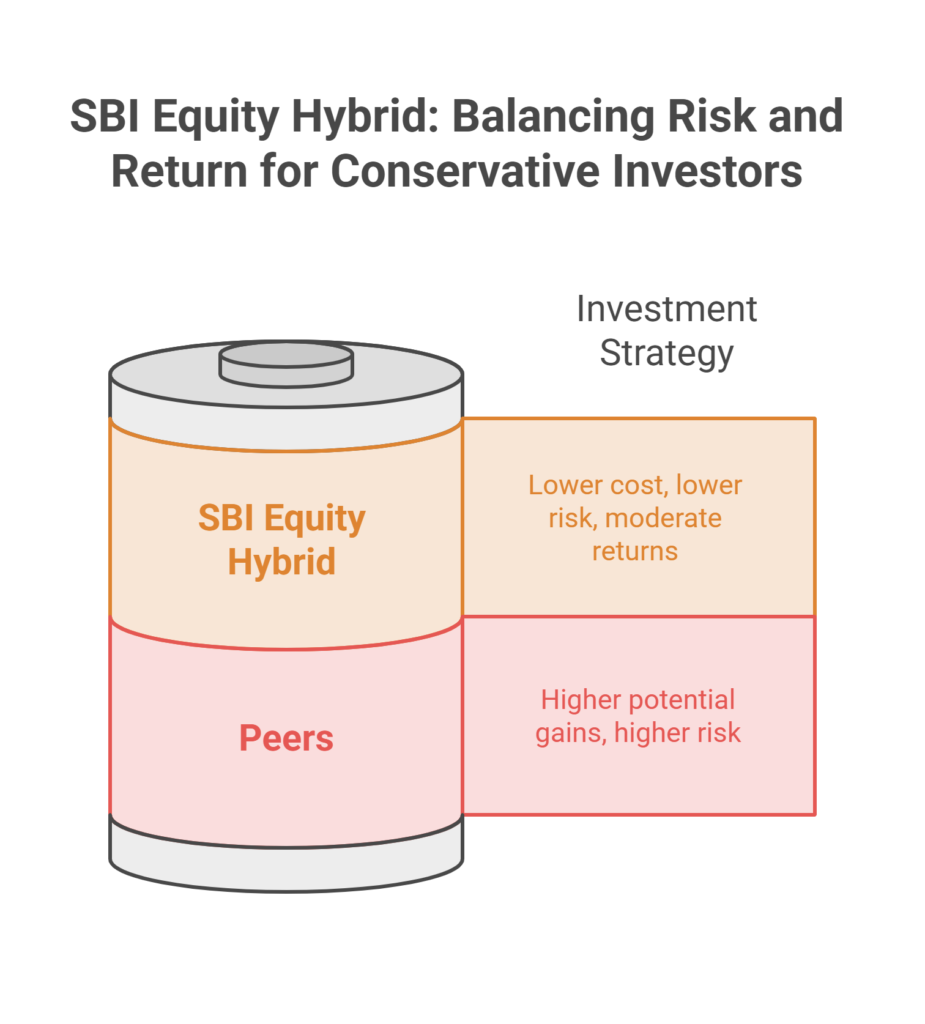
Thirty years of history across multiple equity and debt cycles — the only fund in this evaluation with that depth. The lowest expense ratio (1.12%) and portfolio turnover (18%) make it the most cost-efficient and tax-friendly choice. Standard deviation of 10.76 is the lowest in the group. Mean return of 13.34% trails peers, but the cost and stability profile make it compelling for conservative investors.
Wealth management role: Primary allocation for conservative investors entering Accumulate Wealth for the first time, or as a goal-proximity de-risking instrument 3–5 years from a deadline.
Bank of India Mid & Small Cap Eqt & Debt — Highest Return, Highest Risk
Leads on mean return (19.28%) but carries the highest standard deviation (16.08%) — closer to a pure Mid Cap fund than a conventional hybrid. This is structurally a mid-small cap equity fund with a debt overlay, not a balanced hybrid. AUM of ₹1,482 Cr and fund age of 9Y 10M further limit cycle validation.
Wealth management role: Not suitable as a core Aggressive Hybrid holding. Appropriate only as a tactical high-return satellite for experienced investors who understand the mid-small cap risk concentration.
Edelweiss Aggressive Hybrid — Moderate Profile, High Churn
Sharpe of 0.69 and Sortino of 0.90 are acceptable, but portfolio turnover of 78% creates transaction and tax drag that disproportionately erodes returns in a hybrid structure. The 16-year track record provides reasonable cycle validation but does not outperform SBI Equity Hybrid at better cost.
Wealth management role: Secondary allocation only. Not a primary recommendation when SBI Equity Hybrid or ICICI Pru Equity & Debt are available at better cost and risk profiles.
A Critical Observation: Hybrid Funds Are a Transition Tool — Not a Destination
| Investor Stage | Appropriate Use | Inappropriate Use |
|---|---|---|
| Early Accumulate Wealth | First equity instrument — behavioural cushion | Permanent replacement for Flexi Cap |
| Mid Accumulate Wealth | Satellite alongside Flexi Cap for stability | Core allocation — reduces return potential |
| Goal Proximity — 3–5Y | De-risking instrument replacing pure equity | Sole holding — insufficient debt protection |
| Accelerate Wealth | No role — pure equity delivers better alpha | Substituting Mid Cap or Small Cap exposure |
An investor holding an Aggressive Hybrid as their only equity allocation for 15 years will generate meaningfully less wealth than one who transitions to a Flexi Cap or Multi Cap core and uses the hybrid only at transition or goal-proximity phases.
Positioning Aggressive Hybrid Funds by Goal
| Goal | Recommended Funds | Complementary Instruments |
|---|---|---|
| First Equity Investment — 5–7Y horizon | SBI Equity Hybrid or ICICI Pru Equity & Debt | Liquid fund for emergency corpus |
| Accumulate Wealth — CORE goal funding | ICICI Pru Equity & Debt as primary | Flexi Cap as equity core as confidence grows |
| Goal Proximity — 3–5Y de-risking | SBI Equity Hybrid replacing Flexi Cap partially | Short duration debt for final 2Y |
A Fund Selection Is Not a Wealth Plan
An Aggressive Hybrid fund reduces the discomfort of equity volatility — but also reduces the return potential of a pure equity allocation. This trade-off is appropriate at specific stages and for specific investor profiles.
Choosing the right hybrid fund is one input. Understanding when to use it, how long to hold it, and when to transition requires a structured plan built around your goals, your risk capacity, and your RSW stage.
Book your free wealth planning consultation →
Frequently Asked Questions
Q: If I already hold a Flexi Cap fund, do I also need an Aggressive Hybrid fund?
A: Only if you are within 3–5 years of a goal deadline and want to reduce volatility without a full exit to debt. For long-horizon investors with 7+ years, adding a hybrid reduces return potential without a meaningful risk benefit.
Q: Is an Aggressive Hybrid fund suitable as my first equity investment?
A: Yes — one of the most appropriate entry points for first-time equity investors. The mandatory debt allocation cushions drawdowns. Once you are comfortable with equity behaviour through a full cycle, transitioning to a Flexi Cap or Multi Cap core generates better long-term returns.
Q: How much of my portfolio should be in an Aggressive Hybrid fund?
A: For early Accumulate Wealth investors, up to 40–50% of equity allocation as a starting point — reducing to 20–30% as equity confidence grows. For goal-proximity de-risking, typically 30–50% of the equity portion in the final 3–5 years before a deadline.
Q: How is an Aggressive Hybrid fund taxed?
A: Taxed as an equity fund — LTCG at 12.5% for gains held over 12 months with ₹1.25 lakh annual exemption, and STCG at 20% under 12 months. A significant tax advantage over pure debt funds taxed at slab rate regardless of holding period.
Q: At what stage of my wealth plan should I exit an Aggressive Hybrid fund?
A: If it is your first equity instrument, begin transitioning to a pure equity core once comfortable with market volatility. If it is a goal-proximity tool, shift to short-duration debt in the final 2 years before the deadline. Never exit abruptly — a phased transition protects both returns and behavioural discipline.
Begin your rebalancing review for you Portfolio [ Book a Call ] →

Founder R S W Personal Finance Advisors.
B.E , PGDM [Marketing] ,
Chaterered Wealth Manager,
PMS Disributor, Mutual Fund Distributor.
Passionate about Personal Wealth Management. Practising 4+ Years.
Read more “About Me”