
Why This Category Exists
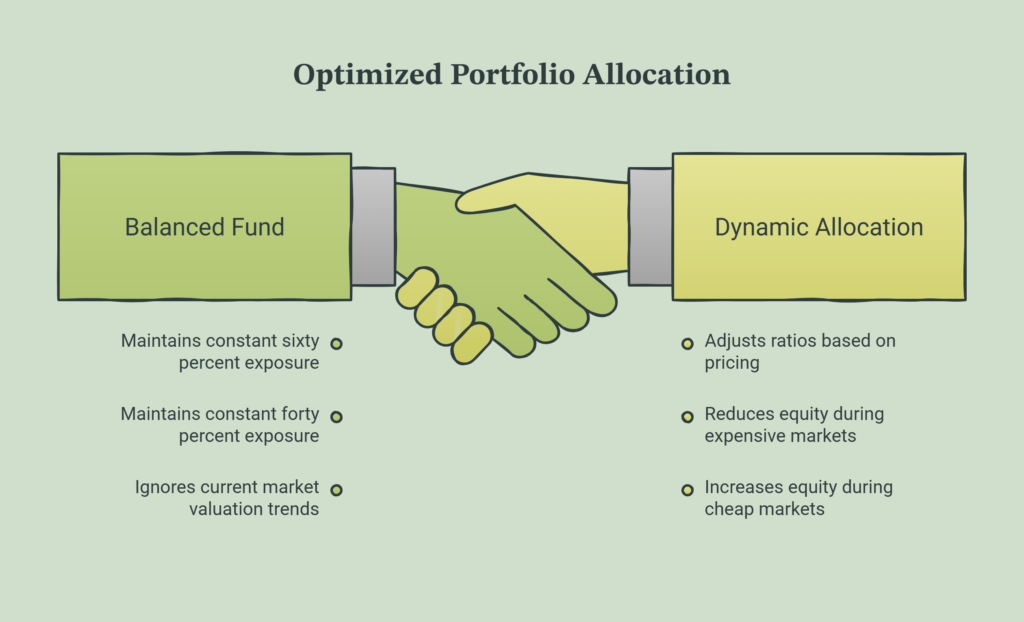
The Balanced fund — a fixed 60% equity, 40% debt allocation — reduced volatility but did so mechanically, without regard for market valuations. In an expensive market, it maintained 60% equity and absorbed the full correction. In a cheap market, it maintained 40% debt and missed part of the recovery.
Dynamic Asset Allocation funds — Balanced Advantage Funds — were designed to solve this. Using a model-driven approach, they shift the equity-debt ratio based on market valuations. When markets are expensive, equity reduces to 30–40%. When markets are cheap, equity increases to 70–80%.
The category does not time the market. It systematically reduces risk when valuations are stretched and increases participation when opportunity is high — without the investor making that call manually.
Where Balanced Advantage Funds Fit in a Wealth Plan
Balanced Advantage Funds sit one step below Aggressive Hybrid funds on the risk-return spectrum. The dynamic rebalancing produces lower volatility — making this the right category for investors who need equity participation but cannot tolerate Aggressive Hybrid drawdowns.
Within the RSW Financial Independence Framework:
- Accumulate Wealth: Conservative core equity instrument for risk-averse investors with a 5–7 year horizon, where dynamic rebalancing reduces the emotional burden of equity volatility.
- Accumulate Wealth — Goal Proximity: Preferred de-risking instrument 2–4 years before a goal deadline — the model-driven equity reduction provides automatic downside protection without manual rebalancing decisions.
For long-horizon investors with 10+ years, replacing a Flexi Cap core with a Balanced Advantage Fund accepts meaningfully lower returns in exchange for comfort — a trade-off rarely justified over a decade.
A Note on Portfolio Turnover in This Category
In pure equity funds, high turnover signals excessive trading. In Balanced Advantage Funds, turnover is partly structural — constant rebalancing between equity and debt as valuations change is the core function.
However, turnover above 200% goes beyond valuation-driven shifts into speculative trading — creating transaction costs and tax drag that erode net returns. This is a critical filter in fund selection for this category.
The 5-Parameter Evaluation Framework
| Parameter | What It Measures | Why It Matters in Wealth Planning |
|---|---|---|
| Risk-Adjusted Returns | Sharpe & Sortino Ratios | Efficiency of return given the dynamic equity-debt blend |
| Consistency | Rolling 3Y/5Y/7Y returns across cycles | Confirms the rebalancing model works across conditions |
| Volatility & Downside Risk | Std Dev & Max Drawdown | Should be lower than Aggressive Hybrid — validates the dynamic mandate |
| Cost Structure | Expense ratio & exit load | High turnover amplifies the cost of active rebalancing |
| Fund Stability | AUM, fund age, manager tenure | Model credibility requires cycle-tested validation |
Top 5 Balanced Advantage Funds for Wealth Management — 2026 Evaluation
| Fund | Mean Return (%) | Sharpe | Sortino | Std Dev (%) | Expense Ratio (%) | Fund Age | Portfolio Turnover (%) |
|---|---|---|---|---|---|---|---|
| HDFC Balanced Advantage | 13.97 | 0.75 | 1.04 | 10.81 | 1.09 | 32Y 4M | 14.58 |
| SBI Balanced Advantage | 11.03 | 0.65 | 0.80 | 7.95 | 1.29 | 4Y 9M | 19.00 |
| ABSL Balanced Advantage | 11.20 | 0.61 | 0.81 | 8.71 | 1.51 | 26Y 1M | 217.00 |
Note: Beta and Alpha are not applicable — benchmark composition shifts with equity-debt rebalancing. Risk ratios and fund data as of May 2026. Past performance does not guarantee future results. Source: Value Research.
HDFC Balanced Advantage — Dominant in Every Parameter
Leads comprehensively: highest mean return (13.97%), Sharpe (0.75), Sortino (1.04), largest AUM (₹1,05,378 Cr), lowest expense ratio (1.09%), and lowest turnover (14.58%). The 32-year track record spans the 2000 dot-com crash, 2008 financial crisis, and 2020 pandemic correction — the deepest cycle validation in this evaluation. No other fund comes close on any single parameter.
Wealth management role: Primary Balanced Advantage allocation within the Accumulate Wealth stage. The default choice for conservative investors seeking dynamic equity-debt management.
SBI Balanced Advantage — Lowest Volatility, Limited History
Lowest standard deviation (7.95%) and second lowest turnover (19%) — the most stable return profile in the group. However, 4Y 9M fund age means it has never operated through a sustained equity bear market. Promising, but requires full cycle validation before primary consideration.
Wealth management role: Secondary allocation for ultra-conservative investors. Elevate to primary once the fund demonstrates bear cycle resilience.
ABSL Balanced Advantage — Long History, Extreme Churn
Twenty-six years of track record — the second deepest in this evaluation. However, turnover of 217% goes well beyond valuation-driven rebalancing, introducing transaction costs and tax drag that erode returns. Expense ratio of 1.51% compounds the cost burden further.
Wealth management role: Secondary allocation only where track record is the primary criterion. Cost structure must be explicitly justified before inclusion.
A Critical Observation: Turnover Is the Hidden Cost in This Category
| Fund | Portfolio Turnover | Assessment |
|---|---|---|
| HDFC Balanced Advantage | 14.58% | Exceptional — precise, valuation-driven rebalancing |
| SBI Balanced Advantage | 19.00% | Disciplined — consistent with dynamic mandate |
| ABSL Balanced Advantage | 217.00% | Excessive — beyond rebalancing into active trading |
The gap between HDFC (14.58%) and Axis (434%) is not a difference of degree — it is a difference of philosophy. HDFC rebalances precisely when valuations demand it. Axis trades continuously — which defeats the purpose of a Dynamic Asset Allocation fund.
Balanced Advantage vs Aggressive Hybrid — Which One?
| Factor | Balanced Advantage | Aggressive Hybrid |
|---|---|---|
| Equity allocation | Dynamic — 30–80% based on valuations | Fixed — 65–80% always |
| Volatility | Lower — dynamic reduction protects downside | Higher — mandatory equity floor |
| Return potential | Moderate | Higher |
| Best suited for | Conservative investors, goal proximity | First-time equity investors, 5–7Y goals |
| Ideal horizon | 4–7 years | 5–7 years |
Positioning Balanced Advantage Funds by Goal
| Goal | Recommended Funds | Complementary Instruments |
|---|---|---|
| Conservative Accumulate Wealth — 5Y+ | HDFC Balanced Advantage | Liquid fund for emergency corpus |
| Goal Proximity — 2–4Y de-risking | HDFC Balanced Advantage replacing Flexi Cap | Short duration debt for final 1–2Y |
| Senior investor — capital preservation with growth | HDFC + SBI Balanced Advantage | Debt funds for remaining allocation |
A Fund Selection Is Not a Wealth Plan
A Balanced Advantage Fund systematically manages the equity-debt trade-off so the investor does not have to. But the model only works if the investor stays invested long enough for rebalancing to deliver its benefit.
Choosing the right fund is one input. Where it belongs in your RSW stage, what it replaces in your existing portfolio, and when to transition out requires a structured plan — not just a fund selection.
Book your free wealth planning consultation →
Frequently Asked Questions
Q: Is a Balanced Advantage Fund safer than an Aggressive Hybrid fund?
A: Yes — in terms of drawdown depth. Dynamic equity reduction during expensive markets means Balanced Advantage Funds typically fall less during corrections. However, lower drawdown comes with lower long-term return potential. Safety and return are always a trade-off.
Q: If I already hold a Flexi Cap fund, should I add a Balanced Advantage Fund?
A: Only at goal proximity — 2–4 years before a deadline — when you want to reduce equity exposure without a full shift to debt. For long-horizon investors with 7+ years, replacing Flexi Cap with a Balanced Advantage Fund reduces return potential without a proportionate risk benefit.
Q: How much of my portfolio should be in a Balanced Advantage Fund?
A: For conservative investors in Accumulate Wealth stage, 40–60% of equity allocation as a core holding. For goal-proximity de-risking, 30–50% of the equity portion in the final 2–4 years — replacing Flexi Cap or Mid Cap progressively as the goal approaches.
Q: How is a Balanced Advantage Fund taxed?
A: Generally taxed as an equity fund — LTCG at 12.5% for gains held over 12 months with ₹1.25 lakh annual exemption, and STCG at 20% under 12 months. Important caveat: if equity drops below 65% during a low-valuation rebalancing phase, debt taxation at slab rate applies for that period. Verify the specific fund’s equity allocation history before assuming equity tax treatment.
Q: At what stage of my wealth plan should I exit a Balanced Advantage Fund?
A: Begin shifting to short-duration debt 1–2 years before a goal deadline. The dynamic model provides automatic de-risking up to that point — but in the final stretch, capital preservation requires the certainty of debt, not the probability of equity reduction. A phased transition over 12–18 months protects both returns and sequencing risk.
Begin your rebalancing review for you Portfolio [ Book a Call ] →

Founder R S W Personal Finance Advisors.
B.E , PGDM [Marketing] ,
Chaterered Wealth Manager,
PMS Disributor, Mutual Fund Distributor.
Passionate about Personal Wealth Management. Practising 4+ Years.
Read more “About Me”